Uktena
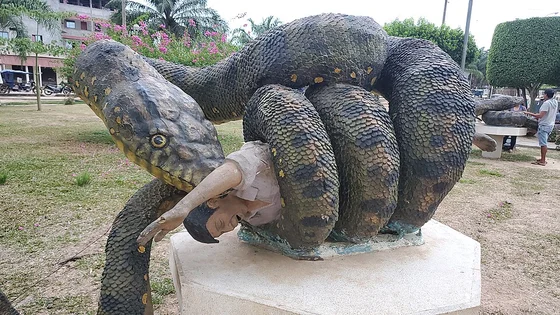
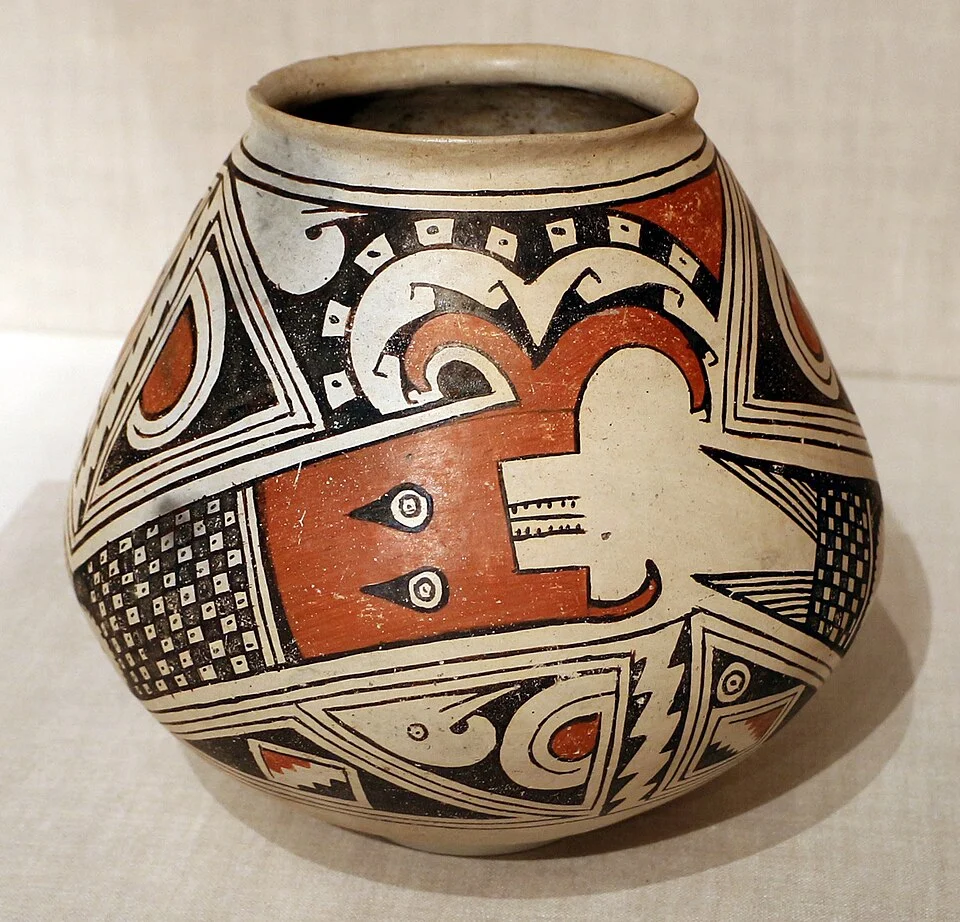
Image associated with the exact linked encyclopedia article; consult credited file description for its interpretation.
Overview
Uktena is a great horned serpent whose appearance joins bodily danger with brilliant light. In Mooney’s collected account, its girth resembles a tree trunk, its patterned scales glitter, and a blazing stone shines on its forehead. That light can bewilder someone who sees it, drawing the observer toward the snake. The first Uktena begins as a transformed man sent to confront the sun after a destructive sickness. Its failure, followed by the rattlesnake’s intervention, leaves it angry and feared. The original is removed to an upper world, but other formidable serpents remain in deep river pools and lonely mountain passes. Visit Cherokee’s public account retains the transformation and failed mission. These are related witnesses to a Cherokee story, while Mooney’s fuller description supplies details that the brief contemporary page does not claim to exhaust.
In the collected search narrative, a captive named Âgan-Uni’tsi secures his release by promising to obtain the serpent’s shining stone. He moves southward through mountain gaps, dismissing an enormous blacksnake, water moccasin, greensnake, lizard and frog as lesser creatures. A dive at the Leech Place on the Hiwassee reveals large aquatic animals but no Uktena. He finally finds the serpent asleep on Gahûti mountain. The confrontation releases poisonous blood and a violent downhill struggle that breaks trees; birds subsequently consume its body. A raven drops the shining stone on a branch, where the searcher retrieves it after seven days. A small snake appears on his head where a drop of poison struck, although he never notices it. The story connects the resulting dark water with basket-dyeing. A separate account has a hunter free the Red Man of the Lightning from an Uktena’s coils. Together these episodes give the being several relationships: an adversary of celestial power, a danger tied to named terrain, and a source of extraordinary gifts won at considerable risk.
Swimmer’s separate Snake Boy story describes a household transformation rather than the first Uktena’s mission against the Sun. A mistreated boy returns with deer horns and spends the night alone in the âsi. At dawn his grandmother sees an immense Uktena with horns but still with two human legs. It takes until noon to emerge fully, leaving a broad trail through the settlement to a deep river bend. After the family taunts her for grieving, the grandmother follows that trail into the water. A fisherman later sees her sitting on a rock, looking unchanged; she dives out of sight. Her disappearance is narrated, but no transformation of her body is described.
Origins & earliest records
The inspected historical edition of Mooney's collection is dated 1902, following fieldwork chiefly conducted from 1887 to 1890. Visit Cherokee supplies contemporary public reception without dating a first telling. Neither date measures the age of the transmitted story, and the supernatural transformation belongs to narrative time rather than a historical chronology.
Records & interpretation
The community tourism page directly supports the horned-serpent identity and transformation account. Mooney provides a separately attributable historical appearance, not a complete representation of Cherokee religion. Comparing these witnesses establishes documented public storytelling, while differences and the limits of collector mediation remain important. No animal specimen or biological classification is claimed.
In the literature
“with horns on its head”
Story50, printed pp.297–298
The physical description of the enormous serpent, distinct from talisman practices.
“but still with two human legs instead of a snake tail.”
Story56, printed pp.304
The grandmother’s first view of her transformed grandson; no later loss of those legs is expressly narrated.
Selected bibliography
Documented works and useful reading. This is not a list of every appearance.
- 01
Myths of the Cherokee
Inspected 1902 edition; stories 50–52, pp. 297–301. Narrative appearance and episodes only; practical ceremonial knowledge omitted. Also §56, The Snake Boy, p.304, and corresponding note naming Swimmer; complete household-transformation account.
- 02
The Cherokee Culture: Uktena
Public contemporary cultural description.
- 03
Myths of the Cherokee — Uktena stories50–52,56 and selected nest encounter64
Selected Washington Government Printing Office1902 offprint, Extract from the Nineteenth Annual Report of the Bureau of American Ethnology; title independently read. Historical collector-mediated English narratives.
Family & connections
A source-supported family tree or inspiration record has not yet been compiled for this profile. Related reading below indicates a connection in subject matter, not a proven lineage or creative influence.
Located primary passages
Specific passages supporting details in this entry, grouped by their published witness.
Myths of the Cherokee — Uktena stories50–52,56 and selected nest encounter64
Selected Washington Government Printing Office1902 offprint, Extract from the Nineteenth Annual Report of the Bureau of American Ethnology; title independently read. Historical collector-mediated English narratives.
- The opening makes Uktena a man transformed by Little Men for a failed mission against the Sun; Rattlesnake succeeds instead and the dangerous jealous first Uktena is removed to Galunlati. Other Uktena remain in isolated water and mountain locations. The visible description includes huge size, horns, a bright crest and sparkling scales. The talisman is identified as story context only; practical ceremonial maintenance and prophecy instructions are omitted.
Complete selected story50, printed pp.297–298; corresponding commentary scope specified in evidence
No whole collection or separate oral recording reviewed; no current zoological identification or contemporary cultural permission inferred. Ceremonial instructions, divination methods and treatment recipes excluded.
Primary source witness
Selected Washington Government Printing Office1902 offprint, Extract from the Nineteenth Annual Report of the Bureau of American Ethnology; title independently read. Historical collector-mediated English narratives.
- A captured Shawano medicine-man promises a talisman in exchange for life. He rejects various immense snakes, lizard and frog, finally finds Uktena on Cohutta and defeats it. Birds consume the body; he retrieves the shining object, returns with an unnoticed small snake at the poison spot on his head, and the blood-filled trench becomes a lake. Practical ceremonial and protective sequences omitted; the source’s blanket magician label for Shawano is not endorsed.
Complete selected story51, printed pp.298–300; corresponding commentary scope specified in evidence
No whole collection or separate oral recording reviewed; no current zoological identification or contemporary cultural permission inferred. Ceremonial instructions, divination methods and treatment recipes excluded.
Primary source witness
Selected Washington Government Printing Office1902 offprint, Extract from the Nineteenth Annual Report of the Bureau of American Ethnology; title independently read. Historical collector-mediated English narratives.
- A hunter frees the Red Man of Lightning from a constricting Uktena, which rolls down the ridge and dies. A later reward from the dead serpent is dangerous to the hunter’s brother, who is nevertheless restored; the hunter enjoys later success. The plot outcome is retained without a preparation or treatment recipe. The address nephew does not independently establish biological kinship.
Complete selected story52, printed pp.300–301; corresponding commentary scope specified in evidence
No whole collection or separate oral recording reviewed; no current zoological identification or contemporary cultural permission inferred. Ceremonial instructions, divination methods and treatment recipes excluded.
Primary source witness
Selected Washington Government Printing Office1902 offprint, Extract from the Nineteenth Annual Report of the Bureau of American Ethnology; title independently read. Historical collector-mediated English narratives.
- A bird-hunting boy favored by his grandmother leaves after family mistreatment and becomes an immense horned Uktena while still retaining two human legs at the first viewing. He leaves a broad trail and enters the river. His grandmother later follows into the water and is subsequently seen looking human; she dives away on noticing the fisherman. Neither her serpent transformation nor either person’s death is explicitly narrated.
Complete selected story56, printed pp.304; corresponding commentary scope specified in evidence
No whole collection or separate oral recording reviewed; no current zoological identification or contemporary cultural permission inferred. Ceremonial instructions, divination methods and treatment recipes excluded.
Primary source witness
Selected Washington Government Printing Office1902 offprint, Extract from the Nineteenth Annual Report of the Bureau of American Ethnology; title independently read. Historical collector-mediated English narratives.
- In the separate Tlanuwa nest account the water-dwelling Uktena consumes the four young birds thrown from the cliff. The returning adult pair seize it, carry it aloft and tear it into pieces; falling pieces explain holes in rocks in the story. The adult birds then disappear, not die.
Complete selected story64, printed pp.315–316; corresponding commentary scope specified in evidence
No whole collection or separate oral recording reviewed; no current zoological identification or contemporary cultural permission inferred. Ceremonial instructions, divination methods and treatment recipes excluded.
References
Sources supporting this profile. Linked pages have their own scope and editorial standards.
- CommunityVisit Cherokee: public culture and legendsResearch access: 2026-10-05
- Primary textMooney: Myths of the CherokeeResearch access: 2026-10-05
Image credits
Reference illustrationUktena
Image associated with the exact linked encyclopedia article; consult credited file description for its interpretation.