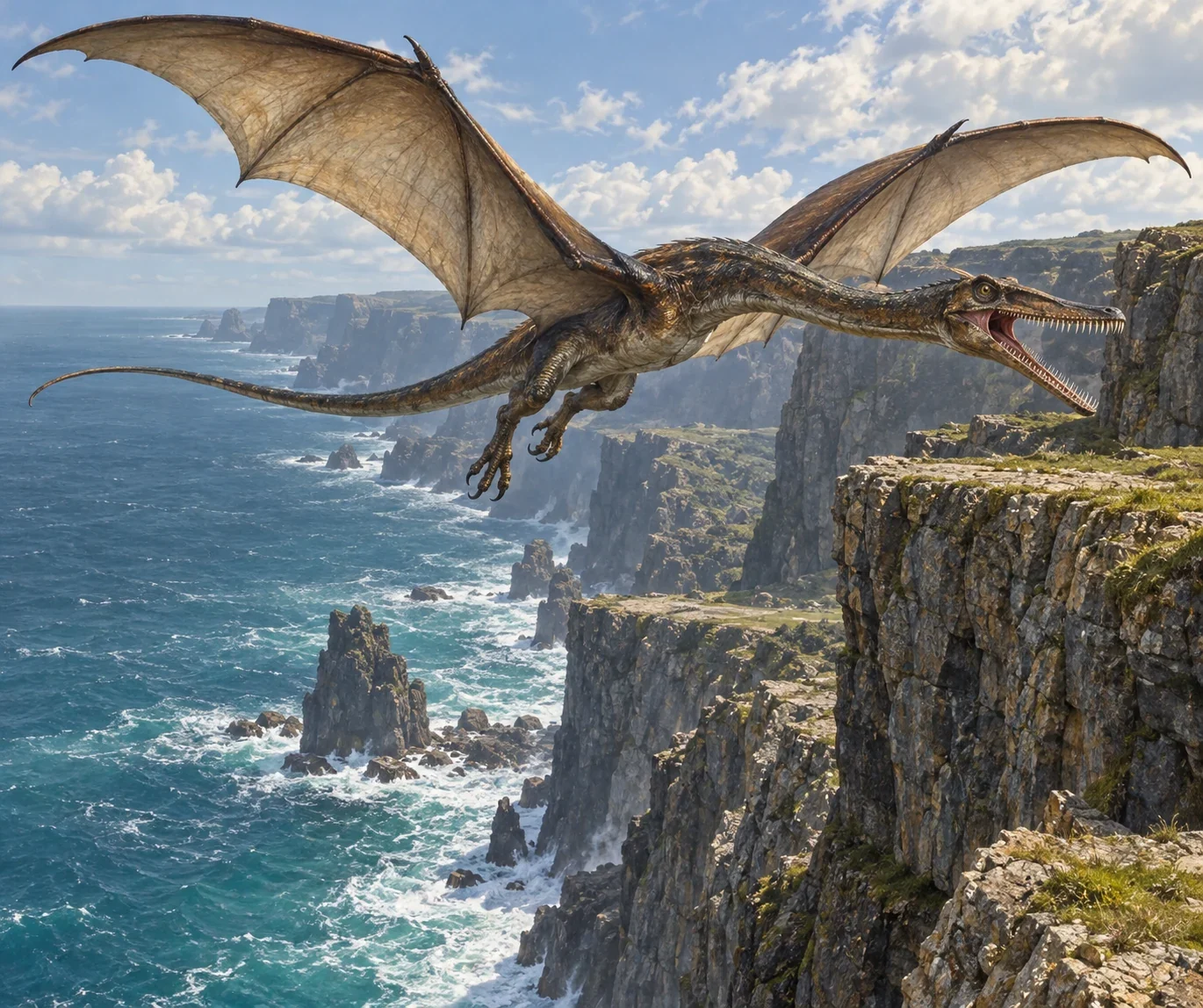
Unofficial AI interpretation of a Thipdar circling a broken sea cliff, following the novel’s batlike wings, sharp teeth and talons. Colour, tail contour and landscape details are imagined; size is conveyed approximately, not as a measured reconstruction.
Unofficial AI interpretation of a Thipdar circling a broken sea cliff, following the novel’s batlike wings, sharp teeth and talons. Colour, tail contour and landscape details are imagined; size is conveyed approximately, not as a measured reconstruction. Full-frame display derivative; no upscaling.
Overview
The name thipdar belongs to the giant winged predators of Pellucidar, rather than to the intelligent Mahars who rule its underground cities. David Innes initially learns their reputation from fellow captives: Ghak warns that escaping Phutra would still leave a fugitive exposed to these creatures. David later sees two huge thipdars walking beside the Mahar queen in the amphitheatre. When she flies to her central rocky seat, they rise with her and settle nearby. Their role combines conspicuous royal protection with the wider fear that prevents prisoners from imagining safe escape.
The temple procession makes their association with the Mahars visible on a larger scale. David describes at least twenty pterodactyls entering after the first Mahars, with more flanking the queen. After the Mahars have attacked captives in the pool, the queen’s thipdars take flight, circle the temple and descend on those left on the islands. Their attack is physical predation rather than the gaze-induced behaviour David attributes to the Mahars. Once the feeding ends, the large reptiles return to their stations beside the queen and sleep. The account does not establish a training method or a supernatural bond between ruler and guard.
A later encounter gives the clearest individual description. Above a broken cliff ledge, David sees an immense dragonlike animal with an estimated forty-foot body and a thirty-foot span of batlike wings. Its open jaws bear long sharp teeth, and he notes formidable talons. It hisses while circling Dian, who is trapped on the lower part of the ledge. David jumps down beside her, turns an initial attack with a thrown stone and then readies his bow. Dian identifies the returning attacker as a thipdar. His arrow penetrates its breast, and it falls into the sea. The stated dimensions are the narrator’s estimates, not measurements or a universal species standard.
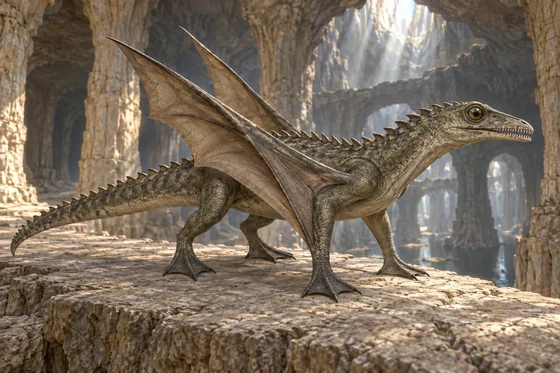
David calls the thipdar a pterodactyl and compares its appearance with dragons from stories of the outer world. Both comparisons belong to Burroughs’s fictional prehistoric setting. They do not identify a real fossil species, or supply every detail of its colouring, tail, head ornament or wing structure. Its dependence on ordinary jaws, claws and flight also separates it from the Mahars’ literacy, reproductive science and unusual communication. A thipdar can be terrifying without being an invulnerable or magical creature: the cliff episode turns the protagonists’ unfamiliar weapon into a decisive advantage.
First appearances & development
The thipdar appears in the original At the Earth’s Core narrative as a surviving giant flying reptile of Pellucidar. Burroughs juxtaposes the narrator’s pterodactyl terminology with a dragon comparison and integrates the animal into Mahar rule and David’s rescue of Dian. No independent folklore origin or precise real species is established by those comparisons.
Canon & continuity
Chapters IV–VII establish warnings about pursuit and the queen’s guards; chapter VIII describes the temple procession and attack. Chapter XIV supplies the estimated dimensions, batlike wings, teeth, talons and cliffside confrontation. These passages are retained in complete context in the research packet.
Selected bibliography
Documented works and useful reading. This is not a list of every appearance.
- 01
At the Earth’s Core
Primary novel: warnings and royal guards precede the temple sequence; chapter XIV provides the detailed encounter with Dian and David.
Family & connections
A source-supported family tree or inspiration record has not yet been compiled for this profile. Related reading below indicates a connection in subject matter, not a proven lineage or creative influence.
References
Sources supporting this profile. Linked pages have their own scope and editorial standards.
- Public-domain primary fictionAt the Earth’s Core — complete primary textResearch access: 2026-10-11
- Edition metadata and public-domain witnessProject Gutenberg ebook 123 — bibliographic and rights recordResearch access: 2026-10-11
Image credits
Unofficial modern AI interpretationUnofficial AI interpretation of a Thipdar circling a broken sea cliff, following the novel’s batlike wings, sharp teeth and talons. Colour, tail contour and landscape details are imagined; size is conveyed approximately, not as a measured reconstruction.
Unofficial AI interpretation of a Thipdar circling a broken sea cliff, following the novel’s batlike wings, sharp teeth and talons. Colour, tail contour and landscape details are imagined; size is conveyed approximately, not as a measured reconstruction. Full-frame display derivative; no upscaling.