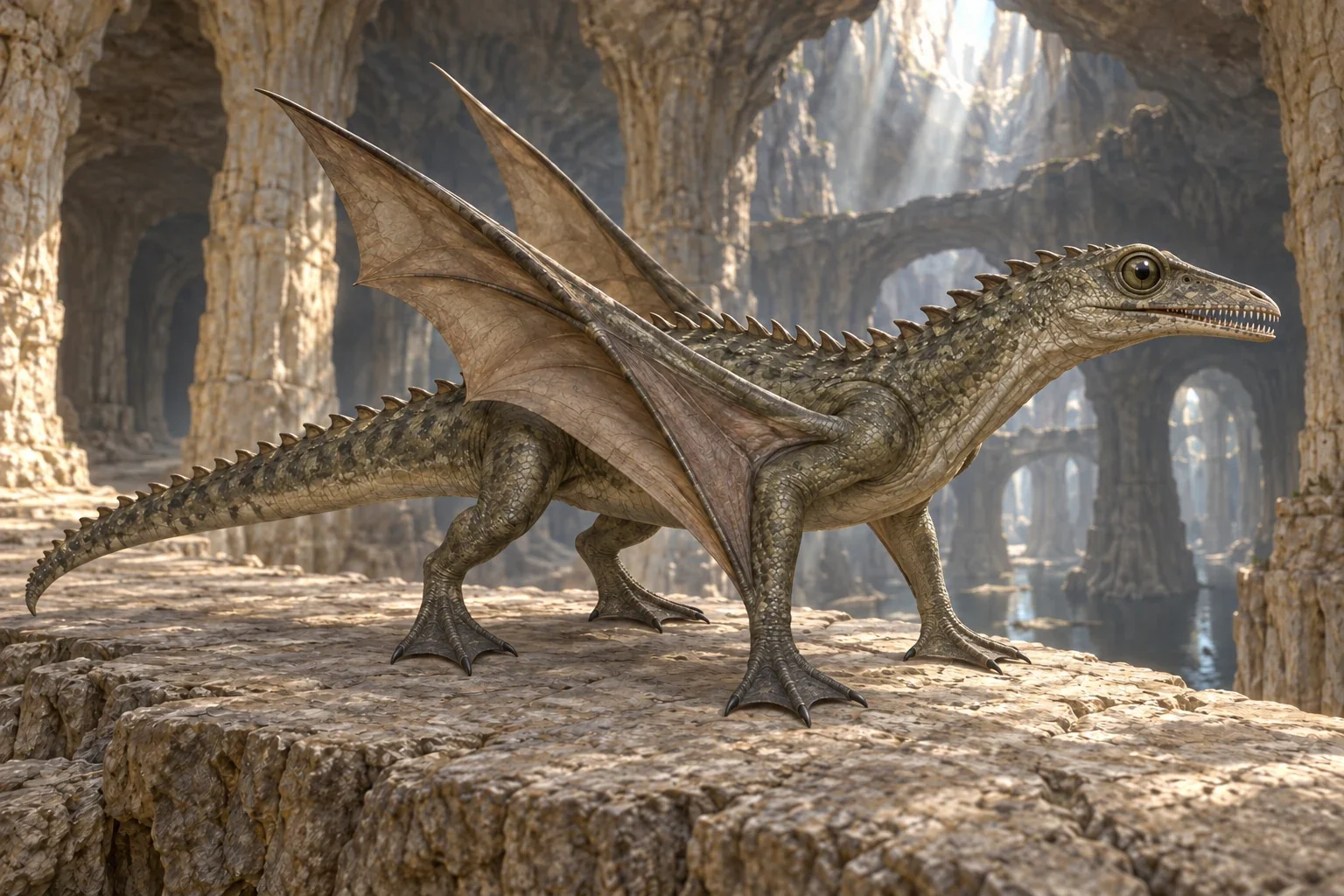
Unofficial AI interpretation of a Mahar in Phutra, following the novel’s round eyes, ridged tail, integrated wings and three webbed toes. Colour, pose and limestone architecture are imagined staging; this is not official artwork or a fossil reconstruction.
Unofficial AI interpretation of a Mahar in Phutra, following the novel’s round eyes, ridged tail, integrated wings and three webbed toes. Colour, pose and limestone architecture are imagined staging; this is not official artwork or a fossil reconstruction. Full-frame display derivative; no upscaling.
Overview
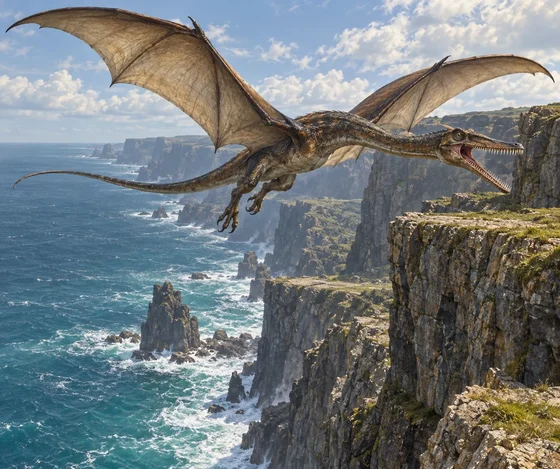
David Innes first sees Mahars on the broad staircase into Phutra. He describes reptiles about six to eight feet long, with narrow heads, large round eyes and beaklike mouths containing white fangs. Bony ridges extend along their lizardlike backs and long tails. Each foot has three webbed toes. Membranous wings extend from the forefeet and join the body just ahead of the hind legs; at rest their pointed ends rise behind the animal. These details distinguish the novel’s Mahars from both ordinary lizards and the much larger thipdars that accompany their queen. The account is fictional anatomy, including Perry’s comparison with Rhamphorhynchus, rather than a palaeontological reconstruction.
Phutra gives their intelligence a material setting. Its avenues are cut through limestone below ground, and roof shafts use lenses and reflectors to introduce sunlight. David and Perry are assigned to move written records which Perry identifies as the race’s archives. Sagoths provide armed enforcement, while enslaved humans perform manual work. The Mahars communicate with Sagoths through signs. They have no auditory organs or spoken language; Perry describes their mutual communication as thoughts projected into a fourth dimension and apprehended by a sixth sense. He explicitly rejects David’s suggestion that this is telepathy because it requires the participants’ presence. These are Perry’s explanations within the story, not established science.
Reading the archives, Perry reports that the Mahars’ former male population disappeared after chemical fertilisation of eggs made males unnecessary. The surviving population is female. The crucial reproductive formula is restricted to the Mahars of Phutra, both to preserve their power and to control numbers. David and Perry therefore connect escape with taking the guarded manuscript. Perry also questions David’s assumption that killing an intelligent reptile cannot be murder: the Mahars misunderstand human thought just as humans misunderstand animals. This exchange complicates the novel’s division between the human protagonists and their reptilian rulers, even as David plans to overthrow their supremacy.
The island temple exposes a brutal side of Mahar rule. David witnesses the queen swimming in a tank and drawing human captives into it by an apparently hypnotic gaze; other Mahars follow her example. The thipdars attack the remaining captives by physical force. Ja’s explanation distinguishes public disapproval of eating warm-blooded flesh from what he believes happens in practice; his broader accusation remains a character’s claim. Mahars are capable of flight, sustained swimming and sleeping, although David’s companions had supplied misleading expectations about the last of these. The profile follows the first novel’s observations and attributed explanations, without importing the appearance or abilities of film adaptations.
First appearances & development
Burroughs places the Mahars within his invented hollow Earth: David Innes and Abner Perry reach Pellucidar in an experimental drilling machine. The novel uses prehistoric reptile comparisons and a reversal of human dominance to construct their society. These devices are present in the primary text; they do not establish a specific external design influence.
Canon & continuity
The primary novel supplies the anatomy and Phutra encounter in chapter V, the archives and reproductive account in chapter V, and the temple observations in chapter VIII. David narrates what he sees; Perry and Ja supply interpretations that are identified as such here.
Selected bibliography
Documented works and useful reading. This is not a list of every appearance.
- 01
At the Earth’s Core
Primary novel: chapters V–VIII distinguish bodily description, archival interpretation, urban institutions and the temple episode.
Family & connections
A source-supported family tree or inspiration record has not yet been compiled for this profile. Related reading below indicates a connection in subject matter, not a proven lineage or creative influence.
References
Sources supporting this profile. Linked pages have their own scope and editorial standards.
- Public-domain primary fictionAt the Earth’s Core — complete primary textResearch access: 2026-10-11
- Edition metadata and public-domain witnessProject Gutenberg ebook 123 — bibliographic and rights recordResearch access: 2026-10-11
Image credits
Unofficial modern AI interpretationUnofficial AI interpretation of a Mahar in Phutra, following the novel’s round eyes, ridged tail, integrated wings and three webbed toes. Colour, pose and limestone architecture are imagined staging; this is not official artwork or a fossil reconstruction.
Unofficial AI interpretation of a Mahar in Phutra, following the novel’s round eyes, ridged tail, integrated wings and three webbed toes. Colour, pose and limestone architecture are imagined staging; this is not official artwork or a fossil reconstruction. Full-frame display derivative; no upscaling.