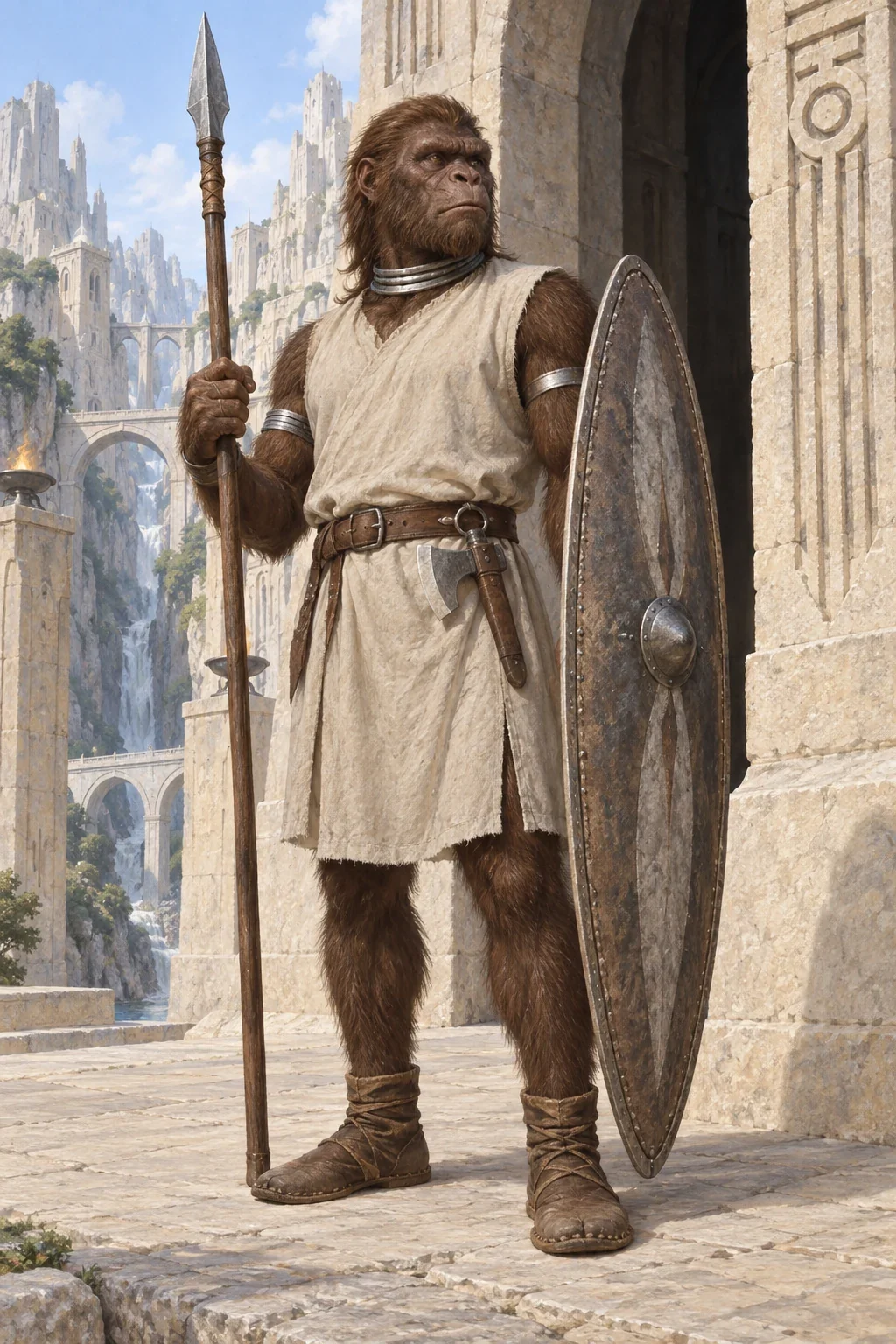
Unofficial AI interpretation of a fictional Sagoth guard, following brown hair, humanlike limb proportions, cloth tunic, hide shoes, spear and oval shield. Clothing details, fittings and architecture are imagined; this is not a real-community portrait or official artwork.
Unofficial AI interpretation of a fictional Sagoth guard, following brown hair, humanlike limb proportions, cloth tunic, hide shoes, spear and oval shield. Clothing details, fittings and architecture are imagined; this is not a real-community portrait or official artwork. Full-frame display derivative; no upscaling.
Overview
The Sagoths first enter David Innes’s experience as a force of armed attackers. They drive away the separate tree-dwelling ape creatures who had captured him and Perry, then place the newcomers in a caravan of human prisoners. David describes the guards as lighter in build than gorillas, with limb proportions closer to human ones. Shaggy brown hair covers their bodies, and their faces remind him of gorilla specimens he has seen. He nevertheless distinguishes their developed crania from those of the animals in that comparison. These are the narrator’s observations of an invented people, not a description of a real human community or a claim about human ancestry.
Their equipment and clothing mark a social role rather than an unarmed animal population. David sees spears, hatchets and long oval shields. The guards wear knee-length tunics of light cloth, loincloths beneath them and thick hide footwear. Metal ornaments encircle arms and necks, with silver prominent; small reptile heads decorate the tunics. They speak among themselves in a language different from that of the human captives and use a third contact language when addressing those prisoners. Burroughs’s narrator explains that contact language through a dated colonial analogy, but the narrative fact is multilingual communication, not a linguistic description of any living people.
At Phutra, Sagoths act as intermediaries between humans and Mahars. Because the Mahars lack auditory organs, a Sagoth guard reports the prisoners’ capture through signs. Perry later explains that the Mahars recognise Sagoth speech without understanding how sound conveys meaning. The guards accompany the Mahar queen in the amphitheatre, inspect traffic at the city entrances and control access through official buildings. Their apparent authority over humans therefore rests within a hierarchy: the literate reptilian rulers direct them, while the Sagoths provide much of the practical armed enforcement.
Their pursuit of David, Perry and Ghak demonstrates speed and tactical danger without making them invulnerable. During the escape, a guard notices blood leaking from the Mahar skin David is using as a disguise. David imitates a Mahar’s intimidating gaze and passes him, a deception that depends on the guard’s response to rank rather than on David acquiring supernatural power. Later Sagoths gain on the fugitives in a mountain canyon. David turns with his bow; the leading guard throws a hatchet and follows with a spear. Arrows stop individual pursuers, and a subsequent cave-bear encounter disrupts the group. In the final human resistance, the same spear-armed forces face organised bowmen and swordsmen. These episodes establish their function as formidable but fallible soldiers.
First appearances & development
The Sagoths belong to Burroughs’s invented Pellucidar setting in At the Earth’s Core. The novel separates them from the earlier tree-dwelling ape captors and from the human societies subject to the Mahars. Their gorilla comparison, speech and equipment are narrative constructions; no real ethnic group or authenticated ethnographic tradition is their identity.
Canon & continuity
Chapter III supplies the first attack, body description, clothing and weapons. Chapter V establishes their interpretation and sign communication with Mahars. The later escape and canyon pursuit show how they enforce the rulers’ power and react to disguise and unfamiliar weapons.
Selected bibliography
Documented works and useful reading. This is not a list of every appearance.
- 01
At the Earth’s Core
Primary novel: first capture, Phutra institutions, escape and pursuit distinguish Sagoths from both humans and the tree-dwelling ape captors.
Family & connections
A source-supported family tree or inspiration record has not yet been compiled for this profile. Related reading below indicates a connection in subject matter, not a proven lineage or creative influence.
References
Sources supporting this profile. Linked pages have their own scope and editorial standards.
- Public-domain primary fictionAt the Earth’s Core — complete primary textResearch access: 2026-10-11
- Edition metadata and public-domain witnessProject Gutenberg ebook 123 — bibliographic and rights recordResearch access: 2026-10-11
Image credits
Unofficial modern AI interpretationUnofficial AI interpretation of a fictional Sagoth guard, following brown hair, humanlike limb proportions, cloth tunic, hide shoes, spear and oval shield. Clothing details, fittings and architecture are imagined; this is not a real-community portrait or official artwork.
Unofficial AI interpretation of a fictional Sagoth guard, following brown hair, humanlike limb proportions, cloth tunic, hide shoes, spear and oval shield. Clothing details, fittings and architecture are imagined; this is not a real-community portrait or official artwork. Full-frame display derivative; no upscaling.