Taotie
Image associated with the exact linked encyclopedia article; consult credited file description for its interpretation.
Overview
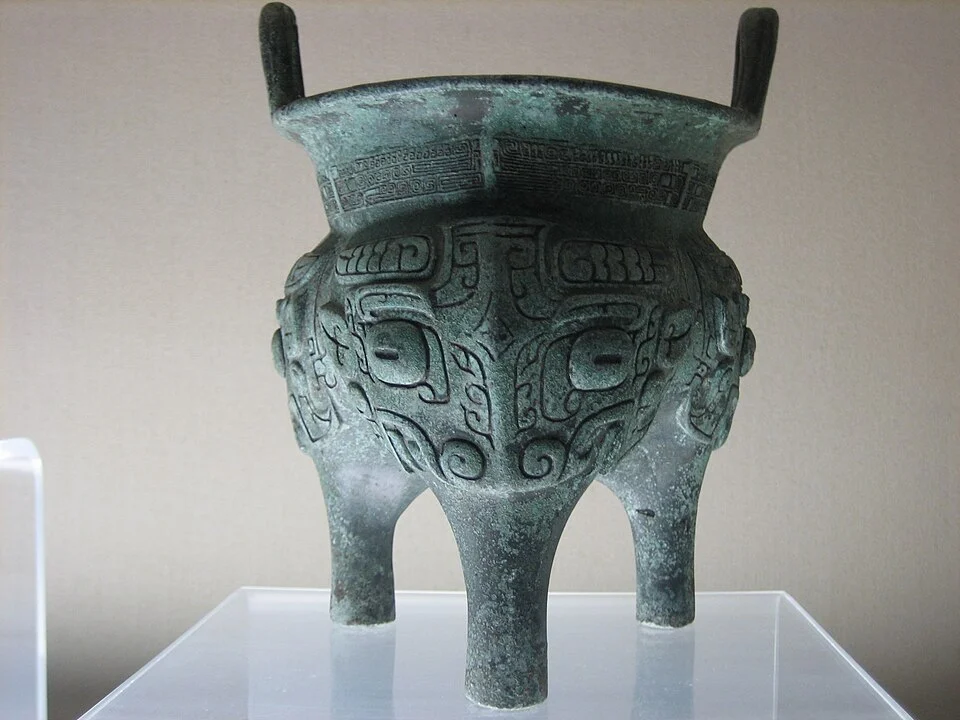
Taotie requires a distinction between an ancient bronze mask motif and literary accounts attached to its name. The Met’s ritual water container, accession 23.17, is dated to the thirteenth or twelfth century BCE. Its museum description identifies four incised imaginary-animal masks as taotie. The vessel was used for washing during sacrificial rites; holes in the foot and lugs at the neck allowed ropes to be attached for carrying. These details describe a surviving ritual object, not the body or locomotion of a living monster.
The museum interprets the masks as inducing awe among ritual participants. That is a curatorial reading of the ornament’s purpose, and does not demonstrate that the original makers told precisely the later stories about Taotie. A mask on an ancient vessel can establish a visual tradition while leaving its contemporary spoken name and full meaning unresolved. The historical object and the museum’s naming of its motif should therefore remain distinct kinds of evidence.
A directly read passage in the Lüshi chunqiu, volume sixteen, discusses a Taotie represented on a Zhou cauldron. It says the figure has a head but no body and that injury overtakes it before a swallowed human has passed down. The surrounding argument treats harmful action and its consequences as a warning. This literary example supplies an explicit name and moral framing, rather than a catalogue of the creature’s habitat, offspring, or magical abilities.
The resulting profile is broader than a description of greed alone, but narrower than a supposed universal monster species. The Met vessel supplies a specific material witness and visual mask context; the Lüshi chunqiu supplies a named head-without-body image interpreted through destructive appetite and consequences. These do not license copying the full anatomy of other named human-eaters into Taotie. Nor does the early date of the bronze settle the first occurrence of the literary name. Comparing the witnesses preserves the useful connection while acknowledging that ornament, identification, and moral story are not interchangeable.
Origins & earliest records
The selected work or object is a witness to this representation. Its date is not asserted to be the beginning of the tradition; textual layers and regional variants need separate review.
Records & interpretation
The linked source and contextual bibliography support the stated motifs. Material objects document iconography; narratives document imagined encounters. Neither alone is zoological confirmation.
Selected bibliography
Documented works and useful reading. This is not a list of every appearance.
- 01
Ritual Water Container (Yu)
Selected reading or object; bibliography is not exhaustive. Secondary links identify primary passages where a direct primary edition was not verified.
Family & connections
A source-supported family tree or inspiration record has not yet been compiled for this profile. Related reading below indicates a connection in subject matter, not a proven lineage or creative influence.
Primary records and illustrations
Ritual Water Container (Yu)
Metropolitan Museum of Art, China, 13th–12th century BCE. Museum object 23.17
Institutional object record and public-domain photograph directly inspected. Date, material, accession and subject identification come from the museum, not an inferred historical story.
The inspected bronze carries a broad band of incised decoration beneath its neck. A frontal mask occupies the visible central panel: two rounded eyes flank a vertical ridge, and interlocking angular patterns extend symmetrically to either side. Above it is another narrow decorative band, while the foot repeats a smaller patterned register. The face is integrated into the vessel's surface rather than modelled as a complete free-standing animal. The Metropolitan Museum identifies four taotie masks around the container and dates the bronze to the thirteenth or twelfth century BCE. Its object number is 23.17. This witness concerns an ancient ritual design, not an illustrated episode from a later monster tale.
Encyclopedia background
An additional attributed reference, separate from the editorial profile above.
Read the open encyclopedia overview
The taotie is an ancient Chinese mythological creature that was commonly emblazoned on bronze and other artifacts during the 1st millennium BCE. Taotie are one of the Four Perils in Chinese classics like the Classic of Mountains and Seas, alongside the Hundun, Qiongqi, and Taowu.
The Taotie is often represented as a motif on dings, which are Chinese ritual bronze vessels from the Shang (c. 1600 – c. 1050 BCE) and Zhou dynasties (c. 1046 – 256 BCE). The design typically consists of a zoomorphic mask, described as being frontal, bilaterally symmetrical, with a pair of raised eyes and typically no lower jaw area. Some argue that the design can be traced back to jade pieces found at Neolithic sites belonging to the Liangzhu culture (3310–2250 BCE). There are notable similarities with the jades of the Shijiahe culture (2500-2000 BCE) and the painted pottery of the Lower Xiajiadian culture (2200–1600 BCE).
Text from Wikipedia contributors, “Taotie”. CC BY-SA 4.0. Extracted introduction; formatting changed. Retrieved 5 October 2026. The source article may have changed since retrieval.
References
Sources supporting this profile. Linked pages have their own scope and editorial standards.
- Museum / primary objectRitual Water Container (Yu)Research access: 2026-10-05
- Secondary referenceTaotie — contextual bibliographyResearch access: 2026-10-05
- Primary text transcriptionLushi chunqiu volume sixteen: Xianshi, Zhou cauldron Taotie passageResearch access: 2026-10-05
Image credits
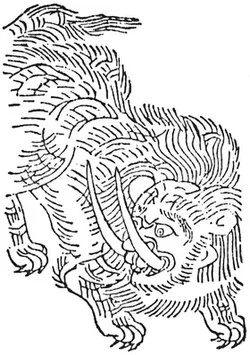
Reference illustrationTaotie
Image associated with the exact linked encyclopedia article; consult credited file description for its interpretation.