Qiongqi
Image associated with the exact linked encyclopedia article; consult credited file description for its interpretation.
Overview
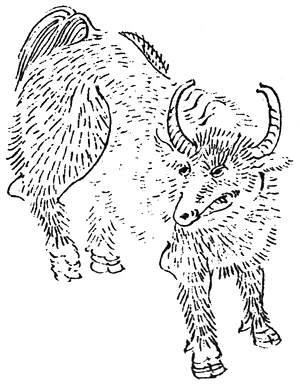
Qiongqi has substantially different bodies and conduct in the directly read Chinese witnesses. The Western Mountains section of the Shanhaijing places it at Mount Gui and describes an oxlike beast with hedgehog bristles. Its voice resembles a barking dog, and it eats people. The bracketed commentary adds a tigerlike, winged alternative, but that annotation should remain distinguishable from the base mountain entry.
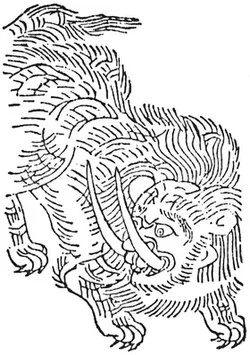
The Northern Within-the-Seas section gives a more compact winged-tiger account. It says that Qiongqi eats people starting at the head, then records an alternative beginning at the feet. Its position is described relative to another man-eating creature. The difference is not merely a modern illustrator choosing a pose: the text itself supplies incompatible or alternative descriptions that should remain attached to their respective passages.
The Northwestern Wilderness section of the Shenyi jing develops its conduct into a moral inversion. Here it resembles a tiger, has wings, and can fly. It understands human language. Hearing people quarrel, it eats the person in the right; encountering loyalty and trustworthiness, it bites the person’s nose. Hearing of wrongdoing, it kills animals and brings them to the wrongdoer. It also eats birds and beasts. The creature’s danger therefore extends beyond appetite to a deliberate reversal of expected judgment.
The hosted Shenyi jing introduction itself disputes the traditional attribution to Dongfang Shuo, so this profile does not treat the account as securely written by a named Han author. Its displayed notes also preserve another bodily version. The received narrative can be cited without assigning a false composition date or making every alternative body simultaneous.
A separate Zuo zhuan passage under Duke Wen’s eighteenth year uses Qiongqi as a name for a harmful descendant or lineage, emphasizing disloyalty, slander, and destructive conduct. That political and moral portrait should not be read as a literal anatomical description of a winged tiger. Together the witnesses explain why Qiongqi can be represented as a bodily monster and as a figure of corrupted values, while offering no basis for collapsing every appearance into one fixed zoological species.
Origins & earliest records
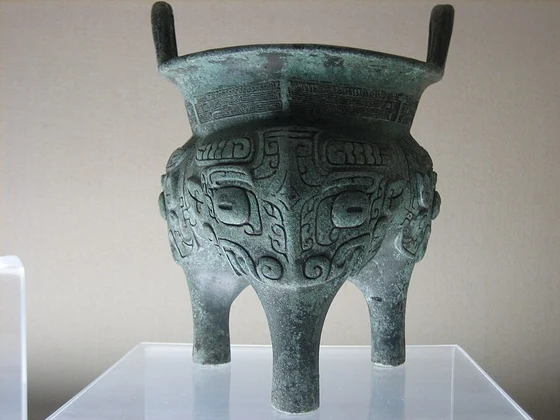
The selected work or object is a witness to this representation. Its date is not asserted to be the beginning of the tradition; textual layers and regional variants need separate review.
Records & interpretation
The linked source and contextual bibliography support the stated motifs. Material objects document iconography; narratives document imagined encounters. Neither alone is zoological confirmation.
Selected bibliography
Documented works and useful reading. This is not a list of every appearance.
- 01
Classic of Mountains and Seas
Selected reading or object; bibliography is not exhaustive. Secondary links identify primary passages where a direct primary edition was not verified.
- 02
Shanhaijing, Western Mountains: Mount Gui
Directly read named passage; commentary distinguished.
- 03
Shanhaijing, Northern Within-the-Seas: Qiongqi
Directly read named passage; commentary distinguished.
- 04
Shenyi jing, Northwestern Wilderness: Qiongqi
Directly read named passage; commentary distinguished.
- 05
Zuo zhuan, Duke Wen year18: four evil lineages
Directly read named passage; commentary distinguished.
Family & connections
A source-supported family tree or inspiration record has not yet been compiled for this profile. Related reading below indicates a connection in subject matter, not a proven lineage or creative influence.
Primary records and illustrations
Gujin Tushu Jicheng, quoting Shanhaijing and Shenyi Jing
Digitized volume 525; compiled early 18th century. Scan page 10; 窮奇圖 and following textual sections
Primary excerpts checked in an unproofread community transcription. Scan not visually inspected; illustration heading alone is not counted as a verified picture. Different quoted textual forms are retained separately.
The compilation preserves incompatible-looking descriptions under the same name. Its Western Mountains quotation gives Qiongqi an ox-like shape, hedgehog hair and a dog-like voice, while the Northern Seas passage describes a winged tiger that begins eating a person at the head. The cited Shenyi Jing shifts attention from anatomy to inverted judgment: the flying tiger understands human speech, attacks the person in the right during a dispute, harms the faithful and brings hunted animals to the wicked. These are distinct textual witnesses, not features to combine into one supposedly definitive body. The page also transmits commentary relating the name to moral comparisons, showing how a creature could carry both geographical and ethical meanings.
References
Sources supporting this profile. Linked pages have their own scope and editorial standards.
- Secondary reference quoting primary passagesClassic of Mountains and SeasResearch access: 2026-10-05
- Primary-text transcriptionGujin Tushu Jicheng, quoting Shanhaijing and Shenyi Jing — exact primary witnessResearch access: 2026-10-05
- Primary-text transcriptionShanhaijing, Western Mountains: Mount GuiResearch access: 2026-10-05
- Primary-text transcriptionShanhaijing, Northern Within-the-Seas: QiongqiResearch access: 2026-10-05
- Primary-text transcriptionShenyi jing, Northwestern Wilderness: QiongqiResearch access: 2026-10-05
- Primary-text transcriptionZuo zhuan, Duke Wen year18: four evil lineagesResearch access: 2026-10-05
Image credits
Reference illustrationQiongqi
Image associated with the exact linked encyclopedia article; consult credited file description for its interpretation.