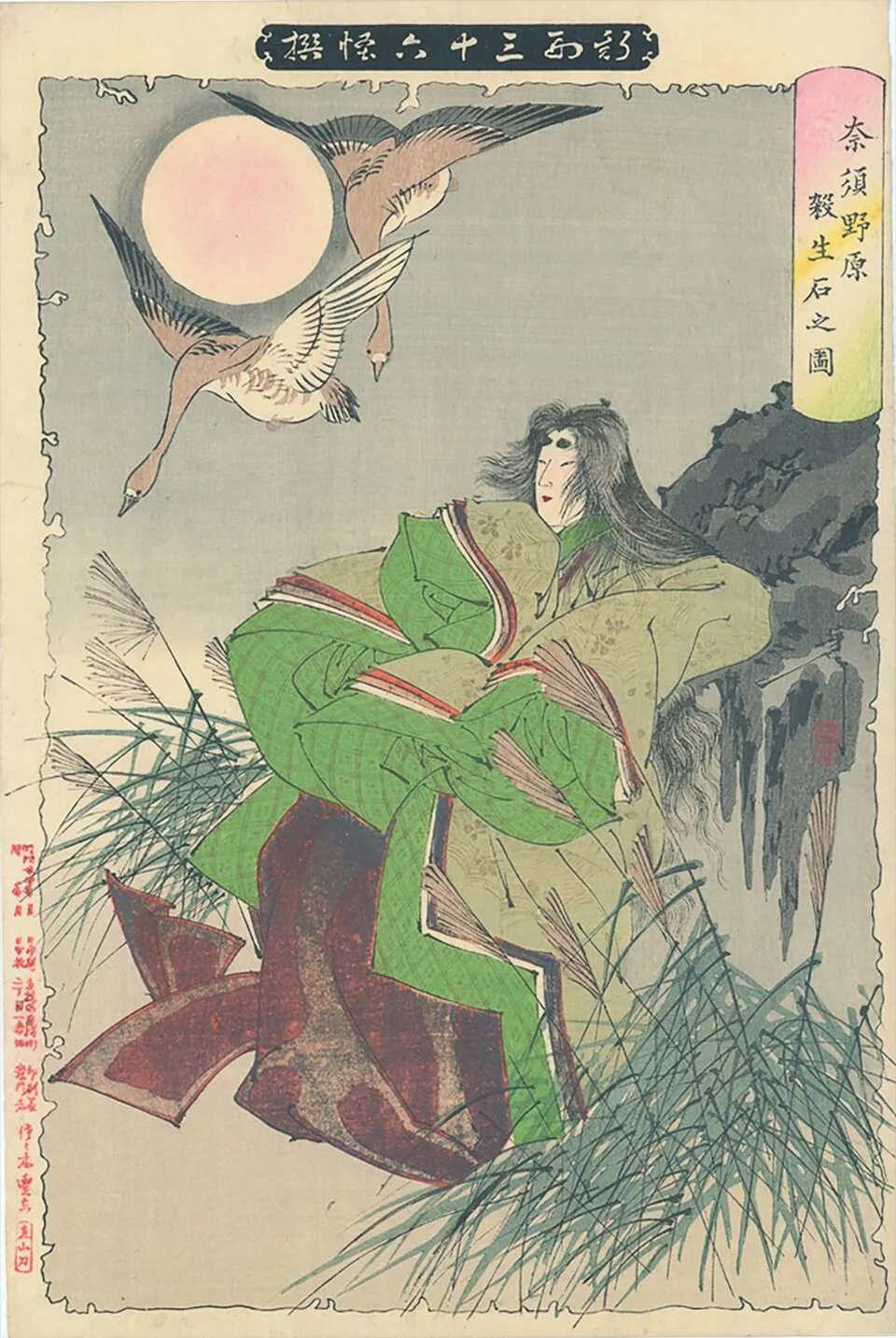
Tamamo-no-Mae
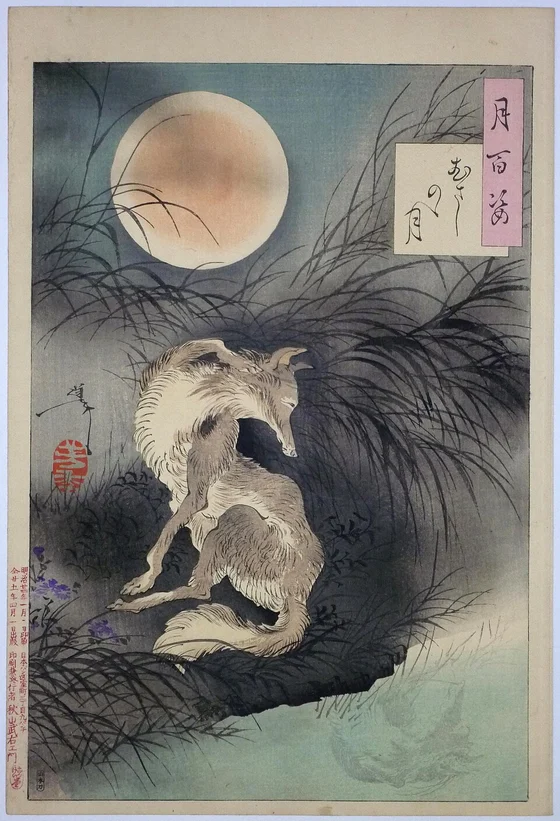
Image associated with the exact linked encyclopedia article; consult credited file description for its interpretation.
Overview
Tamamo-no-mae is a named fox-associated court figure whose story appears in handscrolls, prints, and Sekien’s illustrated compendium. The Smithsonian’s seventeenth-century Illustrated legend of Tamamo no mae, F 1987.9, is credited to Yasunobu Kichizaemon. Its curatorial description presents the woman as possessed by a fox spirit and able to take either a beautiful female guise or a magical nine-tailed fox form. Those formulations belong to this object’s interpretation and should not erase differences between possession and a fox impersonating a woman.
The paired handscrolls F 1987.9 and F 1987.10 alternate narrative passages with short painted scenes. Gold decoration on the writing papers and cloud-bordered pictures make the story a sequence disclosed gradually as the scroll is unrolled from right to left. This format supports multiple moments of a transformation narrative rather than a single fixed portrait. The museum associates such imaginative legends with popularity from the fourteenth century onward, while dating these particular material witnesses to the seventeenth century.
The Met’s 1835 surimono Tamamo no Mae and the Archer Miura Kuranosuke, accession JP 1038, offers another documented version. Its description connects the nine-tailed fox with enchantment of Chinese emperors, arrival in Japan as the Toba emperor’s favourite, exposure by the astrologer named Abe no Seimei, flight to Nasu, and the archer’s attack. The museum’s account ends with transformation into stone. This named sequence supplies the Nasu and stone episodes without making their every detail universal across earlier texts.
The Met now lists the print as formerly attributed to Yashima Gakutei; the former attribution should remain visible rather than becoming an unqualified artist credit. Sekien’s independently inspected named plate is a further eighteenth-century witness, separate from that 1835 object. A fox body in one image, a court woman in another, and a stone episode in a narrative belong to distinguishable moments and versions. This profile consequently treats Tamamo as a specific literary and artistic identity, while avoiding a claim that every nine-tailed fox or every fox-associated court legend tells the same story.
Origins & earliest records
Selected historical witness: Konjaku Gazu Zoku Hyakki (1779) by Toriyama Sekien. The linked library record identifies a surviving printed edition; it does not establish when the belief first arose.
Records & interpretation
Verified Sekien primary plate supplemented by explicitly attributed museum object records and narrative interpretation; no full historical manuscript transcription claimed.
Selected bibliography
Documented works and useful reading. This is not a list of every appearance.
- 01
Konjaku Gazu Zoku Hyakki
Selected historical witness; individual illustration now checked in the separately linked primary scan. This edition is not a claim of the earliest oral attestation.
Family, evolution & connections
Red fox
Tamamo-no-Mae’s concealed fox identity turns a courtly human appearance into a supernatural disguise. A real red fox provides a representative animal comparison, not a species determination for the legendary figure. Sekien’s surviving depiction and later narrative layers should remain distinct from any claim about ordinary fox biology.
Kitsune
Tamamo-no-Mae is a named supernatural fox figure with a particular courtly narrative, while kitsune refers to a wider and varied body of fox traditions. Comparing their concealed identities is useful, but a single named figure cannot stand for every fox account. The link preserves differences in story, setting and religious associations.
Primary records and illustrations
Konjaku Gazu Zoku Hyakki
Volume 1; Smithsonian Libraries digitized copy. IIIF canvas index 21 (zero-based); Konjakuzokuhyak1Tori_0022.jp2
Printed label 玉藻前; a robed woman sits before rays that spread across a palace interior. Label and composition directly inspected; no transcription of cursive explanatory text is claimed.
Encyclopedia background
An additional attributed reference, separate from the editorial profile above.
Read the open encyclopedia overview
Tamamo-no-Mae (玉藻前, 玉藻の前, also 玉藻御前) is a legendary figure in Japanese mythology. One of the stories explaining the legend comes from Muromachi period (1336 to 1573) genre fiction called otogizōshi. In the otogizōshi, Tamamo-no-Mae was a courtesan under the Japanese Emperor Konoe (who reigned from 1142 through 1155).
Text from Wikipedia contributors, “Tamamo-no-Mae”. CC BY-SA 4.0. Extracted introduction; formatting changed. Retrieved 5 October 2026. The source article may have changed since retrieval.
References
Sources supporting this profile. Linked pages have their own scope and editorial standards.
- Primary illustration / library recordKonjaku Gazu Zoku Hyakki — historical library editionResearch access: 2026-10-05
- Secondary referenceTamamo-no-Mae — contextual overview and bibliographyResearch access: 2026-10-05
- Primary illustrated plate / institutional digitizationKonjaku Gazu Zoku Hyakki — directly inspected IIIF canvas index 21 (zero-based); Konjakuzokuhyak1Tori_0022.jp2Research access: 2026-10-05
- Museum object interpretation or living institutional narrativeSmithsonian F 1987.9: Illustrated legend of Tamamo no maeResearch access: 2026-10-05
- Museum object interpretation or living institutional narrativeMet JP 1038: Tamamo no Mae and the Archer Miura KuranosukeResearch access: 2026-10-05
Image credits
Reference illustrationTamamo-no-Mae
Image associated with the exact linked encyclopedia article; consult credited file description for its interpretation.