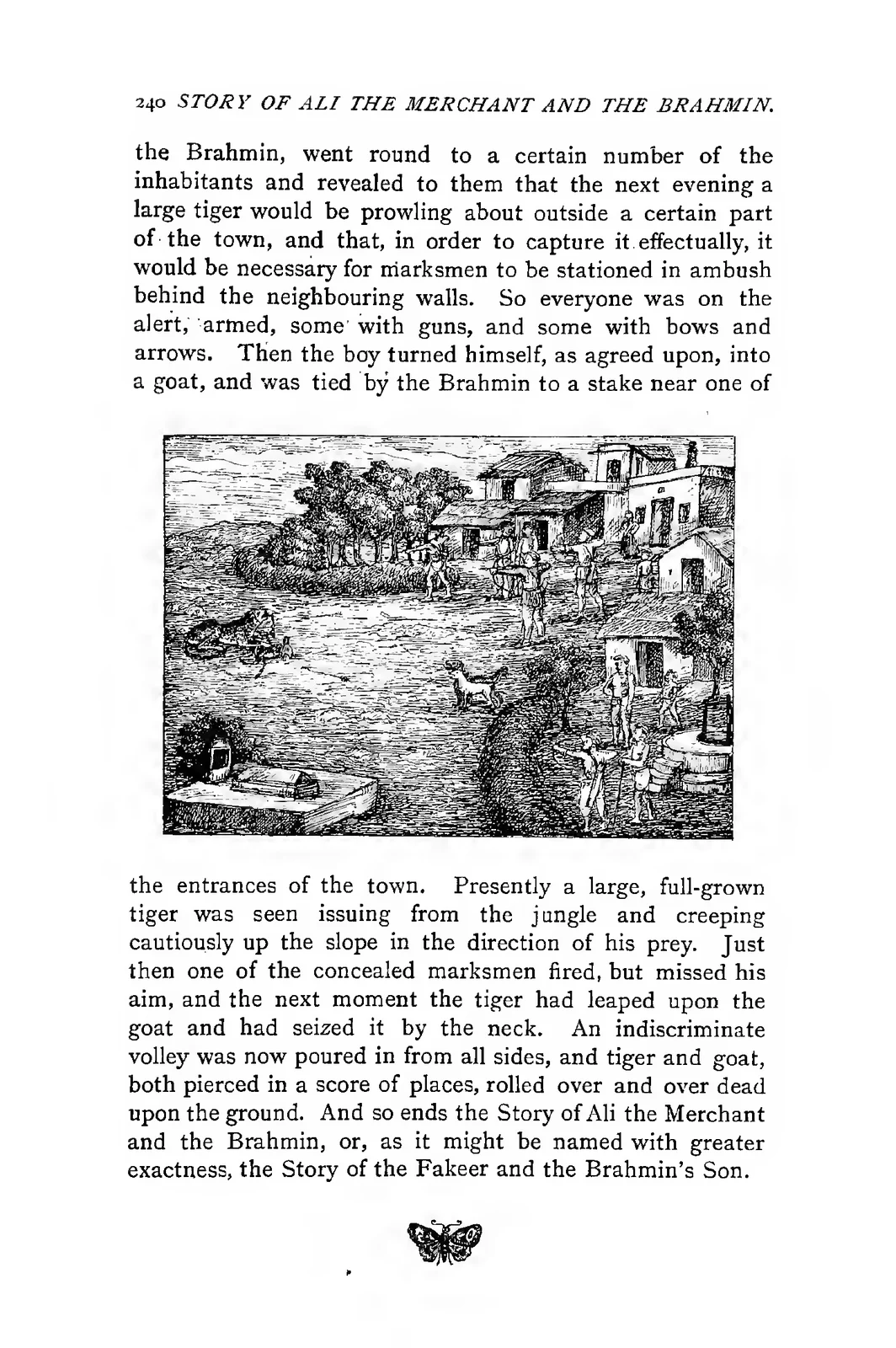
The transformed master as a tiger approaches his pupil as a tied goat while townspeople prepare their ambush, original 1892 illustration
The tiger and goat are the teacher and pupil’s final transformations in Ali the Merchant and the Brahmin. Townspeople wait nearby with weapons. The story’s volley kills both rivals; the picture does not imply that the pupil survives or that these are ordinary wild animals.
Overview
A Brahmin entrusts his two sons to a fakeer who will educate them in exchange for keeping one. The teacher gives his magical knowledge to the more intelligent younger boy, but the father chooses to retain that son. Their dispute produces a pursuit between two actual shape-changers. The pupil first supplies a bullock for sale while becoming its headstall himself. When the father preserves the headstall as instructed, the boy returns home. He repeats the scheme with a horse and bridle: the narrative expressly places him in the bridle, rather than simply identifying him with the horse.
The teacher recognizes the second scheme and strikes the horse. During the chase, the pupil makes the horse vanish and becomes a dove, while his master becomes a pursuing hawk. The boy then enters a lake as a fish, and the master follows as an alligator. Escaping onto the bank, the pupil becomes a mosquito and hides in the nostril of a hanging corpse. His teacher resumes human form and seals the nostrils with clay and linen before persuading the charitable merchant Ali to fetch the body.
The corpse repeatedly escapes back to its tree and later tells Ali an extended story, provoking replies that frustrate the merchant’s attempts to carry it away in silence. Finally it persuades him to remove the bindings. The mosquito flies out, becomes the Brahmin’s son and leaves; the corpse then falls motionless. This sequence links the moving, speaking body to the concealed pupil without naming an independent possessing spirit or calling it a Vetāla. The embedded story of a revived girl and her three suitors belongs to the corpse’s narration, not to another transformation by the pupil.
In the final contest, the pupil agrees to become a goat while the master becomes a tiger. Secretly he arranges for townspeople to ambush the tiger, intending to overcome his stronger teacher through outside help. One marksman misses; the tiger seizes the goat, and an indiscriminate volley kills both transformed rivals. The pupil neither survives nor permanently outwits his master. This entry concerns their specified nonhuman manifestations in Swynnerton’s English witness, not a claim that human religious mendicants generally constitute a supernatural species.
Origins & earliest records
Upper Indus Panjabi tales in Charles Swynnerton’s English collection
Records & interpretation
Complete story and ending read; critical printed pages visually checked.
Selected bibliography
Documented works and useful reading. This is not a list of every appearance.
- 01
Indian Nights’ Entertainment; or, Folk-Tales from the Upper Indus
LVII, The Story of Ali the Merchant and the Brahmin, pp.216–240, including the embedded tale and footnote
Family & connections
A source-supported family tree or inspiration record has not yet been compiled for this profile. Related reading below indicates a connection in subject matter, not a proven lineage or creative influence.
Primary records and illustrations
Charles Swynnerton, Indian Nights’ Entertainment (1892)
1892 edition. LVII, The Story of Ali the Merchant and the Brahmin, pp.216–240, including the embedded tale and footnote
Complete swynnerton1892-ch57.txt read through ending and embedded story/footnote. Actual printed220/222/238/240 PNGs viewed to resolve headstall/bridle identities, departure from corpse, and deaths of both transformed rivals.
References
Sources supporting this profile. Linked pages have their own scope and editorial standards.
- Historical primary English translationCornell scan of Swynnerton (1892), LVII, The Story of Ali the Merchant and the Brahmin, pp.216–240, including the embedded tale and footnoteResearch access: 2026-10-05
Image credits
Historical illustrationThe transformed master as a tiger approaches his pupil as a tied goat while townspeople prepare their ambush, original 1892 illustration
The tiger and goat are the teacher and pupil’s final transformations in Ali the Merchant and the Brahmin. Townspeople wait nearby with weapons. The story’s volley kills both rivals; the picture does not imply that the pupil survives or that these are ordinary wild animals.