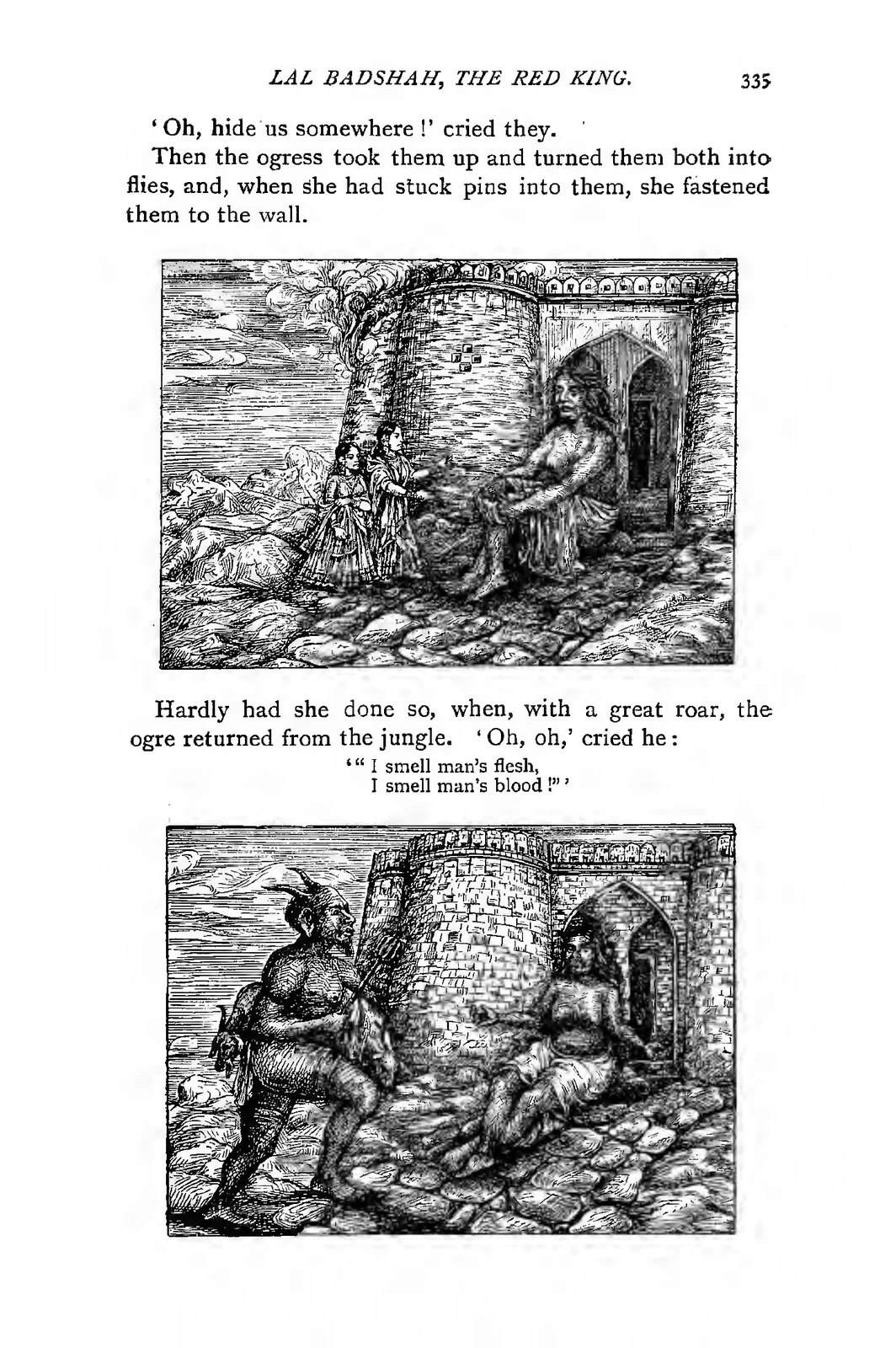
Two original 1892 scenes of the merciful ogress meeting the princesses and concealing them from her man-eating son
The upper scene shows the tall ogress with the two abandoned princesses; the lower scene shows her facing her returning son. The nearby narrative explains her fly transformation and concealment. The artist’s horned or bulky forms belong to this particular illustration, rather than anatomy supplied by the tale.
Overview
Two young princesses abandoned in the wilderness find a castle occupied by a very tall old woman. Swynnerton identifies her as an ogress but stresses her compassion. She warns that her son eats human beings and will devour them when he returns. Responding to their plea for concealment, she turns both children into flies and pins them to the wall.
Her son returns roaring that he smells human flesh and blood. She denies that anyone is present besides the two of them, and he eats hog’s flesh, drinks wine and falls asleep. After he leaves in the morning, she removes the pins and restores the sisters to their human shapes. She sends them away quickly, explaining that their presence could get her into trouble as well.
The sisters survive the transformation and continue into the forest; the tale later follows their separation, marriage, persecution and reunion. Neither ogress nor son returns in that ending. Her mercy coexists with her stated monstrous identity and the danger posed by her household. The text does not name her, specify how the spell is spoken or make the pins kill the children. The illustration’s particular bodily design is not treated as additional textual anatomy, and the helpful mother is not merged with the separate ghoul spouses in The Princess and the Ogres.
Origins & earliest records
Upper Indus Panjabi tales in Charles Swynnerton’s English collection
Records & interpretation
Complete story and ending read; critical printed pages visually checked.
Selected bibliography
Documented works and useful reading. This is not a list of every appearance.
- 01
Indian Nights’ Entertainment; or, Folk-Tales from the Upper Indus
LXXXI, Lâl Bâdshâh, the Red King; or, The Two Little Princesses, pp.330–342; ogress episode pp.334–336
Family, evolution & connections
Unnamed man-eating ogre son in Lâl Bâdshâh
The ogress calls the returning ogre her son, and the narrator identifies her as his mother. The two princesses she conceals are rescued strangers; their temporary fly forms do not make them her offspring.
Primary records and illustrations
Charles Swynnerton, Indian Nights’ Entertainment (1892)
1892 edition. LXXXI, Lâl Bâdshâh, the Red King; or, The Two Little Princesses, pp.330–342; ogress episode pp.334–336
Complete swynnerton1892-ch81.txt read and retained. Printed43/335/336 actually viewed in sourcePNG images; no revived parrot or fatal fly-transformation inferred.
References
Sources supporting this profile. Linked pages have their own scope and editorial standards.
- Historical primary English translationCornell scan of Swynnerton (1892), LXXXI, Lâl Bâdshâh, the Red King; or, The Two Little Princesses, pp.330–342; ogress episode pp.334–336Research access: 2026-10-05
Image credits
Historical illustrationTwo original 1892 scenes of the merciful ogress meeting the princesses and concealing them from her man-eating son
The upper scene shows the tall ogress with the two abandoned princesses; the lower scene shows her facing her returning son. The nearby narrative explains her fly transformation and concealment. The artist’s horned or bulky forms belong to this particular illustration, rather than anatomy supplied by the tale.