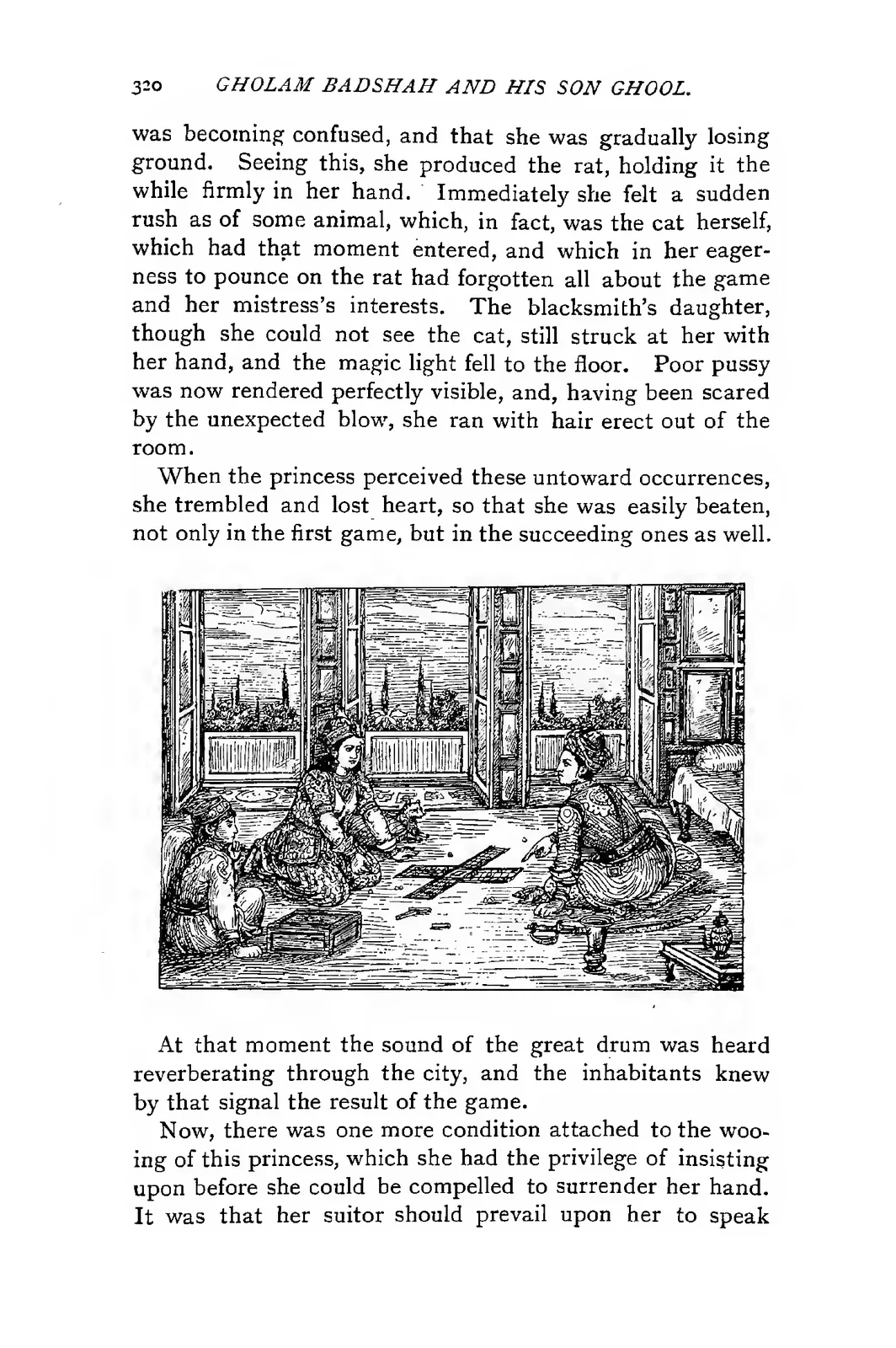
Chess-game scene with the rat used to distract the princess’s magic cat, original 1892 illustration
The whole illustrated page shows the chess match and the rat lure. The adjoining narrative identifies the cat’s intervention and the loss of its concealing light. This is a scene illustration, rather than an isolated portrait demonstrating invisible anatomy.
Overview
In Swynnerton’s tale, the supposedly dumb princess defeats her suitors at chess with concealed assistance. A grateful rat tells the blacksmith’s daughter that the princess possesses a magic cat. A light carried on the cat’s head makes the animal invisible, allowing her to mix the chessmen without detection. Defeated suitors lose their freedom, and the daughter’s husband, Prince Ghool, has become a groom after three losses.
Disguised as a man, the daughter takes the rat’s advice and chooses the side of the chessboard nearest the cat’s usual entrance. As the pieces become confused, she displays the rat while holding it securely. The unseen cat rushes toward this prey and forgets the game. The daughter feels the movement and strikes: the light falls, the cat becomes visible, and she runs from the room with her hair erect. The princess then loses three consecutive games. The passage supplies no coat color, breed or independent power of invisibility apart from the light.
The cat disappears from the subsequent action. The rat helps the daughter satisfy a further condition by speaking from the princess’s bed supports, provoking her to answer three times. These voices are a trick performed by the rat, not living wooden furniture. The daughter eventually frees the captive suitors and exposes her husband’s false claim to have won the princess himself. The title’s Prince Ghool is this human husband, not an identification of the cat or prince as a ghoul.
Origins & earliest records
Upper Indus Panjabi tales in Charles Swynnerton’s English collection
Records & interpretation
Complete story and ending read; critical printed pages visually checked.
Selected bibliography
Documented works and useful reading. This is not a list of every appearance.
- 01
Indian Nights’ Entertainment; or, Folk-Tales from the Upper Indus
LXXX, Gholâm Bâdshâh and His Son Ghool, pp.313–330; cat episode pp.319–320
Family & connections
A source-supported family tree or inspiration record has not yet been compiled for this profile. Related reading below indicates a connection in subject matter, not a proven lineage or creative influence.
Primary records and illustrations
Charles Swynnerton, Indian Nights’ Entertainment (1892)
1892 edition. LXXX, Gholâm Bâdshâh and His Son Ghool, pp.313–330; cat episode pp.319–320
Complete swynnerton1892-ch80.txt read including ending and footnotes. Original printed pages279/283/296/319/320 visually checked and retained as PNGs. Bird name, cat visibility and breath restoration checked against actual print.
References
Sources supporting this profile. Linked pages have their own scope and editorial standards.
- Historical primary English translationCornell scan of Swynnerton (1892), LXXX, Gholâm Bâdshâh and His Son Ghool, pp.313–330; cat episode pp.319–320Research access: 2026-10-05
Image credits
Historical illustrationChess-game scene with the rat used to distract the princess’s magic cat, original 1892 illustration
The whole illustrated page shows the chess match and the rat lure. The adjoining narrative identifies the cat’s intervention and the loss of its concealing light. This is a scene illustration, rather than an isolated portrait demonstrating invisible anatomy.