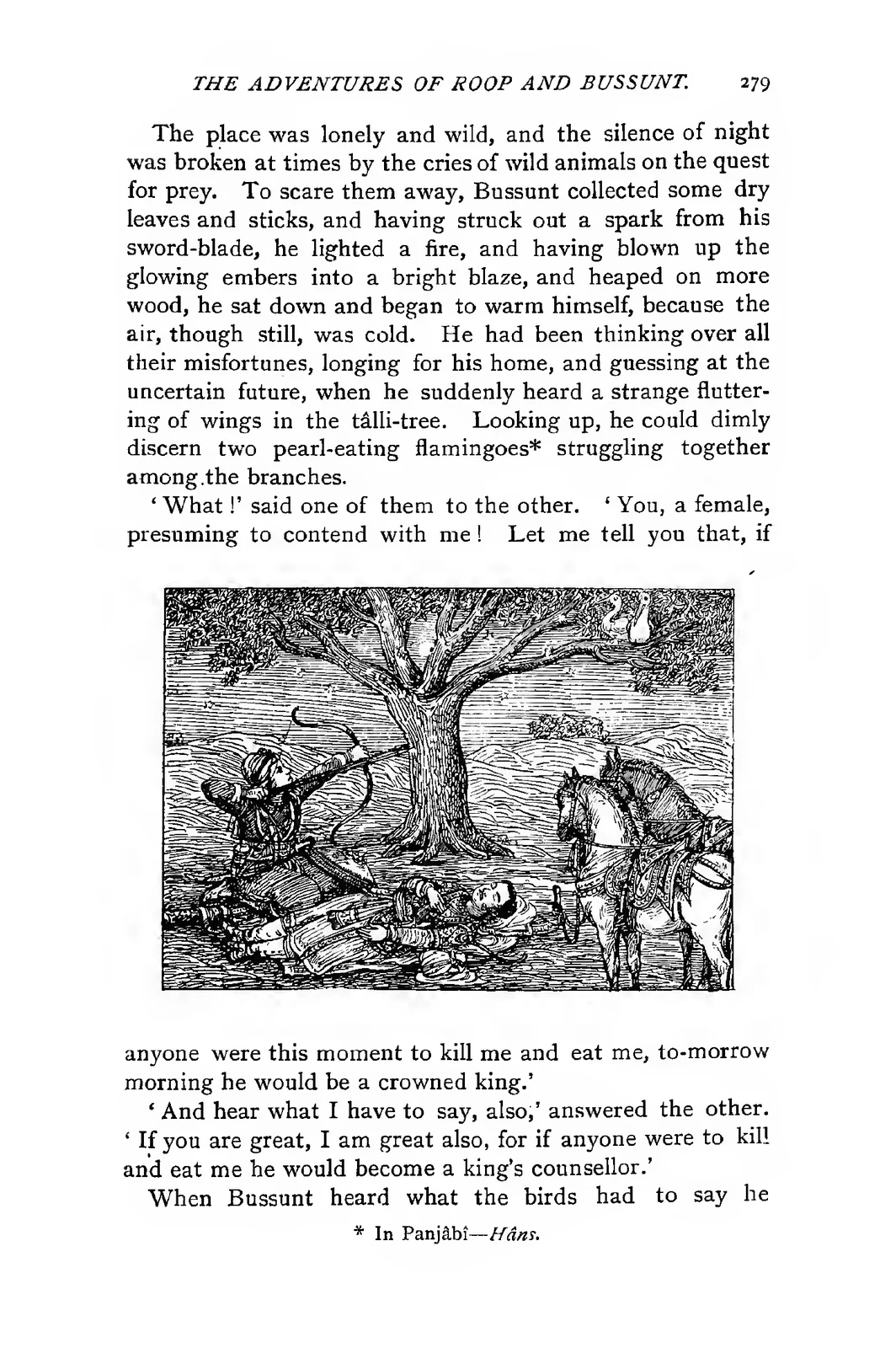
Bussunt aims his bow at two fortune-giving Hans birds above his sleeping brother, original 1892 illustration
The birds in the tree belong to Roop and Bussunt’s story. Swynnerton calls them flamingoes and records Hâns in a footnote; this narrative and drawn appearance do not establish their modern zoological identity.
Overview
Two pearl-eating birds converse above the sleeping princes Roop and Bussunt. Swynnerton calls them flamingoes and gives Hâns as their Panjabi name in a footnote. The male foretells that whoever kills and eats him will be crowned king the following morning; the female says her eater will become that king’s counsellor. These are the translator’s narrative identifications, not a modern zoological determination or a complete account of all traditions associated with the name.
Keeping watch, Bussunt shoots both birds with his bow. He gives the larger male to his elder brother Roop and eats the smaller female himself, intending that Roop receive the higher station. Roop subsequently enters a city whose succession custom makes the first strange horseman its new king. Bussunt’s corresponding appointment is delayed by a long series of separations and dangers. Once the brothers recognize each other again, Roop makes him chief counsellor, completing the paired predictions.
The birds are also connected to a snake that deprives Bussunt of breath after finding that he has killed them. The snake calls them its two flamingoes; the story does not establish a parental or marital relationship. Their deaths are not reversed when the snake restores the prince’s breath. Nor do the promised offices guarantee a happy life: Bussunt later returns to his father’s kingdom, and their stepmother’s false accusation brings the brothers into war. Roop dies and Bussunt remains unhappy. That ending belongs to the same complete witness as the earlier fortune-giving birds.
Origins & earliest records
Upper Indus Panjabi tales in Charles Swynnerton’s English collection
Records & interpretation
Complete story and ending read; critical printed pages visually checked.
Selected bibliography
Documented works and useful reading. This is not a list of every appearance.
- 01
Indian Nights’ Entertainment; or, Folk-Tales from the Upper Indus
LXXI, The Story of Roop and Bussunt, pp.273–296; birds pp.279–280
Family & connections
A source-supported family tree or inspiration record has not yet been compiled for this profile. Related reading below indicates a connection in subject matter, not a proven lineage or creative influence.
Primary records and illustrations
Charles Swynnerton, Indian Nights’ Entertainment (1892)
1892 edition. LXXI, The Story of Roop and Bussunt, pp.273–296; birds pp.279–280
Complete swynnerton1892-ch71.txt read including ending and footnotes. Original printed pages279/283/296/319/320 visually checked and retained as PNGs. Bird name, cat visibility and breath restoration checked against actual print.
References
Sources supporting this profile. Linked pages have their own scope and editorial standards.
- Historical primary English translationCornell scan of Swynnerton (1892), LXXI, The Story of Roop and Bussunt, pp.273–296; birds pp.279–280Research access: 2026-10-05
Image credits
Historical illustrationBussunt aims his bow at two fortune-giving Hans birds above his sleeping brother, original 1892 illustration
The birds in the tree belong to Roop and Bussunt’s story. Swynnerton calls them flamingoes and records Hâns in a footnote; this narrative and drawn appearance do not establish their modern zoological identity.