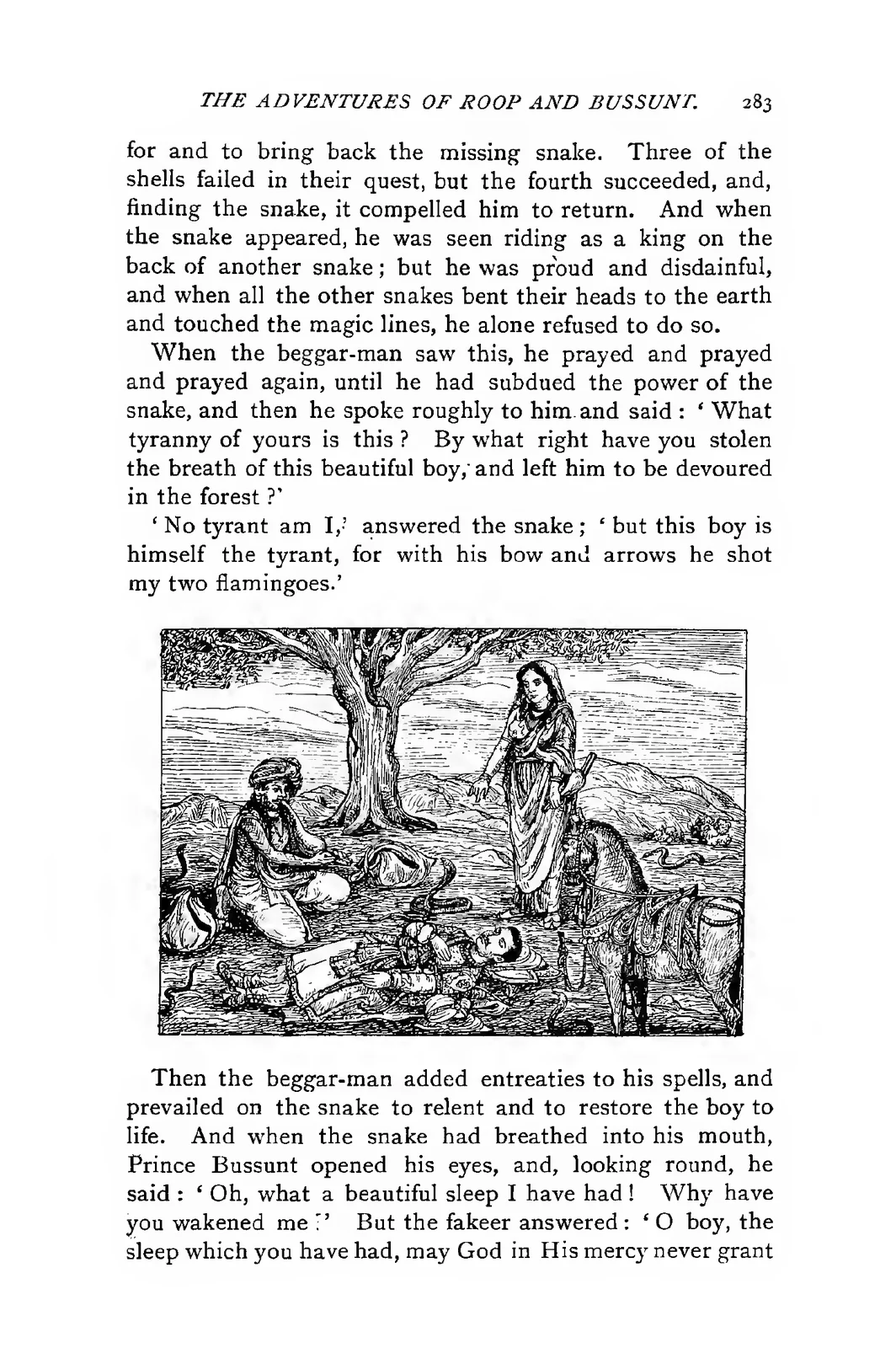
Snake-charmer and assembled serpents beside the unconscious Bussunt, original 1892 illustration
The scene shows the snake-charmer, gathered serpents and unconscious prince. The adjacent account identifies the stolen-breath rescue. The drawing does not securely identify which individual coil is the culprit, and the story describes restoration of stolen breath rather than resurrection after established death.
Overview
Bussunt returns for a forgotten whip and finds a snake lying across it. As he tries to retrieve it from horseback, the snake draws away his breath. He falls into a swoon, while his horse remains motionless under the snake’s poisonous influence. No bite is described in this encounter. Although the prince appears dead for days, an old woman recognizes that his breath has been taken and that he is not truly dead.
A snake-charmer draws magical lines and recites prayers that assemble the surrounding snakes, including ancient ones. The culprit alone remains absent until four enchanted cowrie shells are sent to seek it in different directions. The fourth compels its arrival. It rides on another snake’s back like a king and initially refuses to bow or enter the prescribed lines. Further prayers subdue its resistance. The royal comparison describes this entrance without supplying a personal name or expressly identifying a Nāga king.
The snake explains that Bussunt killed its two flamingoes, the birds whose flesh foretold kingship and a counsellor’s office for the brothers. Persuaded by the charmer, it breathes into the prince’s mouth. Bussunt wakes believing that his rest has been interrupted. This is a specifically narrated restoration of stolen breath, rather than resurrection after established bodily death. Bussunt’s later ordeals, appointment as counsellor and tragic war against Roop continue beyond the rescue; the snake has no further narrated role. Its relation to the birds is left at its claim of possession, without an invented family relationship.
Origins & earliest records
Upper Indus Panjabi tales in Charles Swynnerton’s English collection
Records & interpretation
Complete story and ending read; critical printed pages visually checked.
Selected bibliography
Documented works and useful reading. This is not a list of every appearance.
- 01
Indian Nights’ Entertainment; or, Folk-Tales from the Upper Indus
LXXI, The Story of Roop and Bussunt, pp.273–296; snake episode pp.281–284
Family & connections
A source-supported family tree or inspiration record has not yet been compiled for this profile. Related reading below indicates a connection in subject matter, not a proven lineage or creative influence.
Primary records and illustrations
Charles Swynnerton, Indian Nights’ Entertainment (1892)
1892 edition. LXXI, The Story of Roop and Bussunt, pp.273–296; snake episode pp.281–284
Complete swynnerton1892-ch71.txt read including ending and footnotes. Original printed pages279/283/296/319/320 visually checked and retained as PNGs. Bird name, cat visibility and breath restoration checked against actual print.
References
Sources supporting this profile. Linked pages have their own scope and editorial standards.
- Historical primary English translationCornell scan of Swynnerton (1892), LXXI, The Story of Roop and Bussunt, pp.273–296; snake episode pp.281–284Research access: 2026-10-05
Image credits
Historical illustrationSnake-charmer and assembled serpents beside the unconscious Bussunt, original 1892 illustration
The scene shows the snake-charmer, gathered serpents and unconscious prince. The adjacent account identifies the stolen-breath rescue. The drawing does not securely identify which individual coil is the culprit, and the story describes restoration of stolen breath rather than resurrection after established death.