
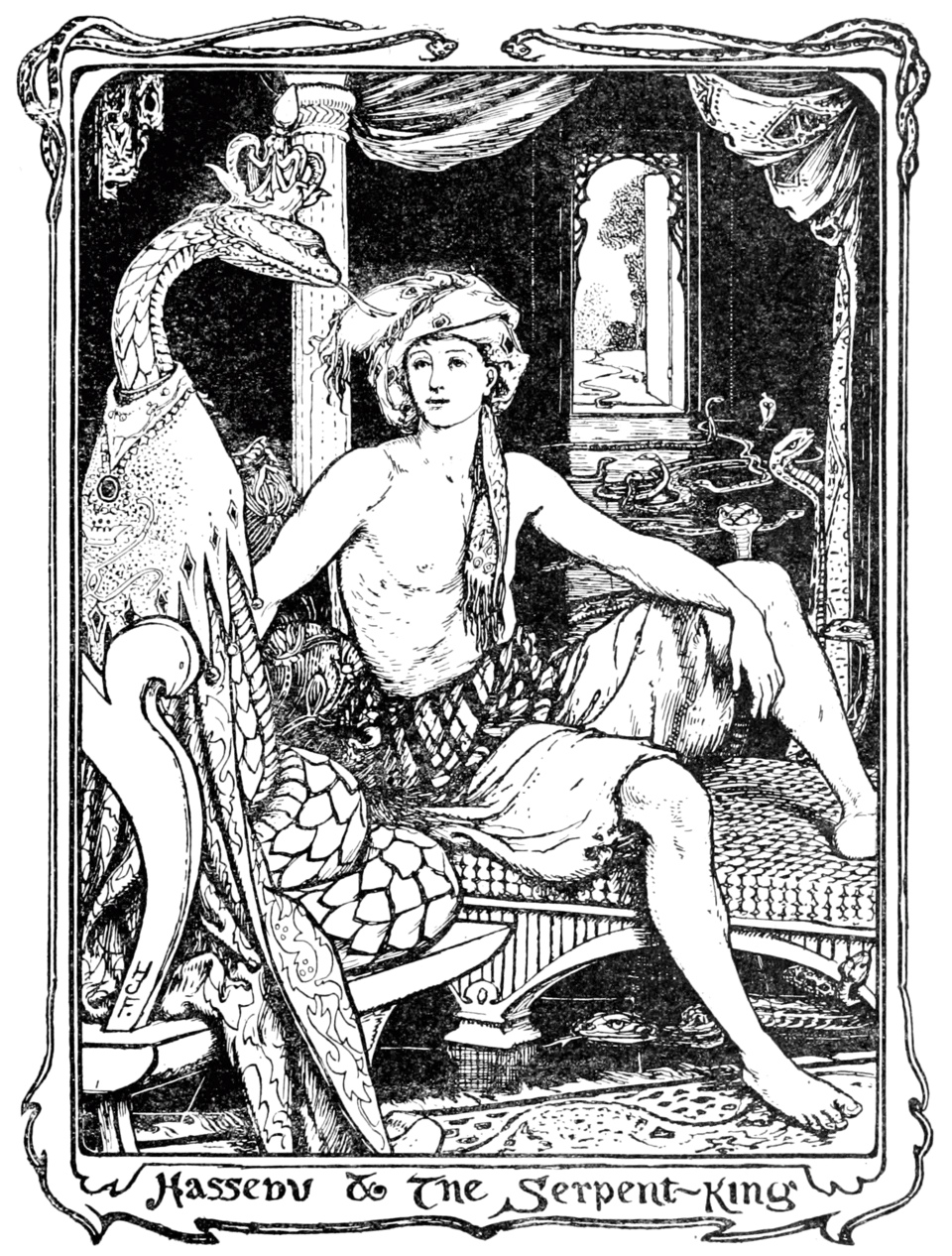
Hassebu and the Serpent-King, Henry Justice Ford illustration
Henry Justice Ford illustration to The Story of Hassebu in Andrew Lang’s Violet Fairy Book, first published1901; this reproduction is from the1906 edition. Depicts the corresponding Snake King episode in a separate English adaptation; the Bateman profile’s spelling Sultaanee Waa Neeoka is not a caption on this plate.
Overview
Sultaanee Waa Neeoka is the Snake King encountered by Hasseeboo Kareem Ed Deen after dishonest woodcutters abandon the boy in a honey pit. A fallen scorpion leads Hasseeboo to a crack, which he enlarges until he can reach an unfamiliar path. The path brings him to a splendid house with golden doors and locks, pearl keys, jewel-inlaid chairs and a luxurious couch. Snakes surround him while he sleeps, but their king instructs them to wake him gently. Royal colors distinguish the king from his attendants. He asks the visitor’s name and offers excellent fruit and conversation. Neither an enormous body nor an additional human head is specified in this encounter.
The king’s earlier adventure makes his knowledge useful and his body vulnerable. In the mountains of Al Kaaf he encounters Bolookeea, a traveler seeking a prophet not yet born. Later Bolookeea and Al Faan lure the king into a cage with milk and wine. He drinks, becomes intoxicated and is captured. They seek medicine that permits walking on water. In a grove, trees announce their medicinal properties to the captive king, who identifies the desired plant; the men gather it and release him. Their subsequent journey toward Solomon’s ring and Jan Shah’s marriage to the bird-maiden are nested accounts, rather than additional feats all performed by the Snake King. His later warning to Hasseeboo similarly reveals foresight: he predicts that the grateful visitor will cause his death and tells him to avoid public baths. A mark on the boy’s stomach identifies him to soldiers there; a vizir beats him until he discloses the king’s dwelling.
Facing capture, the Snake King sees the injuries and accepts that the boy was coerced, rather than freely choosing betrayal. He asks Hasseeboo to carry him and explains the consequences of cooking his body. The first skimming is to be retained as poison for the vizir, the second makes the boy a great physician, and the third cures the human sultan. Hasseeboo exchanges the first and second portions as instructed; the vizir dies, the sultan recovers, and the boy gains his medical standing. These properties are narrative marvels, not medical instructions. Bateman presents the tale as translated from Swahili storytelling in Zanzibar; its nested distant journeys are not proof that every represented being originated there.
Origins & earliest records
Bateman presents these accounts as tales told to him in Zanzibar and translated from Swahili; individual narrators are not named in this edition.
Records & interpretation
The selected chapter attests these actions and represented forms. English spellings are retained as edition labels, not proof of personal-name etymology or zoological identity.
Selected bibliography
Documented works and useful reading. This is not a list of every appearance.
- 01
Zanzibar Tales
The Physician’s Son and the King of the Snakes
- 02
Zanzibar Tales: Told by Natives of the East Coast of Africa
Chicago: A. C. McClurg & Co., 1901; George W. Bateman, translated from the original Swahili. Preface dated 1 August 1901; narrators are not individually named.
Family & connections
A source-supported family tree or inspiration record has not yet been compiled for this profile. Related reading below indicates a connection in subject matter, not a proven lineage or creative influence.
Located primary passages
Specific passages supporting details in this entry, grouped by their published witness.
Zanzibar Tales
Chicago: A. C. McClurg & Co., 1901; George W. Bateman, translated from the original Swahili. Preface dated 1 August 1901; narrators are not individually named.
- Hasseeboo reaches a rich house from a hole in the abandoned honey pit; the snake king receives him gently and shares fruit before exchanging stories.
- In his own narrative, the snake king is trapped with wine by seekers of Solomon’s ring, then reveals a tree medicine for walking on water and is released.
- The king predicts Hasseeboo’s betrayal and warns against public baths; after the youth is tortured into revealing his home, the king directs three successive skimmings of his cooked body to kill the vizir, empower the physician and heal the sultan.
Entire chapter read. The author’s colonial framing and unnamed contributors limit provenance; no earliest-origin or exclusive regional claim inferred. Bateman’s lifespan remains unverified.
References
Sources supporting this profile. Linked pages have their own scope and editorial standards.
- Historical oral-tale translationThe Physician’s Son and the King of the SnakesResearch access: 2026-10-05
Image credits
Historical illustrationHassebu and the Serpent-King, Henry Justice Ford illustration
Henry Justice Ford illustration to The Story of Hassebu in Andrew Lang’s Violet Fairy Book, first published1901; this reproduction is from the1906 edition. Depicts the corresponding Snake King episode in a separate English adaptation; the Bateman profile’s spelling Sultaanee Waa Neeoka is not a caption on this plate.