A sourced illustration has not yet been added. This gap is included in the coverage record.
Overview
The helper appears to the young herdsman as a very old woman. After hearing his fear of thieves and his father’s anger, she points to a smooth stone as large as a hut. It is new to him and impossible for others to climb, but he can ascend. She promises that it will grow with him and serve as a safe lookout. She also teaches a song compelling cattle that hear it to follow. Her aid includes a warning: sleeping on the stone will allow the cattle to be stolen.
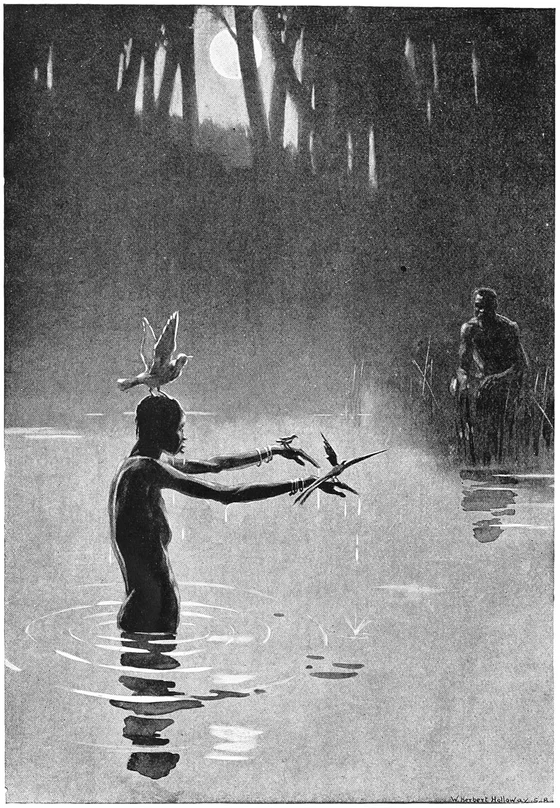
When he disregards that warning and is banished, she returns beside the stone and advises him to serve the chief who stole the herd. After years of service he recovers the cattle, only to be pursued. She appears again at his night refuge by a stream and directs him to cut little white shields from an ox hide. Calling the frogs to help, she obtains their agreement to obey the prince. Their drilled display later frightens the pursuers away.
The woman’s repeated appearances organize the tale’s rescue without erasing the prince’s error or years of work. A bat flies near him immediately before the last appearance, but the text does not explicitly transform that bat into her; it is therefore not listed as an established form. She remains unnamed in this episode and is not treated as necessarily the same old woman who grants Setuli speech in another tale.
Origins & earliest records
Sarah F. Bourhill and Beatrice L. Drake collected and arranged this English children’s retelling. Their preface says most stories came from Swazi contributors, others from Zulu and nearby communities, but gives no individual narrator for this episode. Its colonial generalizations are not adopted as community self-description.
Records & interpretation
Complete II. The Story of the King’s Son and the Magic Song, printed pp. 18–27, read through the ending; collection title page, preface and chapter community label checked.
Selected bibliography
Documented works and useful reading. This is not a list of every appearance.
- 01
Fairy Tales from South Africa
II. The Story of the King’s Son and the Magic Song, pp. 18–27; English literary arrangement for children, unnamed episode contributor.
Family & connections
A source-supported family tree or inspiration record has not yet been compiled for this profile. Related reading below indicates a connection in subject matter, not a proven lineage or creative influence.
Located primary passages
Specific passages supporting details in this entry, grouped by their published witness.
Primary source witness
Sarah F. Bourhill (Mrs. E. J. Bourhill) and Beatrice L. Drake (Mrs. J. B. Drake), Fairy Tales from South Africa, London: Macmillan, 1908, selected original title page and complete headed tales in PG75833. Introduction pp.v–xi says the tales are arranged for children from principally Swazi, also Zulu and border-region sources; individual contributors are not named for these episodes. Its colonial generalisations are attributed historical framing, not present ethnographic fact.
- An old-woman fairy gives the herdsman a smooth protective lookout stone that will grow as he grows. Its protection is conditional on his remaining awake. She also teaches a cattle-gathering song; when he sleeps, the herd is stolen despite the stone.
- The same helper returns after the loss, directs him into the hostile chief’s service and later organises the frog shield-bearers. Her assistance progresses through counsel and intimidation, not a final direct killing of the enemy chief. No song text or ritual formula is reproduced here.
No individual oral contributor or separate original-language manuscript inspected. Historical framing and translations are not universal current community consensus. Original facsimile not visually inspected in this batch.
References
Sources supporting this profile. Linked pages have their own scope and editorial standards.
- Collected historical tale in an English literary retellingBourhill and Drake — II. The Story of the King’s Son and the Magic SongResearch access: 2026-10-05
Image credits
A sourced illustration has not yet been added. This gap is included in the coverage record.