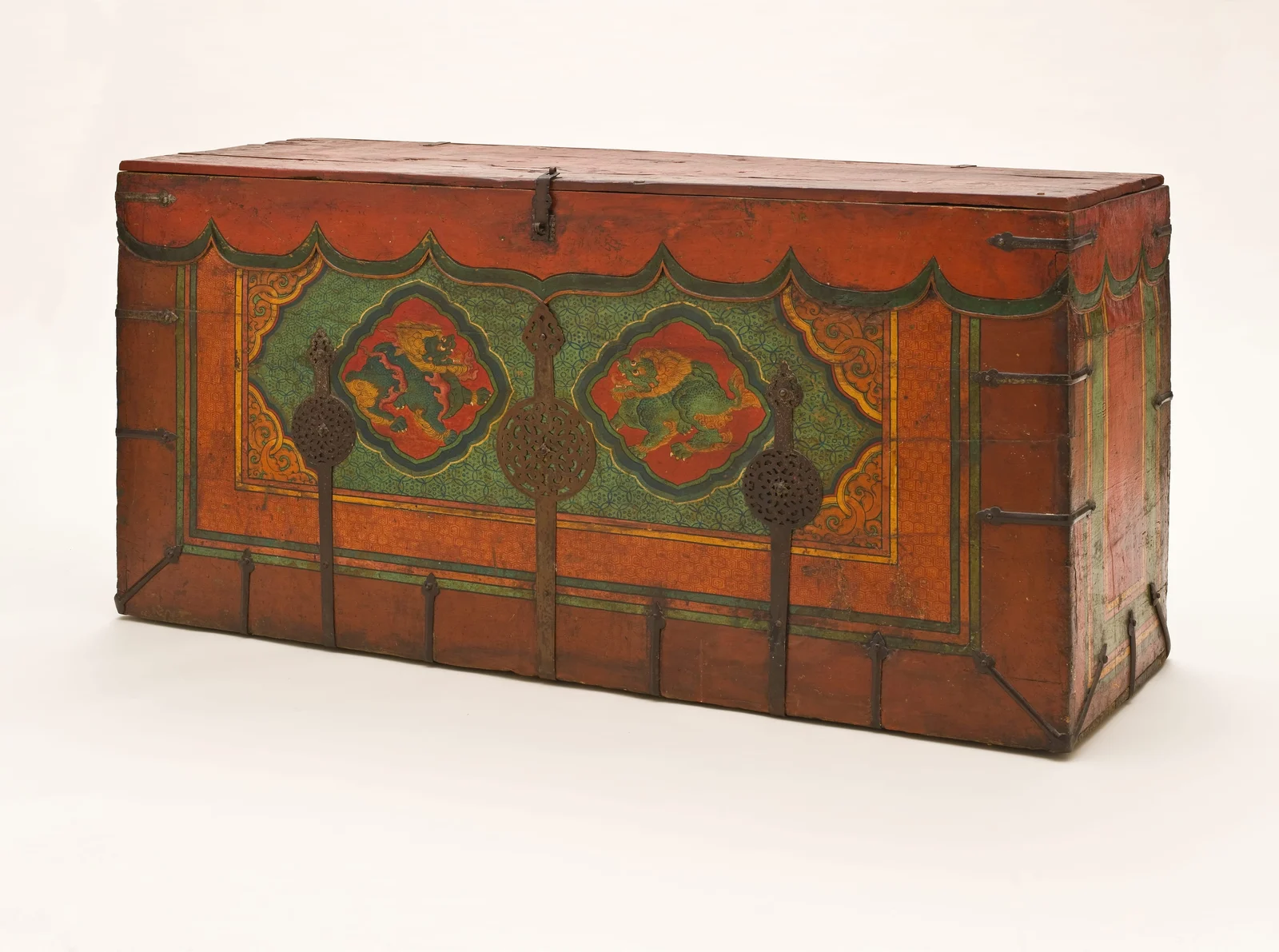
Red-brown Tibetan wooden trunk with two confronting green-bodied, golden-maned lions in red lobed cartouches; patterned borders and three pierced metal straps cross the painted front.
The museum identifies these confronting figures as snow lions, gangs seng ge. Their green bodies and gold manes show this painted trunk’s particular treatment; they are not a claim that all snow-lion imagery uses these colours. Tibet, ca.1475–1650.
Overview
The snow lion is a mythical Himalayan lion used in religious imagery, including throne supports and divine mounts. Himalayan Art Resources distinguishes this tradition from Indian lions, Central Asian lions and Chinese lion imagery rather than assuming all lion figures carry one identical meaning.
An identified Tibetan bronze fragment in the Rubin collection, C2002.30.9, is catalogued to 1600–1699 and interpreted as a snow lion from a large throne back. In the described arrangement, the lion stands above an elephant and beneath a sharabha and rider. The proposed association with a second surviving fragment is tentative.
The Rubin painting F1996.10.2, dated to the nineteenth century, offers another specific context: Tseringma rides a white snow lion with a green mane and fringe, and Vaishravana also has a snow-lion mount. These are separate uses of the figure in a composition with named protectors. The snow lion also appears among the four animals of dignity with garuda, tiger and dragon.
Origins & earliest records
Tibetan and Himalayan Buddhist/Bon iconography
Records & interpretation
Located object descriptions or openly published textual witness directly read; no independent image inspection asserted.
Selected bibliography
Documented works and useful reading. This is not a list of every appearance.
- 01
Himalayan Art Resources65152 — Rubin C2002.30.9
Exact source record; object and publication dates retained in description.
- 02
Himalayan Art Resources433 — Rubin F1996.10.2
Exact source record; object and publication dates retained in description.
- 03
Jeff Watt, Lion Imagery, updated2021
Exact source record; object and publication dates retained in description.
- 04
Four Animals of Dignity
Exact source record; object and publication dates retained in description.
Family & connections
A source-supported family tree or inspiration record has not yet been compiled for this profile. Related reading below indicates a connection in subject matter, not a proven lineage or creative influence.
Primary records and illustrations
Himalayan Art Resources65152 — Rubin C2002.30.9
Tibetan and Himalayan Buddhist/Bon iconography. HAR65152/RubinC2002.30.9; HAR433/RubinF1996.10.2
Actual text/catalogue description read. Object descriptions do not claim direct visual or reuse-rights verification. Modern editorial interpretation separated from primary composition.
References
Sources supporting this profile. Linked pages have their own scope and editorial standards.
- Custodial/art-historical descriptionHimalayan Art Resources65152 — Rubin C2002.30.9Research access: 2026-10-05
- Custodial/art-historical descriptionHimalayan Art Resources433 — Rubin F1996.10.2Research access: 2026-10-05
- Custodial/art-historical descriptionJeff Watt, Lion Imagery, updated2021Research access: 2026-10-05
- Custodial/art-historical descriptionFour Animals of DignityResearch access: 2026-10-05
Image credits
Historical Tibetan furniture paintingRed-brown Tibetan wooden trunk with two confronting green-bodied, golden-maned lions in red lobed cartouches; patterned borders and three pierced metal straps cross the painted front.
The museum identifies these confronting figures as snow lions, gangs seng ge. Their green bodies and gold manes show this painted trunk’s particular treatment; they are not a claim that all snow-lion imagery uses these colours. Tibet, ca.1475–1650.