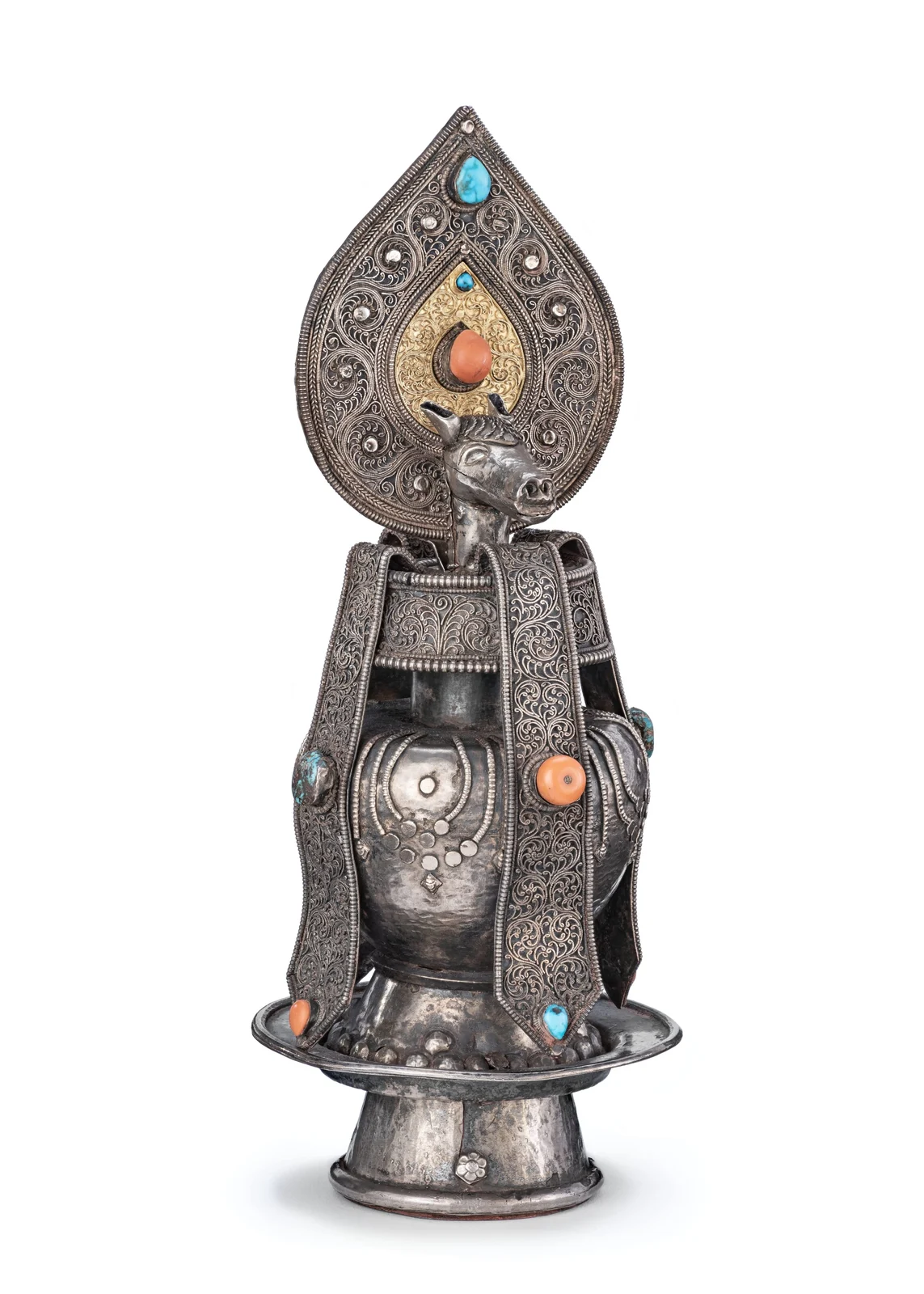
Silver-and-gold filigree ritual vase with a projecting horse head beneath a tall teardrop-shaped finial, inset with turquoise and coral; the complete vessel and pedestal are visible.
Tibet, 18th–early19th century, attributed to Newar craftsmanship. A wind-horse head emerges from this longevity-ritual vase beneath a precious-jewel finial. This is a specific ritual depiction of the head, rather than an illustration of a complete galloping windhorse.
Overview
Lungta is the windhorse associated with prayer flags; it is also a ritual concept, rather than simply the name of a fantastic equine species. Lotsawa House indexes both rlung rta and klung rta as spellings. Himalayan Art Resources places windhorse flags within Buddhist and Bon traditions and describes flags as images and texts on paper or cloth exposed to the wind.
A directly read example is Mipham’s Brief Windhorse Invocation, dated in its colophon to the tenth day of the ninth month of the Water Hare year, 1903. It treats the windhorse flag as an auspicious offering and asks spiritual protectors to fulfil aspirations. The inspected edition gives Tibetan text, transliteration and Rigpa Translations’ 2013 English rendering, with a 2007 collected-works locator, volume 31, page 41.
This record concerns an openly published liturgical witness and its visual setting. Its aspiration for spiritual benefit is attributed to the prayer, not presented as an empirically demonstrated effect or as a claim that an animal literally carries every flag through the air.
Origins & earliest records
Tibetan and Himalayan prayer-flag traditions
Records & interpretation
Located object descriptions or openly published textual witness directly read; no independent image inspection asserted.
Selected bibliography
Documented works and useful reading. This is not a list of every appearance.
- 01
Mipham, Brief Windhorse Invocation; Rigpa Translations2013
Exact source record; object and publication dates retained in description.
- 02
Lotsawa House, Lungta Series
Exact source record; object and publication dates retained in description.
- 03
Jeff Watt, Prayer Flags, updated2020
Exact source record; object and publication dates retained in description.
Family & connections
A source-supported family tree or inspiration record has not yet been compiled for this profile. Related reading below indicates a connection in subject matter, not a proven lineage or creative influence.
Primary records and illustrations
Mipham, Brief Windhorse Invocation; Rigpa Translations2013
Tibetan and Himalayan prayer-flag traditions. Mipham collected works, Chengdu2007,vol31,p41; Rigpa2013,version1.2-20220120
Actual text/catalogue description read. Object descriptions do not claim direct visual or reuse-rights verification. Modern editorial interpretation separated from primary composition.
References
Sources supporting this profile. Linked pages have their own scope and editorial standards.
- Published religious text or textual catalogueMipham, Brief Windhorse Invocation; Rigpa Translations2013Research access: 2026-10-05
- Published religious text or textual catalogueLotsawa House, Lungta SeriesResearch access: 2026-10-05
- Custodial/art-historical descriptionJeff Watt, Prayer Flags, updated2020Research access: 2026-10-05
Image credits
Historical ritual-object photographSilver-and-gold filigree ritual vase with a projecting horse head beneath a tall teardrop-shaped finial, inset with turquoise and coral; the complete vessel and pedestal are visible.
Tibet, 18th–early19th century, attributed to Newar craftsmanship. A wind-horse head emerges from this longevity-ritual vase beneath a precious-jewel finial. This is a specific ritual depiction of the head, rather than an illustration of a complete galloping windhorse.