A sourced illustration has not yet been added. This gap is included in the coverage record.
Overview
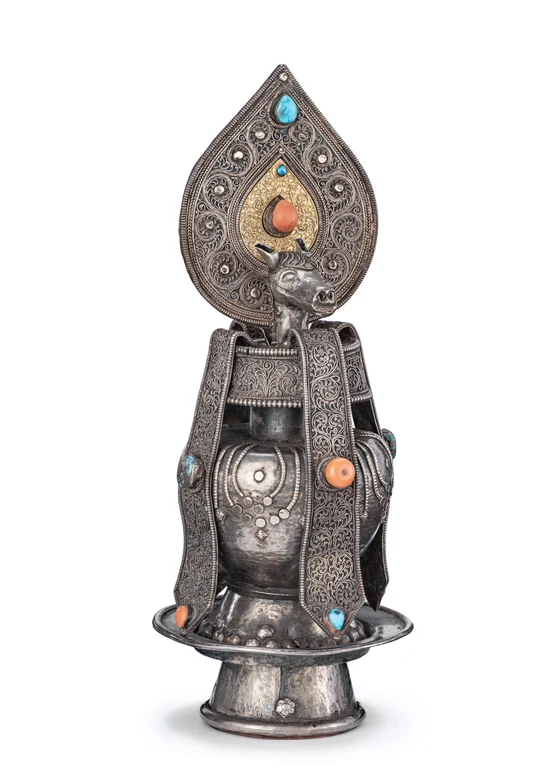
Himalayan Art Resources identifies a seventeenth-century Tibetan metal fragment, item65865 in a private collection, as a boy riding a sharabha or flying horse. In this throne-back tradition the horse can incorporate lion-like characteristics and stands above a lion or snow lion. The catalogue proposes, without certainty, that Rubin snow-lion fragment C2002.30.9 belonged beneath it.
The figure belongs to a vertical arrangement of elephants, lions, horse-and-rider groups, makaras, nagas and a crowning garuda. This object-specific Himalayan use of the name is recorded separately from other Indian Sharabha narratives; an eight-legged or many-headed anatomy is not inferred from the shared name.
Origins & earliest records
Tibetan and Himalayan Buddhist iconography
Records & interpretation
Located object descriptions or openly published textual witness directly read; no independent image inspection asserted.
Selected bibliography
Documented works and useful reading. This is not a list of every appearance.
- 01
Jeff Watt, Himalayan Art Resources65865, September2010
Exact source record; object and publication dates retained in description.
Family & connections
A source-supported family tree or inspiration record has not yet been compiled for this profile. Related reading below indicates a connection in subject matter, not a proven lineage or creative influence.
Primary records and illustrations
Jeff Watt, Himalayan Art Resources65865, September2010
Tibetan and Himalayan Buddhist iconography. HAR65865
Actual text/catalogue description read. Object descriptions do not claim direct visual or reuse-rights verification. Modern editorial interpretation separated from primary composition.
References
Sources supporting this profile. Linked pages have their own scope and editorial standards.
- Custodial/art-historical descriptionJeff Watt, Himalayan Art Resources65865, September2010Research access: 2026-10-05
Image credits
A sourced illustration has not yet been added. This gap is included in the coverage record.