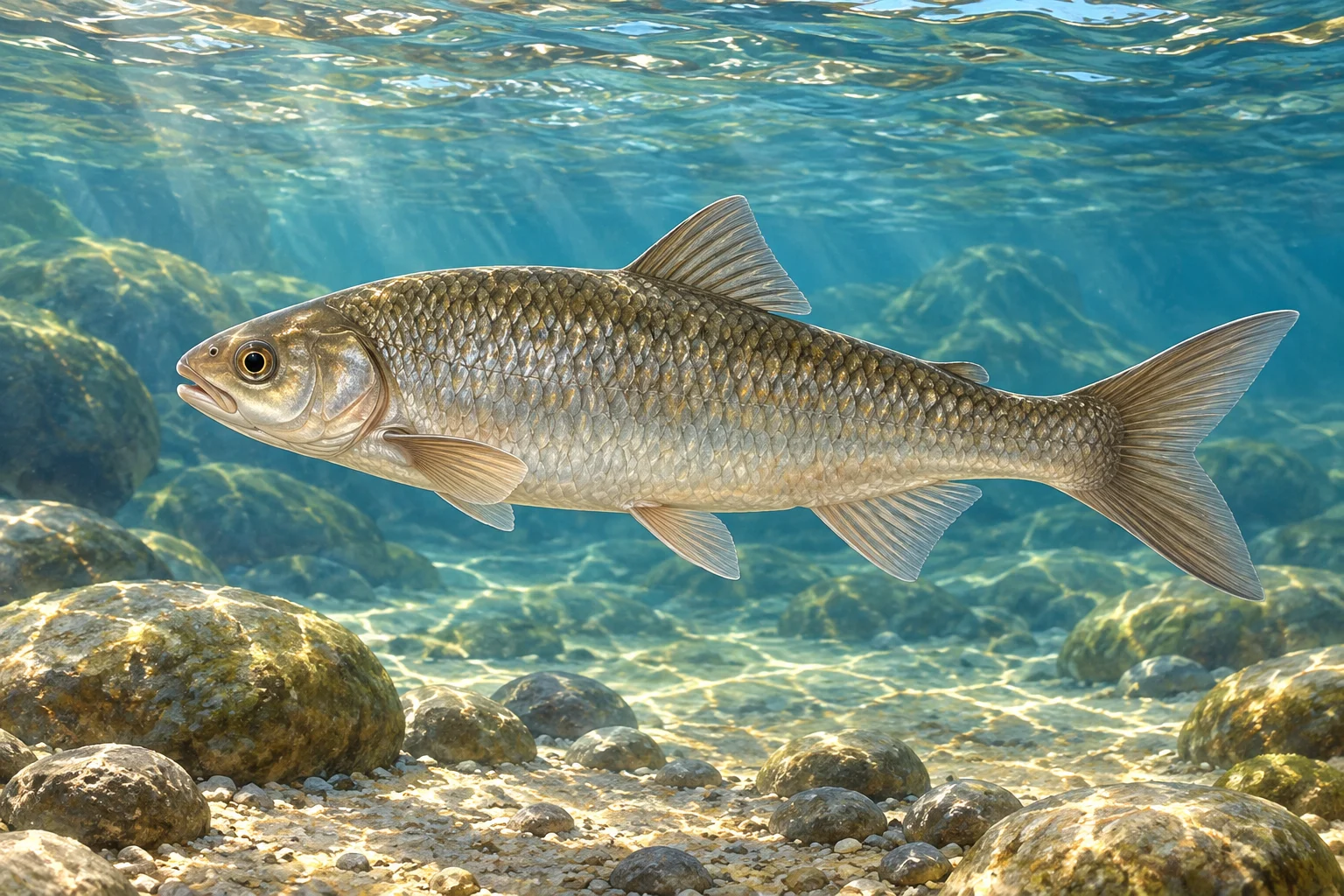
AI-generated reconstruction of Seni in the tale’s fish form.
Original interpretation of Seni’s narrated fish form. Species-like anatomy, colouring, proportions and water setting are imagined; the source does not identify a real fish species or a permanent human-fish hybrid.
Overview
Seni is introduced as the fish whom Maria plans to marry. While gathering wood with her sister Antonia, Maria slips away and calls him with a repeated song. The fish becomes a youth, gathers wood for her and combs her hair; they sit and talk before she returns home late. Antonia knows the secret and threatens to tell their mother, so Maria offers her a fine dress for silence. The fish and the young man are successive forms of the same named lover. Nothing in the telling specifies a fish species, body colour, human portrait or permanent half-human anatomy.
Antonia eventually tells their father while Maria is at church. Father and daughter go to the meeting place with an axe and a dish, and Antonia imitates the calling song. When the fish raises his head, the father kills him. The family cooks and eats the fish, reserving a portion for Maria. The first piece she puts in her mouth leaps out and falls to the ground, prompting her suspicion. She changes into her wood-gathering clothes and returns to call Seni despite her mother’s objections. This is an actual killing within the narrative, not merely an interrupted visit or a successful concealment from the family.
Her renewed calls first yield a drop of blood and then a bone. She weeps until the bones join and form a fish; after another calling song, the fish becomes a youth again. Seni tells her that her father and sister killed him and asks what she wants done to them. Maria asks for the best steamship afloat, loaded with fruit, so that the two relatives will come aboard as customers. She proposes putting them in irons and selling them into enslavement in another country, calling this a disgrace and preferring it to killing them. The printed tale ends with that proposal. It does not narrate the ship’s construction, the abduction or a completed sale, and the profile does not endorse the proposed punishment.
The notes identify Seni as a diminutive of Sena and Senon as an enlarged form, while reporting that the informant knew the name only from this tale. The alternating song names therefore belong to the consulted version rather than two independently described creatures. A further note records uncertainty and euphemistic alteration in translating one expression in the song; no additional anatomy is inferred from it. Seni’s named relationship, return from the cooked remains and unfinished revenge proposal distinguish this account from a generic fish-spouse category and from other separately collected fish-lover stories.
Origins & earliest records
The printed note to Tale 51 names Matheus Dias of San Anton as the informant. It also records his limited knowledge of the name, rather than giving an independent biography or a single fixed island origin for the story. Parsons’s complete preface describes work among Cape Verdean immigrants in New England in 1916–1917, assisted by Gregorio Teixeira da Silva. Stories were translated during recording; many were later written by Silva in Fogo dialect and translated from that written form. This mediated printed version is not assigned a unique point of origin or exclusive modern country.
Records & interpretation
Complete selected English tale, ending, informant note and full editorial preface preserved. No separate island-language version has been directly consulted; the OCR is retained without claiming a facsimile transcription.
Selected bibliography
Documented works and useful reading. This is not a list of every appearance.
- 01
Folk-Lore from the Cape Verde Islands, Part I
Selected complete English narrative and its printed notes. Part II and earlier comparative publications are not directly consulted.
Family & connections
A source-supported family tree or inspiration record has not yet been compiled for this profile. Related reading below indicates a connection in subject matter, not a proven lineage or creative influence.
References
Sources supporting this profile. Linked pages have their own scope and editorial standards.
- Primary historical collected English narrativeParsons 1923 — complete selected tale and prefaceResearch access: 2026-10-18
Image credits
AI-generatedAI-generated reconstruction of Seni in the tale’s fish form.
Original interpretation of Seni’s narrated fish form. Species-like anatomy, colouring, proportions and water setting are imagined; the source does not identify a real fish species or a permanent human-fish hybrid.