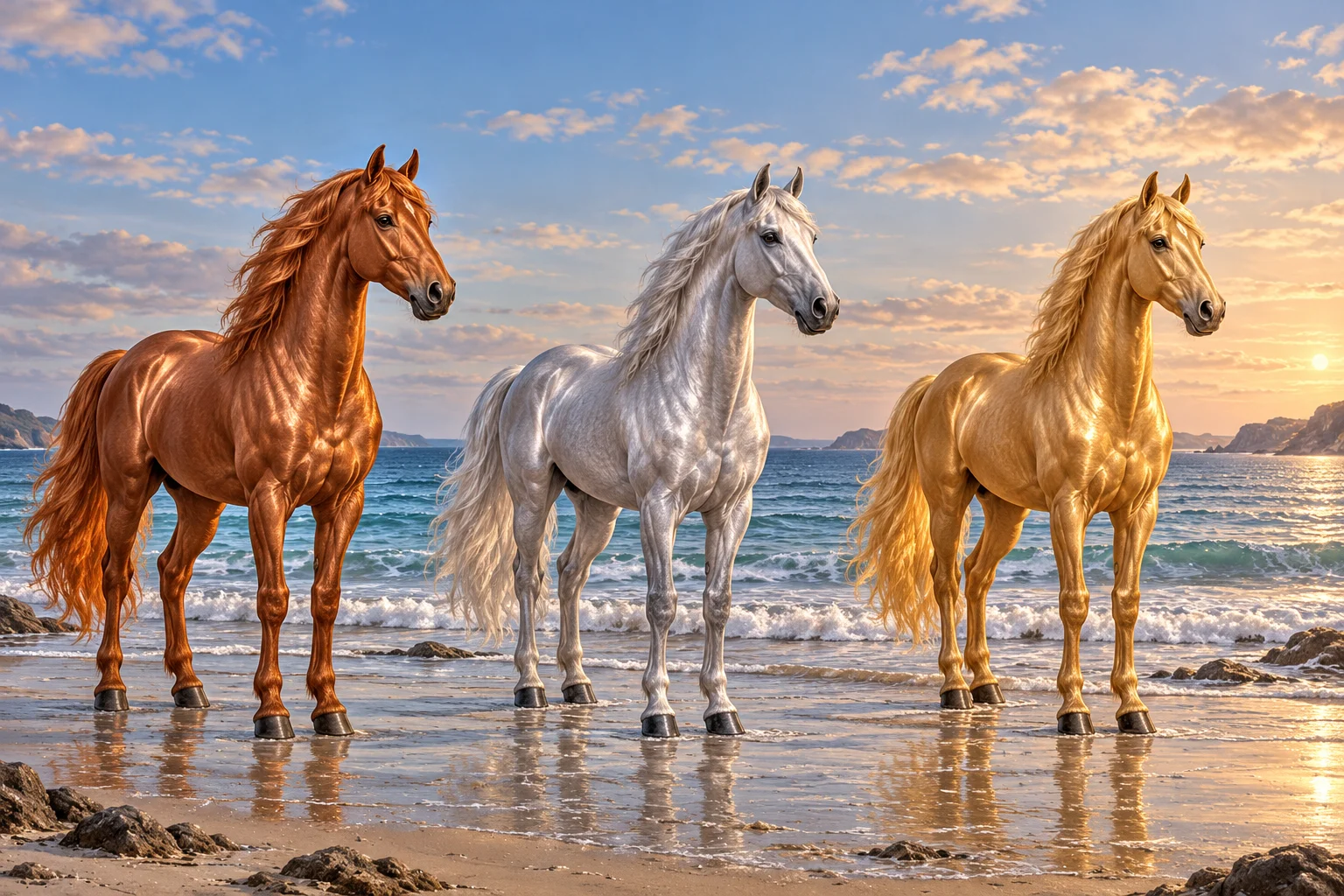
AI-generated reconstruction of the copper, silver and gold horses in Miguel Pina’s telling.
The three metal horses and sea passage are textual. Their exact anatomy, metallic finish and shore pose are imagined; the tale’s aerial journeys do not specify wings.
Overview
The three horses belong to the separately labelled variant of The Youth and his Horse told by Miguel Pina of Brava. A poor fisherman promises Shark the first thing he finds at home in return for plentiful fish. That first arrival is his newborn son, Jonsinh’. Shark eventually takes the child down to a place of enchantment, where rooms and their contents are successively copper, silver and gold. After breaking the objects, the boy encounters and beats a horse of the corresponding metal. Each horse speaks, asks him to stop and promises help in great trouble. These are three distinct equine helpers, presented together here because their repeated actions form one linked sequence.
When Jonsinh’ wants to leave, the horses carry him through the sea to shore. They say that they belong in the sea and cannot go farther, but tell him to call when he needs them and to conceal his name under Crenc Billesmeu. Later episodes nevertheless bring them to the royal household and church. The telling does not explain this shift with a rule about a geographical boundary. Each horse supplies clothes matching its own metal and carries the disguised youth to church. The copper horse rides into the air; the silver horse breaks a heavy chain and rises; the gold horse escapes into the air after its rider mounts. No wings or biological mechanism of flight are described.
The youngest princess recognises the visitor and insists on marrying him. Her angry father permits the wedding but orders the couple away. Jonsinh’ calls on all three horses to build a three-storey palace, with copper, silver and gold levels, and commands transformations of birds and servants into gold. The subsequent visit by two princes reveals a palace with metal servants and magnificent furnishings. The princes receive quail as a gift but tell the king that they caught the birds themselves. The helpers thus support both the youth’s escape from dependence and the display that will expose the princes’ pretensions.
Jonsinh’ and his wife return in a carriage drawn by a copper horse, a silver horse and a gold horse, with music sounding at every step. At the king’s house the gold horse writes the truth about the quail on the princes’ backs after they are put under its hoof. The text does not specify a writing implement or an inscription technique. The princes leap through windows and are destroyed; the king later admires the new palace so much that he never returns to his own. This is the variant’s ending. It is not the main telling’s war, water cure or execution of the king, and the trio is not turned into that main story’s horse, mule and strike-a-light.
Origins & earliest records
Parsons’s printed note identifies the informant of variant a as Miguel Pina of Brava. The preceding main Tale 55 is credited to Antonio Soares Rosa of Fogo, and a note explicitly identifies a splice from Donkey-Son in that main text. The two tellings remain distinct here. Parsons’s complete preface describes collecting among Cape Verdean immigrants in New England in 1916–1917, with assistance from Gregorio Teixeira da Silva and substantial translation mediation. Brava is an attributed island association of this teller’s version, not a claim of exclusive origin or a universal Cape Verdean belief.
Records & interpretation
The complete selected English tale, its ending, printed variants, informant note and complete editorial preface are preserved. The OCR is not presented as a verified facsimile transcription.
Selected bibliography
Documented works and useful reading. This is not a list of every appearance.
- 01
Folk-Lore from the Cape Verde Islands, Part I
Complete selected English narratives, variants, endings and printed notes. Part II and comparative publications are not independently consulted.
Family & connections
A source-supported family tree or inspiration record has not yet been compiled for this profile. Related reading below indicates a connection in subject matter, not a proven lineage or creative influence.
References
Sources supporting this profile. Linked pages have their own scope and editorial standards.
- Primary historical collected English narrativeParsons 1923 — complete selected tale and prefaceResearch access: 2026-10-18
Image credits
AI-generatedAI-generated reconstruction of the copper, silver and gold horses in Miguel Pina’s telling.
The three metal horses and sea passage are textual. Their exact anatomy, metallic finish and shore pose are imagined; the tale’s aerial journeys do not specify wings.