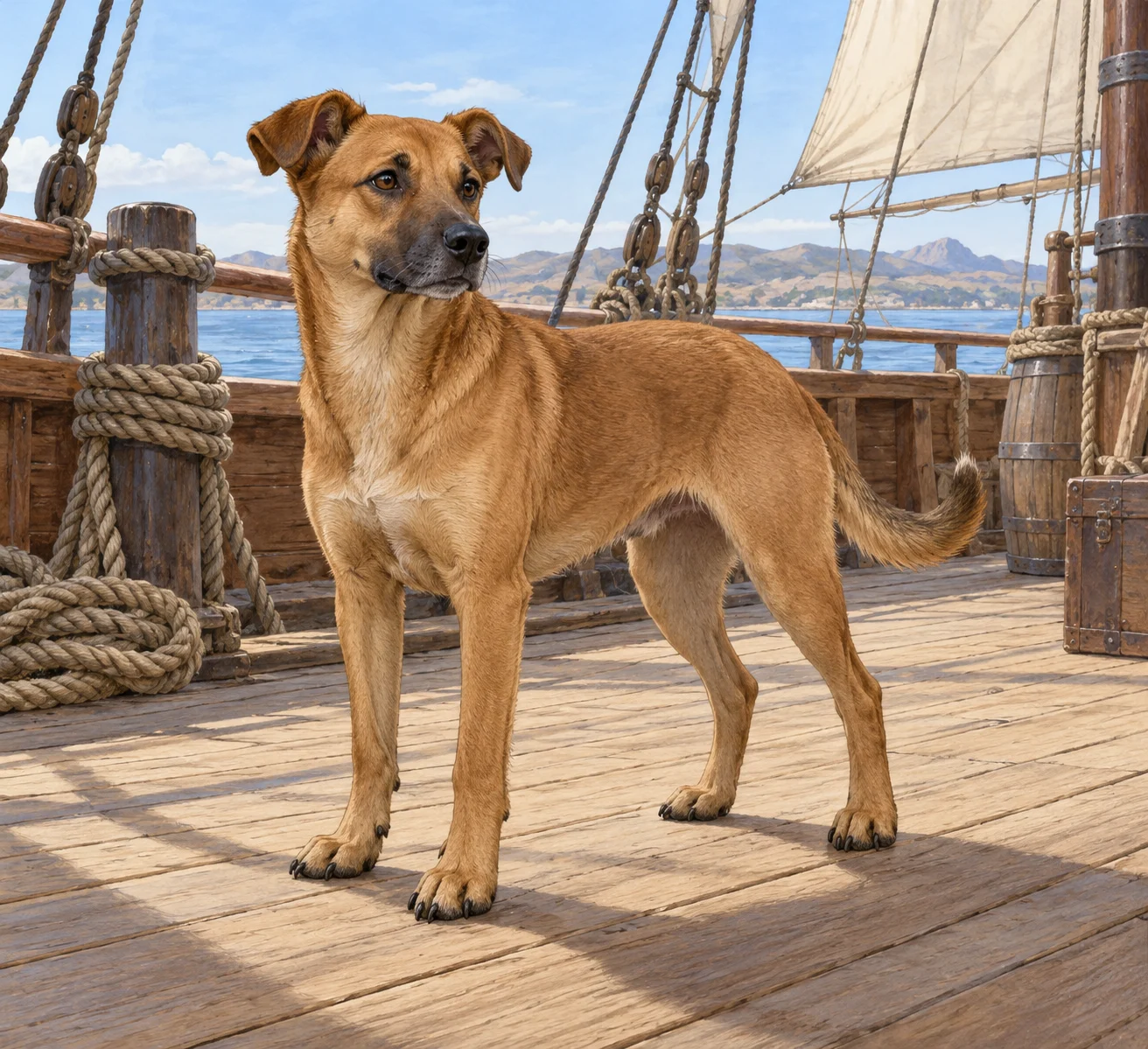
AI-generated textual reconstruction of Anton Coelho’s Dog Captain.
Original interpretation of the tale’s initial dog presentation. Breed-like proportions, coat, ears, tail, pose and ship details are imagined; the later rich-man presentation has no explained transformation mechanism.
Overview
The Dog Captain appears after Jonsinh’ leaves the household of his godfather. As an orphan, he has grown up expecting to marry that man’s daughter, but a quarrel reveals that he is not the man’s biological son. He goes to Praia Nega to find a ship. A launch arrives with nobody in it but a dog; when he boards the full-rigged vessel, he again sees no companion other than that animal. The ship nevertheless sails, and food is set out for him. This is an initially dog-associated, apparently unattended voyage, not proof that the later part of the tale has no human crew.
The boy sails for a year before reaching land. Although the dog has not talked to him during that time, it now warns that the country is strange and may frighten him. Ashore, the dog disappears, goes home and dresses as a rich man, then returns to offer the hungry stranger a home. The telling proceeds to call this figure a man. It does not explain whether this is bodily transformation, a disguise or some other enchantment. A faithful account can connect the two presentations without inventing a transformation scene or supplying a human-like canine body.
The wealthy patron offers the traveller three beautiful daughters in succession. Jonsinh’ refuses, saying that he is too poor. The patron then gives him command of a ship and tells him he must pass through three tempests before going home to keep his promise. A printed note identifies the promise as the earlier betrothal and interprets the offered daughters as a test. The narrative goes on to describe a destructive storm, repairs and another year’s sailing. On his return, the patron praises him as a reliable captain and loads his ship with gold and diamonds. The instruction about three tempests should not be expanded into three separately narrated storm episodes.
The ending follows the traveller rather than another appearance by the dog. Dressed as a poor sailor, he is rejected by his godfather, while the daughter reads his journal and recognises what he has endured. After they flee her father’s threat, the captain invites the family and leading townspeople aboard his richly appointed ship. His godfather tells their history without recognising his host; the daughter then appears, and the reunion exposes the earlier rejection. The dog’s assistance has made the return possible, but no final revelation identifies it as a god, a dead relative or an ordinary pet. Its breed, colour and detailed canine appearance remain unspecified.
Origins & earliest records
The printed note to Tale 128 identifies the informant as Anton Coelho of Cab’ Verde. The preface explains that Parsons uses Cab’ Verde as her informants’ island name, rather than silently treating it as the name of the entire archipelago. Parsons’s complete preface describes work among Cape Verdean immigrants in New England in 1916–1917, assisted by Gregorio Teixeira da Silva. Stories were translated during recording; many were later written by Silva in Fogo dialect and translated from that written form. This mediated printed version is not assigned a unique point of origin or exclusive modern country.
Records & interpretation
Complete selected English tale, ending, informant note and full editorial preface preserved. No separate island-language version has been directly consulted; the OCR is retained without claiming a facsimile transcription.
Selected bibliography
Documented works and useful reading. This is not a list of every appearance.
- 01
Folk-Lore from the Cape Verde Islands, Part I
Selected complete English narrative and its printed notes. Part II and earlier comparative publications are not directly consulted.
Family & connections
A source-supported family tree or inspiration record has not yet been compiled for this profile. Related reading below indicates a connection in subject matter, not a proven lineage or creative influence.
References
Sources supporting this profile. Linked pages have their own scope and editorial standards.
- Primary historical collected English narrativeParsons 1923 — complete selected tale and prefaceResearch access: 2026-10-18
Image credits
AI-generatedAI-generated textual reconstruction of Anton Coelho’s Dog Captain.
Original interpretation of the tale’s initial dog presentation. Breed-like proportions, coat, ears, tail, pose and ship details are imagined; the later rich-man presentation has no explained transformation mechanism.