A sourced illustration has not yet been added. This gap is included in the coverage record.
Overview
Sahasra Dal, whose name Day renders as Thousand-Branched, is born to a Rakshasi and a Brahman. His younger paternal half-brother Champa Dal fears that he too will be eaten after their parents’ deaths. Sahasra instead kills his own mother and escapes with him on their extraordinarily swift pakshiraj horses.
At a town paying a nightly human victim to another Rakshasi, Sahasra volunteers in place of his host. The predator withdraws whenever his name is spoken first because she recognizes his Rakshasa ancestry. When his frightened brother reverses the order, she breaks in; Sahasra wakes and beheads her. The king rewards him with his daughter and half the kingdom.
His loyalty is subsequently compromised: he yields to a false accusation and sends Champa away, then desires the owner of a seven-cubit hair without realizing she is Champa’s wife Keshavati. When Champa publicly recounts their story, Sahasra recognizes him, punishes the deceptive Rakshasi servant and restores their companionship. The text does not give Sahasra his mother’s gigantic form.
Origins & earliest records
Bengali oral storytelling translated by Lal Behari Day
Records & interpretation
Complete relevant tale, attached notes,1883 preface and1912 edition credits directly read.
Selected bibliography
Documented works and useful reading. This is not a list of every appearance.
- 01
Folk-Tales of Bengal
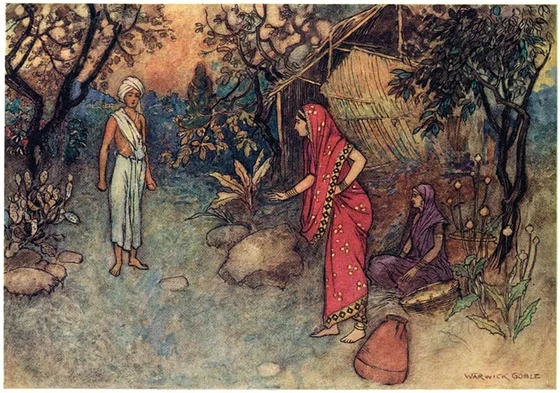
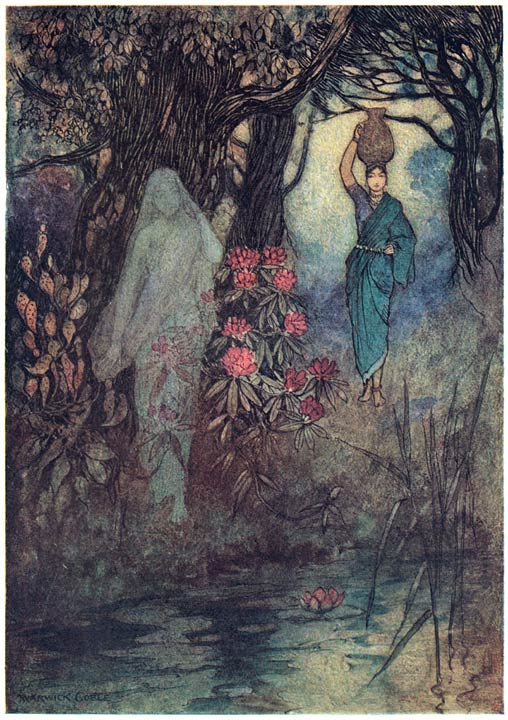
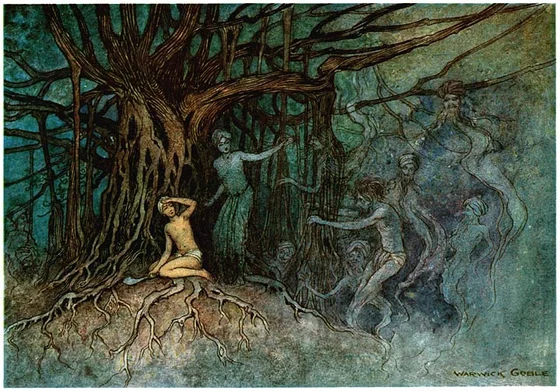
IV, The Story of the Rakshasas, pp.66–88; complete tale61–88 and notes; first edition1883, illustrationsWarwickGoble
Family, evolution & connections
Sahasra Dal and Champa Dal — Day IV
The Story of the Rakshasas, pp. 66–69.
Scroll sideways to see all branches. With a keyboard, focus the tree and use the arrow keys.
- Unnamed Brahman father
- Champa Dal — mother: unnamed human wife
Explicit shared father and separately identified mothers in the narrator’s account. The unnamed Brahman is the shared father. The Rakshasi’s initial claim to a forgotten childhood wedding is deception; subsequent birth and half-brother statements are explicit. Her affectionate address to the human wife does not establish biological sisterhood. Keshavati marries Champa Dal, not Sahasra Dal.
The unnamed Brahman father in Day IV
The narrator states that the Brahman’s two wives bear him Sahasra Dal and Champa Dal. The earlier purported forgotten childhood marriage is the Rakshasi’s deception; the later parentage is independently stated by the narrator.
Champa Dal in Day IV
The boys have the same Brahman father and different mothers. The text expressly calls Sahasra Dal Champa Dal’s half-brother when they escape. Champa Dal later marries Keshavati.
Primary records and illustrations
Lal Behari Day, Folk-Tales of Bengal (Macmillan,1912; first edition1883)
IV. IV, The Story of the Rakshasas, pp.66–88; complete tale61–88 and notes
Complete tale and footnotes read, pluspreface andeditionhistory. Bengali oral informants described collectively, individual teller of this tale not identified. Original paraphrase; no source-image verification claimed.
References
Sources supporting this profile. Linked pages have their own scope and editorial standards.
- Historical translated oral narrative and collector notesLal Behari Day, Folk-Tales of Bengal (1912), IV, The Story of the Rakshasas, pp.66–88; complete tale61–88 and notesResearch access: 2026-10-05
Image credits
A sourced illustration has not yet been added. This gap is included in the coverage record.