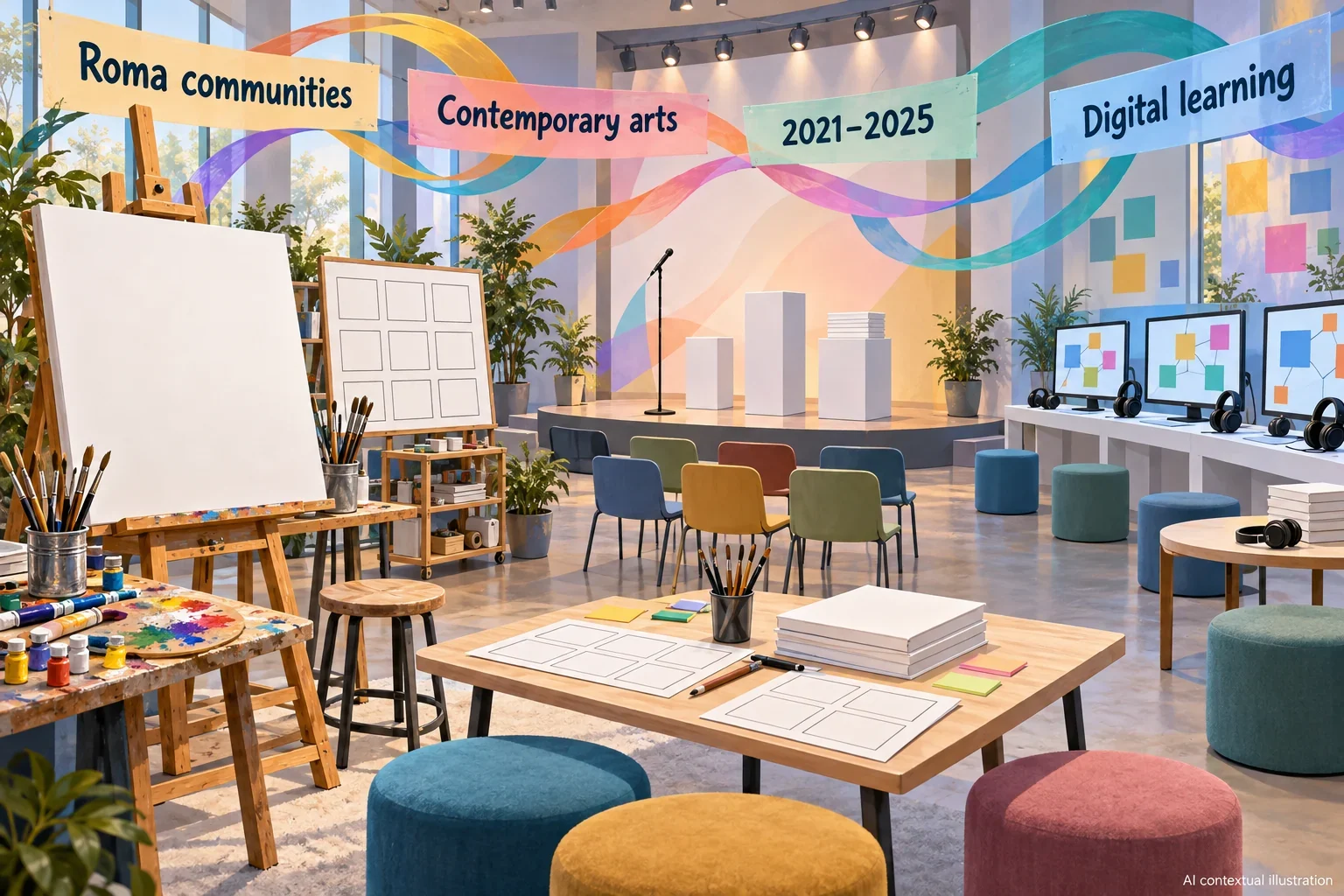
AI concept of Roma contemporary arts and digital learning in the 2021–2025 strategy.
Setting, tools and layout imagined; not ethnographic evidence.
Overview
The European Roma Institute for Arts and Culture describes work across Romani identities and national borders. Established in Berlin in 2017, it supports contemporary arts, cultural exchange and public education to challenge prejudice. This is one institutional perspective on diverse Roma communities, not a uniform tradition or a definition of all Roma lives.
ERIAC’s published 2021–2025 strategy links physical arts spaces with digital tools for exhibitions, language and history learning. It also proposes partnerships with educational institutions and grassroots organisations. These are dated strategic aims, not evidence that every proposed activity occurred or that any artwork defines Roma identity.
History & identity
Selected ERIAC accounts, founded in Berlin in 2017.
Sources & representation
Selected public institutional passages retained.
Selected bibliography
Documented works and useful reading. This is not a list of every appearance.
- 01
- 02
Language & cultural connections
Source-supported language and cultural connections have not yet been compiled for this profile.
References
Sources supporting this profile. Linked pages have their own scope and editorial standards.
- Community institutional accountERIAC: An ExplainerResearch access: 2026-10-11
- Community institutional accountAnnual Report 2022: Strategy 2021–2025Research access: 2026-10-11
Image credits
AI contextual interpretationAI concept of Roma contemporary arts and digital learning in the 2021–2025 strategy.
Setting, tools and layout imagined; not ethnographic evidence.