Rokurokubi
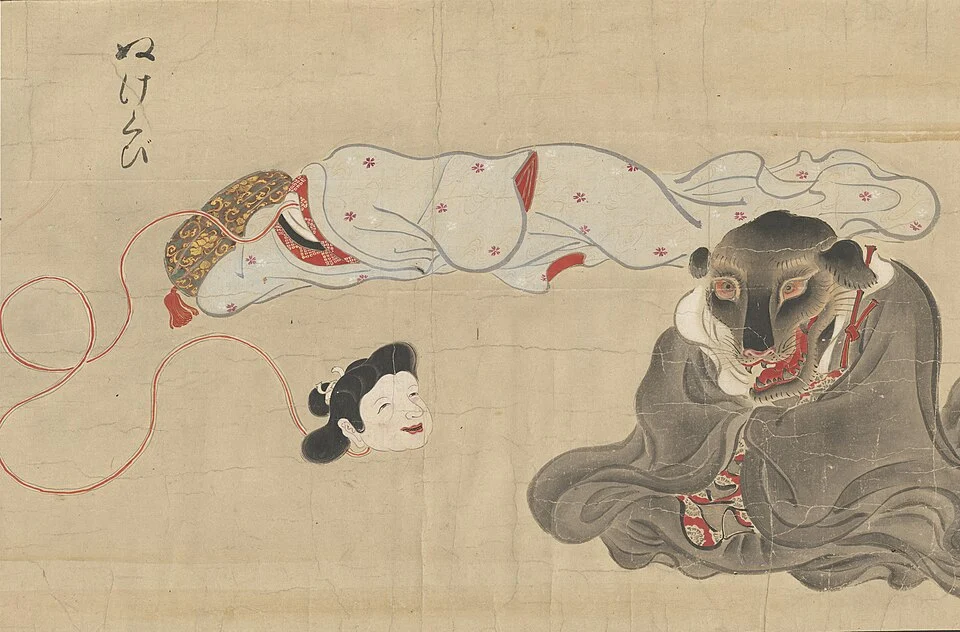
Image associated with the exact linked encyclopedia article; consult credited file description for its interpretation.
Overview
Hearn’s Rokuro-Kubi concerns five apparently human hosts whose heads leave their sleeping bodies at night. Its mechanism differs from the elongated neck familiar in many illustrations. The travelling priest Kwairyō, formerly the samurai Isogai Héïdazaëmon Takétsura, accepts a woodcutter’s offer of shelter in the mountains of Kai. Four other people receive him politely. The householder describes a ruined former life and apparent repentance, prompting the visitor to recite Buddhist texts for him. This welcome disguises the household’s intention to eat its guest.
Going to seek water, Kwairyō discovers five headless bodies without blood or signs of cutting. Recalling a rule attributed within the story to the book Sōshinki, he moves the householder’s body outside through a window. He then finds all five heads talking and eating worms and insects in a grove. The householder says they cannot approach the priest while he recites, and sends a young woman’s head to check whether he has fallen asleep. She returns with news that the guest and the householder’s body are missing.
The householder’s head declares that it can no longer rejoin its displaced body and must die. All five heads attack. Kwairyō fights them with an uprooted young tree; four retreat, but the leader clamps its teeth onto the priest’s left sleeve and dies still gripping it. Back inside, the other four have regained their bodies, though they remain bruised and bleeding. They flee into the woods. The tale therefore kills one attacker, not the entire household, and bodily separation by itself is not fatal: displacement prevents this particular head’s return.
The priest’s journey continues with the dead head attached to his robe. Officials at Suwa arrest him as a suspected murderer. An elderly magistrate examines the uncut neck and red characters on its nape, invoking another book named within the narrative, Nan-hō-ï-butsu-shi. These features persuade the court, and Kwairyō’s former military identity wins further recognition. The legal examination is part of the fiction’s proof, not a surviving forensic record. Neither book’s underlying text has been independently collated for this entry.
The conclusion follows the head beyond the confrontation. A robber exchanges a robe and five ryō for it, intending to frighten travellers. After learning its history near Suwa, he takes it back to the mountain cottage. He cannot find the body, so buries the head alone, commissions a tombstone and has a Ségaki service performed. The final claim that the monument can still be seen is explicitly assigned to the Japanese storyteller. The head is not revived, and the robber’s later use of it does not make him another Rokuro-Kubi.
Modern discussions often call a detached-head being nukekubi, while reserving rokurokubi for neck stretching. Hearn’s actual chapter title is retained here rather than silently corrected to a later category. His general preface names several older collections used for Kwaidan but does not assign this particular story to one of them. An exact earlier Japanese witness remains a separate research task.
Origins & earliest records
The selected witness is Hearn’s Rokuro-Kubi in Kwaidan (1904). His general preface describes adaptation from older Japanese books without assigning this tale an exact source. Story-internal references to Sōshinki and Nan-hō-ï-butsu-shi are retained as narrated references, not independently verified transmission claims.
Records & interpretation
Complete chapter read from the priest’s former career through the robber’s burial of the head, alongside Hearn’s general prefatory source statement. Five detached heads, one displaced body, four surviving attackers and the later trial/burial are distinct stages of the text.
In the literature
“the head will never be able to join itself again to the neck.”
ROKURO-KUBI; paragraph beginning “For one instant he stood bewildered,—imagining a crime. But…” · Lafcadio Hearn (English retellings)
Kwairyō recalls a claimed rule in Sōshinki; Hearn’s story names its beings Rokuro-Kubi although their heads detach.
“the heads,—all five of them,—flitting about, and chatting as they flitted.”
ROKURO-KUBI; paragraph beginning “He seized the body of the aruji by the…” · Lafcadio Hearn (English retellings)
The priest finds the separated heads in a grove; this is Hearn’s flying-head variant.
“we cannot touch him so long as he is praying.”
ROKURO-KUBI; paragraph beginning ““Ah, that traveling priest who came to-night!—how fat all…” · Lafcadio Hearn (English retellings)
The heads discuss the protective effect of the priest’s recitation within the tale.
“Another head—the head of a young woman—immediately rose up and flitted to the house, lightly as a bat.”
ROKURO-KUBI; paragraph beginning “Another head—the head of a young woman—immediately rose up…” · Lafcadio Hearn (English retellings)
One head returns to investigate the missing priest.
Selected bibliography
Documented works and useful reading. This is not a list of every appearance.
- 01
Kwaidan: Stories and Studies of Strange Things — Rokuro-Kubi
Complete chapter read, including Suwa trial, sale to the robber and separate burial. Exact earlier Japanese source not independently established.
- 02
Kwaidan: Stories and Studies of Strange Things
Public English e-text; author’s preface dated Tokyo, 20 January 1904.
Family & connections
A source-supported family tree or inspiration record has not yet been compiled for this profile. Related reading below indicates a connection in subject matter, not a proven lineage or creative influence.
Located primary passages
Specific passages supporting details in this entry, grouped by their published witness.
Kwaidan: Stories and Studies of Strange Things
Public English e-text; author’s preface dated Tokyo, 20 January 1904.
- Kwairyō recalls a claimed rule in Sōshinki; Hearn’s story names its beings Rokuro-Kubi although their heads detach.
ROKURO-KUBI; paragraph beginning “For one instant he stood bewildered,—imagining a crime. But…”
- The priest finds the separated heads in a grove; this is Hearn’s flying-head variant.
ROKURO-KUBI; paragraph beginning “He seized the body of the aruji by the…”
- The heads discuss the protective effect of the priest’s recitation within the tale.
ROKURO-KUBI; paragraph beginning ““Ah, that traveling priest who came to-night!—how fat all…”
- One head returns to investigate the missing priest.
ROKURO-KUBI; paragraph beginning “Another head—the head of a young woman—immediately rose up…”
Attests this published account; does not establish zoological existence, consensus belief or earliest origin.
Kwaidan: Stories and Studies of Strange Things — Rokuro-Kubi
Hearn’s English text; Kwaidan first published 1904, author’s prefatory statement dated Tokyo, 20 January 1904. The exact print impression used by Gutenberg is unidentified; author notes distinguished from digitizer notes.
- Hearn’s named Rokuro-Kubi have detached flying heads; bodily displacement defeats their host, while the four other heads reunite with their bodies.
ROKURO-KUBI, complete narrative and four author notes; author’s prefatory statement
This verifies Hearn’s complete published narrative, not every Japanese version or an independently inspected original of the books named in his preface. No recitation or ritual formula reproduced. Sōshinki and Nan-hō-ï-butsu-shi are reported within Hearn’s story; their original texts have not been independently checked here.
Encyclopedia background
An additional attributed reference, separate from the editorial profile above.
Read the open encyclopedia overview
Rokurokubi (ろくろ首, 轆轤首) is a type of Japanese yōkai (apparition). They look almost completely like humans with some differences. There is a type whose neck stretches and another whose head detaches and flies around freely (nukekubi). The Rokurokubi appear in classical kaidan (spirit tales) and in yōkai works.
Text from Wikipedia contributors, “Rokurokubi”. CC BY-SA 4.0. Extracted introduction; formatting changed. Retrieved 5 October 2026. The source article may have changed since retrieval.
References
Sources supporting this profile. Linked pages have their own scope and editorial standards.
- Historical English literary retellingHearn, Kwaidan, Rokuro-Kubi — complete narrativeResearch access: 2026-10-05
- Author’s source statementHearn’s general Kwaidan source prefaceResearch access: 2026-10-05
Image credits
Reference illustrationRokurokubi
Image associated with the exact linked encyclopedia article; consult credited file description for its interpretation.