A sourced illustration has not yet been added. This gap is included in the coverage record.
Overview
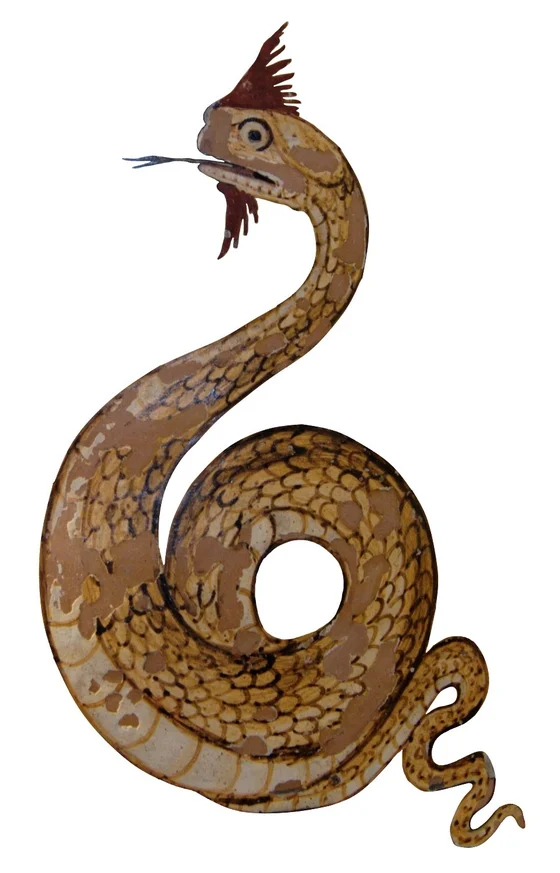
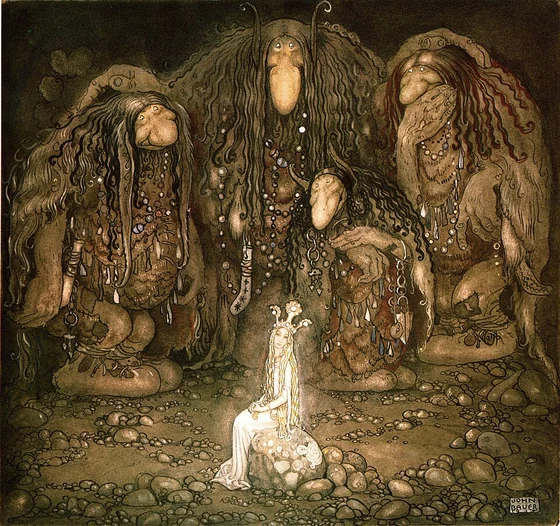
The prophetic island woman names the two creatures while explaining the route to the captive mother and sister. They defend a drawbridge over a canal described as seven times seven paces wide. By day they stand guard; at night the bridge is raised and they sleep. Their bodies are covered with weapon-resistant scales, but each has a vulnerable area below the neck through which a death wound can be dealt.
The hero arrives at night and leaps from his spear toward the sleeping guardians. He strikes beneath their necks, takes their heads and hangs them on a bridge post before entering the palace. The passage supplies the names, defensive covering, routine and defeat, but no wings, number of legs or explicit serpent classification. The pair is therefore kept as one named guardian encounter rather than turned into two anatomically elaborated species. Their service belongs to the Red Shield kingdom in this story and does not make them variants of every bridge troll or dragon.
Origins & earliest records
Jacobs places them within his selected 1895 combination of MacInnes’s Argyleshire tale and Campbell of Tiree’s version. His manuscript comments concern the wider Kayn story. They do not establish a separate early manuscript attestation for these exact English names.
Records & interpretation
The names and vulnerable scaled bodies are explicitly attested in the narrative. Their defeat is a story event, not zoological evidence. Unspecified anatomy remains unspecified, and the resemblance to other guarded-crossing motifs is comparative rather than an asserted identity.
In the literature
“Their names are Roar and Rustle”
The Leeching of Kayn’s Leg; p182; old woman’s warning
The old woman locates the two creatures at the Red Shield kingdom’s drawbridge. Their scales resist ordinary weapons except two spots below the neck. At night the bridge rises and the guards sleep; the account identifies them by name without a biological species description.
Selected bibliography
Documented works and useful reading. This is not a list of every appearance.
- 01
More Celtic Fairy Tales: The Leeching of Kayn’s Leg, pp. 182–183; note XLII
Selected episode and relevant source note inspected. Earlier works named by Jacobs are attributed references, not falsely claimed as independently collated texts.
- 02
More Celtic Fairy Tales
Joseph Jacobs, More Celtic Fairy Tales, selected1895 Nutt/Putnam edition, PG34453. Complete The Leeching of Kayn’s Leg, pp169–194, and noteXLII independently read.
Family & connections
A source-supported family tree or inspiration record has not yet been compiled for this profile. Related reading below indicates a connection in subject matter, not a proven lineage or creative influence.
Located primary passages
Specific passages supporting details in this entry, grouped by their published witness.
More Celtic Fairy Tales
Joseph Jacobs, More Celtic Fairy Tales, selected1895 Nutt/Putnam edition, PG34453. Complete The Leeching of Kayn’s Leg, pp169–194, and noteXLII independently read.
- The old woman locates the two creatures at the Red Shield kingdom’s drawbridge. Their scales resist ordinary weapons except two spots below the neck. At night the bridge rises and the guards sleep; the account identifies them by name without a biological species description.
The Leeching of Kayn’s Leg, pp169–194; Two guarded weaknesses and raised bridge
- The healer finds the bridge raised and creatures asleep, springs across and strikes their vulnerable neck areas with the short spear. He hangs the heads on a bridge post, penetrates the palace wall and regains contact with his mother and sister. No resurrection or subsequent guard replacement is given.
The Leeching of Kayn’s Leg, pp169–194; Night raid and displayed severed heads
Inconsistent names and omitted mechanisms retained. No prayer, recurring healing formula or ritual instructions excerpted.
Primary source witness
Joseph Jacobs, More Celtic Fairy Tales, selected1895 Nutt/Putnam edition, PG34453. Complete The Leeching of Kayn’s Leg, pp169–194, and noteXLII independently read.
- Jacobs explicitly combines MacInnes’s Folk-Tales from ArgyleshireVII with Campbell of Tiree’s version. His manuscript dating, larger episode counts and comparisons are reported compiler scholarship; this selected adaptation is not represented as a direct transcript of one informant.
No cited manuscript or independent earlier print collation claimed.
References
Sources supporting this profile. Linked pages have their own scope and editorial standards.
- Primary textMore Celtic Fairy Tales, selected 1895 edition: The Leeching of Kayn’s Leg, pp. 182–183; note XLIIResearch access: 2026-10-05
Image credits
A sourced illustration has not yet been added. This gap is included in the coverage record.