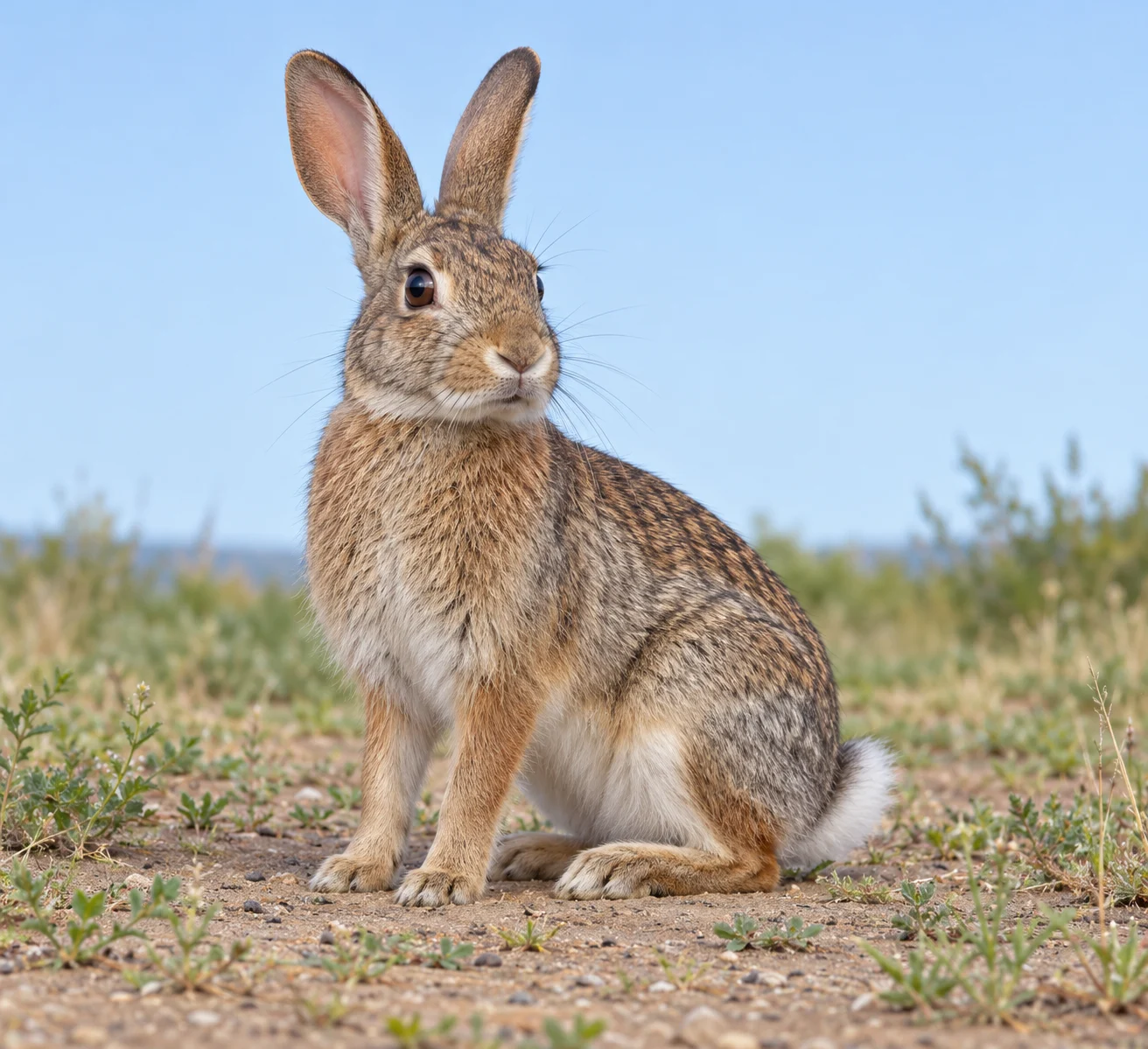
AI-generated tale-rabbit interpretation.
Species, coat, posture and setting imagined; the translator’s Rabbit label is not a zoological identification.
Overview
Rabbit prepares a covered game-pit, places his axe up a tree and cries for help. Each arriving animal hears that another creature has put the tool out of reach. Bushbuck and Buffalo fall into the concealed pit while trying to retrieve it. Rabbit attacks them with the axe, explicitly killing Buffalo. The scheme fails against Lion because Rabbit falls in too. Threatened with death, he offers to nurse Lion’s two cubs and is spared for that service. His apparent helplessness is therefore a device for catching rescuers, not the account’s final judgment of his abilities.
Lion hunts and tells the new nurse to give the cubs the meat and keep the bones for himself because their teeth are weak. Rabbit reverses the allocation, claiming that bones will strengthen them. Taking the cubs to play at a stream, he talks the first into sparing him during wrestling by asking who else could guide it home. He then kills it when their positions are reversed. Later he shows Lion the surviving cub twice, presenting it as two children. The second cub is eventually deceived and killed in the same way.
To explain both deaths, Rabbit scratches himself by plunging through a thorn tree and reports that attackers have killed the cubs and nearly killed him. He visits the baboons while they are throwing tops at maize cobs. He teaches them to answer his question about who ate Lion’s cub with an admission, presenting it as the proper response for the game. Their rehearsed words are not an independent confession of having committed the killings.
Rabbit returns with Lion concealed in a bundle decorated with fruit. He starts the game again and prompts the taught answer. Hearing it, Lion breaks out and seizes the baboons. The tale closes at this seizure; it does not narrate what happens to every captive or describe Rabbit’s later career. Kalulu is the Chinyanja animal label here, rendered Rabbit by Rattray. This profile is confined to tale XIX and does not merge all Kalulu stories or assign a modern zoological species.
Origins & earliest records
Rattray’s Chinyanja collection from Central Angoniland; no individual narrator or separate collection site is assigned to this tale.
Records & interpretation
Complete Chinyanja tale XIX, complete English translation on pp. 136–139, its complete chapter notes and both prefaces.
Selected bibliography
Documented works and useful reading. This is not a list of every appearance.
- 01
Some Folk-Lore Stories and Songs in Chinyanja
XIX, Kalulu ndi Mkango / The Rabbit and the Lion, pp. 136–139; notes to XIX
Family & connections
A source-supported family tree or inspiration record has not yet been compiled for this profile. Related reading below indicates a connection in subject matter, not a proven lineage or creative influence.
References
Sources supporting this profile. Linked pages have their own scope and editorial standards.
- Original historical bilingual narrative and English translationRattray 1907 — XIX, Kalulu ndi Mkango / The Rabbit and the Lion, pp. 136–139; notes to XIXResearch access: 2026-10-18
- Original collector and prefatory contextHetherwick and Rattray — complete prefacesResearch access: 2026-10-18
Image credits
AI-generatedAI-generated tale-rabbit interpretation.
Species, coat, posture and setting imagined; the translator’s Rabbit label is not a zoological identification.