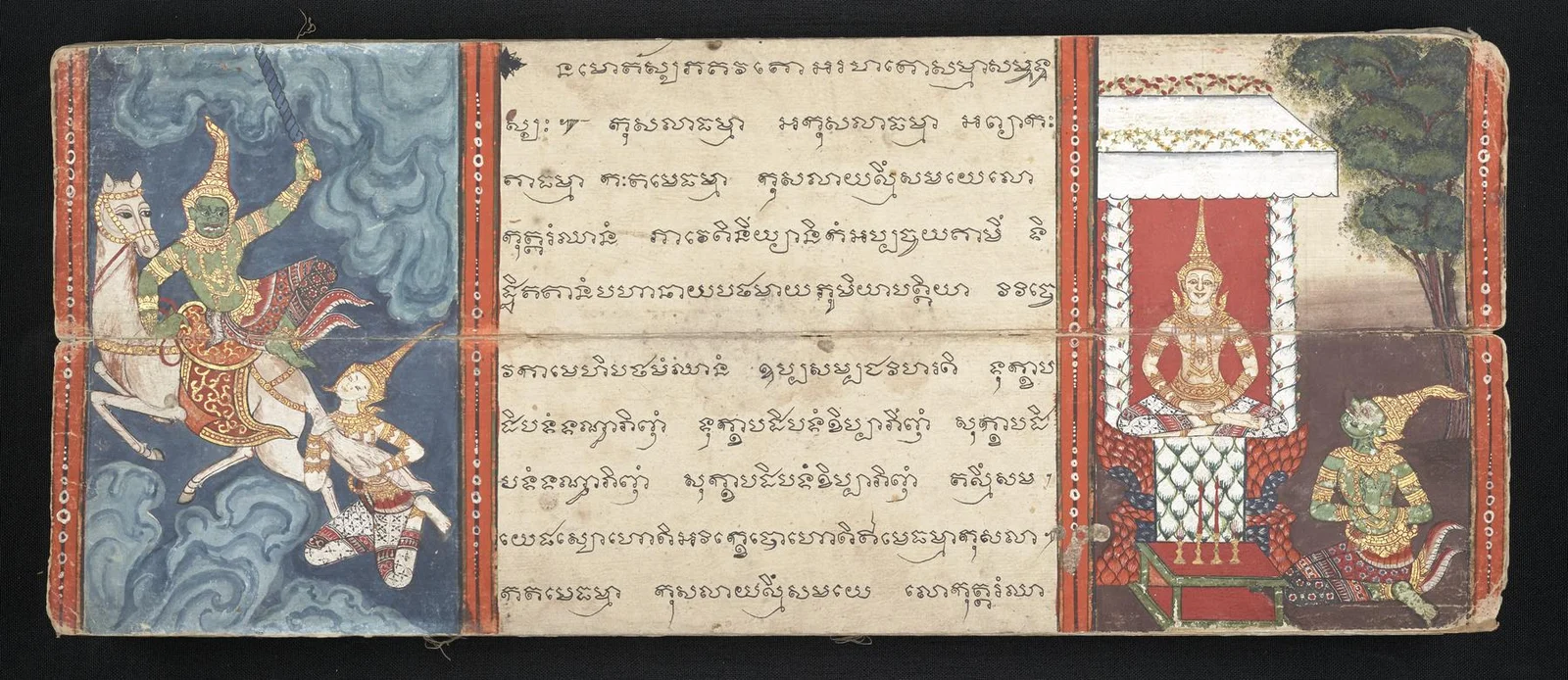
Punnaka on horseback with Vidhura holding the tail, Phra Malai,B41
Actual green yaksha rides white horse left as Vidhura clings to its tail; right scene shows Punnaka listening to Vidhura. Both roles identified in institutional B41 decorations. Source-specific Thai representation, not universal yaksha anatomy.
Overview
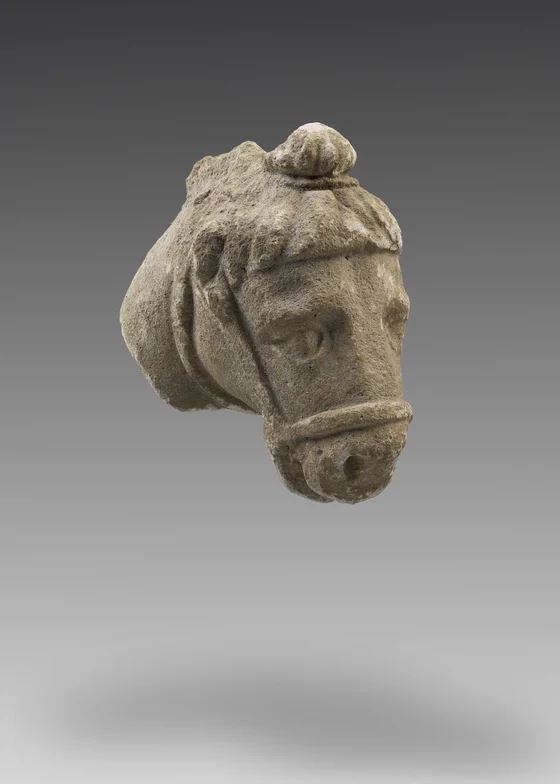
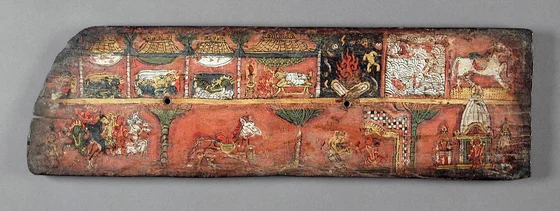
Puṇṇaka serves Vessavana and desires the nāga maiden Irandatī in Jātaka 545. To obtain her he undertakes to bring Vidhura’s heart to the nāga court. He rides through the air on a extraordinary horse, takes a precious gem from Mount Vepulla and challenges King Dhanañjaya at dice. His displays include racing along a city wall until horse and rider become indistinguishable and galloping over water without wetting the hoofs.
Having won Vidhura, he tries to kill him by violent journeys and terrifying assumed forms, including a lion. The sage survives and teaches him the conduct of a good person. Puṇṇaka instead brings him alive to the nāga court, where the supposed desire for a heart proves connected with hearing his wisdom. The successful teaching leads to Irandatī’s marriage to Puṇṇaka, who returns Vidhura safely with gifts.
The planned killing arises from a misunderstanding of what Vimalā, the nāga queen, wants. Vidhura infers that she longs to hear his discourse and asks for a chance to explain the duties of a good person before being killed. Puṇṇaka raises him from the precipice, provides water, heavenly clothing and food, and listens on the summit of the Black Mountain. The lesson turns especially on recognising the obligations created by hospitality and friendship.
Puṇṇaka then sees his own conduct in the teaching: he has spent three days in Vidhura’s house, received food and honour, and is repaying that welcome with violence for a desired marriage. He offers to abandon the mission and return the sage home. Vidhura instead asks to visit the nāga court, where the misunderstanding can be settled through discourse. The final return includes the magical horse, the bride and a precious jewel, so the coveted supernatural treasures remain part of the conclusion while his purpose has changed.
Origins & earliest records
South Asian Buddhist Jātaka narrative tradition
Records & interpretation
Historical primary-text translation directly read with printed page locators.
Selected bibliography
Documented works and useful reading. This is not a list of every appearance.
- 01
The Jātaka, Volume VI
Jātaka 545, pp. 126–155; hosted-volume publication date not independently verified. Narrative prose and verse distinguished from a first-attestation claim.
Family & connections
A source-supported family tree or inspiration record has not yet been compiled for this profile. Related reading below indicates a connection in subject matter, not a proven lineage or creative influence.
Primary records and illustrations
The Jātaka, Volume VI
Volume VI. Jātaka 545, pp. 126–155
Actual translated narrative directly read. Story number and printed English pagination retained; no object or image inferred.
The planned killing arises from a misunderstanding of what Vimalā, the nāga queen, wants. Vidhura infers that she longs to hear his discourse and asks for a chance to explain the duties of a good person before being killed. Puṇṇaka raises him from the precipice, provides water, heavenly clothing and food, and listens on the summit of the Black Mountain. The lesson turns especially on recognising the obligations created by hospitality and friendship.,Puṇṇaka then sees his own conduct in the teaching: he has spent three days in Vidhura’s house, received food and honour, and is repaying that welcome with violence for a desired marriage. He offers to abandon the mission and return the sage home. Vidhura instead asks to visit the nāga court, where the misunderstanding can be settled through discourse. The final return includes the magical horse, the bride and a precious jewel, so the coveted supernatural treasures remain part of the conclusion while his purpose has changed.
References
Sources supporting this profile. Linked pages have their own scope and editorial standards.
- Historical primary-text translationThe Jātaka, Volume VI — Jātaka 545, pp. 126–155Research access: 2026-10-05
Image credits
Historical manuscript illustrationPunnaka on horseback with Vidhura holding the tail, Phra Malai,B41
Actual green yaksha rides white horse left as Vidhura clings to its tail; right scene shows Punnaka listening to Vidhura. Both roles identified in institutional B41 decorations. Source-specific Thai representation, not universal yaksha anatomy.