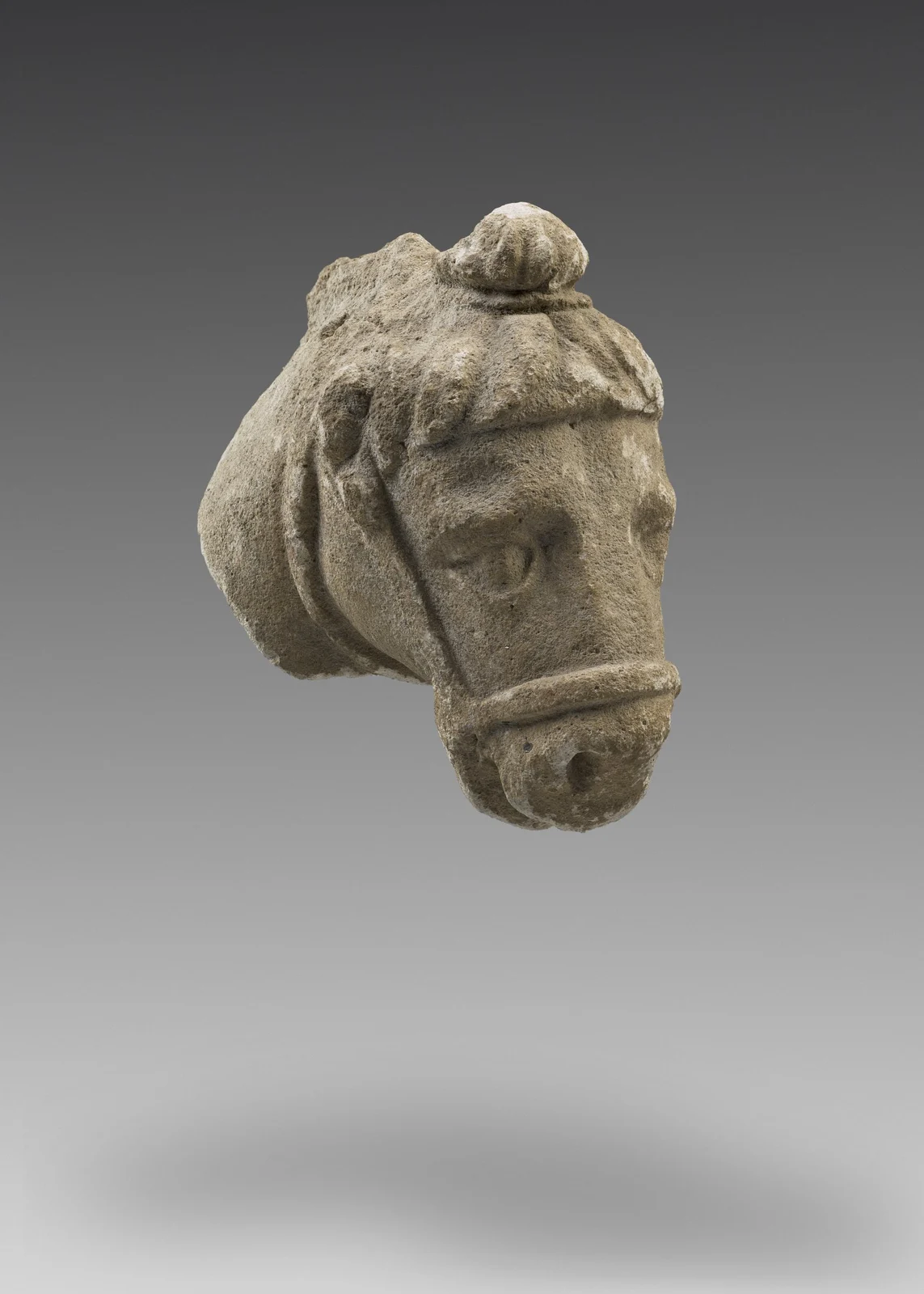
Valahassa Jataka horse-head fragment, Gandhara,100–300CE
Actual limestone horse head with harness and head-top knot, institutional title identifies Valahassa Jataka. Only surviving architectural fragment is shown: no wings or rescue passengers survive in this object, and neither is invented. Paris Musées actual image/manifest CC0 confirmed.
Overview
The Bodhisatta appears as a supernatural horse in Jātaka 196. Its body is white, its mouth is compared to a crow’s beak and its hair to muñja grass. It flies from the Himalayas to Ceylon, where it feeds on wild paddy. This is a speaking rescuer within the narrative, rather than an ordinary horse given an incidental marvellous ability.
The horse offers passage home to traders endangered by female goblins. Half of the five hundred men accept the warning; the others remain with the women who have taken them as husbands. The willing men are carried to safety, including those who stand respectfully nearby instead of climbing onto the horse. Its departure separates escape from the fatal choice to remain: the goblins subsequently kill the traders left behind.
Rouse’s complete account emphasizes the manner of rescue as well as the horse’s appearance. It calls out three times in human speech, asking who wishes to return home. Some traders mount its back, others take hold of its tail, and others merely stand with their hands respectfully raised. All who choose rescue are transported, and each is set down in his own country at his own place. The passage attributes flight to supernatural power; it does not separately describe wings.
The opening frame concerns a monk whose resolve has weakened through attraction to a woman. The closing instruction compares obedience to the horse with following the Buddha’s teaching, and identifies the rescued company with his followers and the horse with the Buddha himself. That ethical and religious framing is essential to the account, while its generalizations about women belong to the historical text. A footnote tentatively connects a Mathura railing image with this episode; the translator’s “perhaps” is not confirmation that every flying-horse carving depicts Valāhassa.
Origins & earliest records
South Asian Buddhist Jātaka narrative tradition
Records & interpretation
Directly read historical English primary-text translation, located by tale number and printed pages.
Additional images
 View larger
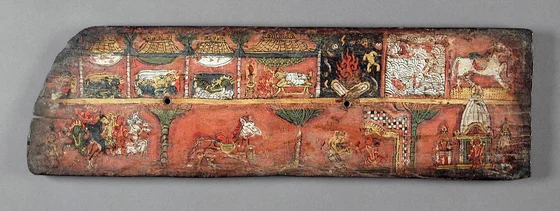
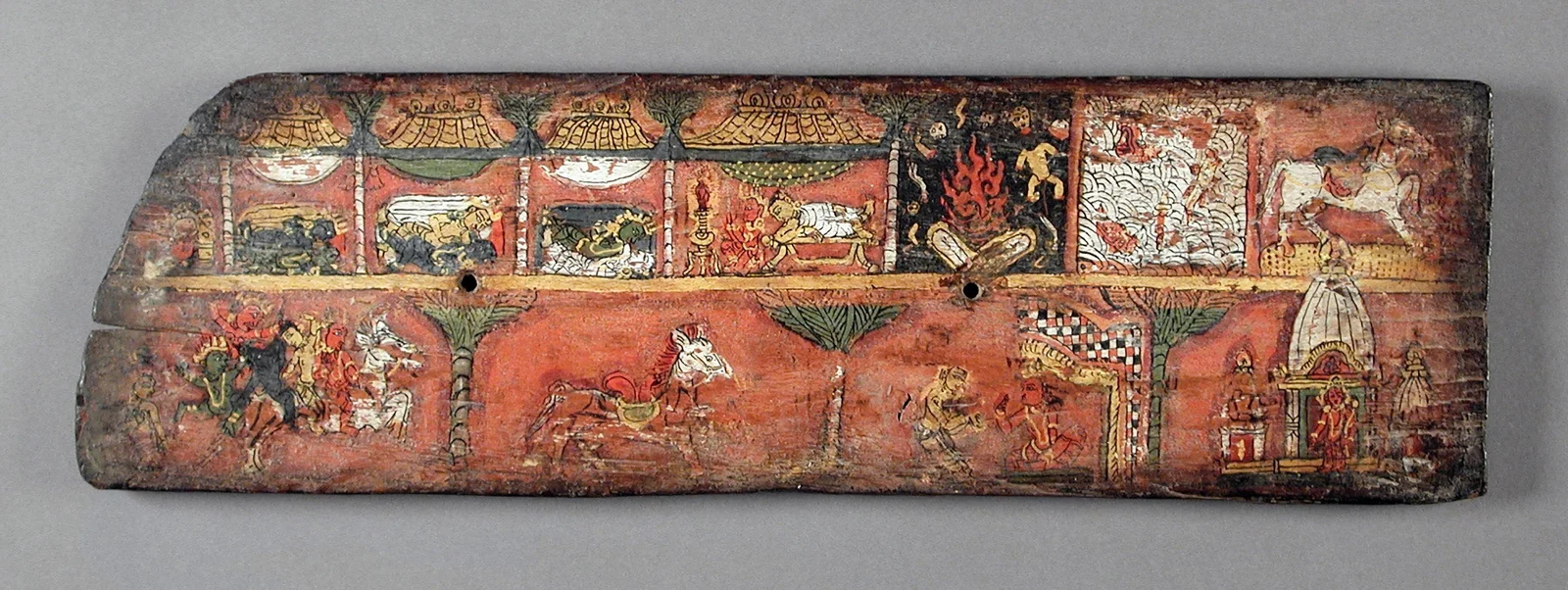
 Nepalese painted manuscript cover showing Valahassa rescuing merchants from the goblin town
The white rescue horse appears in the lower register among the merchants, while the upper scenes present the dangers of the goblin town. This late sixteenth-century Nepalese painted cover gives the episode a visual narrative; its pictorial details supplement the translated account rather than proving one fixed appearance of the horse.
Selected bibliography
Documented works and useful reading. This is not a list of every appearance.
- 01
The Jātaka, Volume II
Jātaka 196, pp.89–91; complete frame, narrative, concluding identification and three footnotes. Hosted title page independently read.
Family & connections
A source-supported family tree or inspiration record has not yet been compiled for this profile. Related reading below indicates a connection in subject matter, not a proven lineage or creative influence.
Primary records and illustrations
The Jātaka, Volume II
Volume II. Jātaka 196, pp. 89–91
Narrative directly read. Printed English pages distinguished from bracketed Pali-edition pagination; no plate image verified. Complete reread retained jataka2-049.html/.txt; 1895 volume title jataka2-000.html/.txt. Frames, three notes and tentative image attribution distinguished.
References
Sources supporting this profile. Linked pages have their own scope and editorial standards.
- Historical primary-text translationThe Jātaka, Volume II — Jātaka 196, pp. 89–91Research access: 2026-10-05
- Historical primary-text translationRouse1895 II, complete Valāhassa narrative and notesResearch access: 2026-10-05
Image credits
Historical sculpture photographValahassa Jataka horse-head fragment, Gandhara,100–300CE
Actual limestone horse head with harness and head-top knot, institutional title identifies Valahassa Jataka. Only surviving architectural fragment is shown: no wings or rescue passengers survive in this object, and neither is invented. Paris Musées actual image/manifest CC0 confirmed.
Further credits appear with each additional image.