Goblin-town marriages and danger in a Nepalese painted cover of the Valahassa Jataka
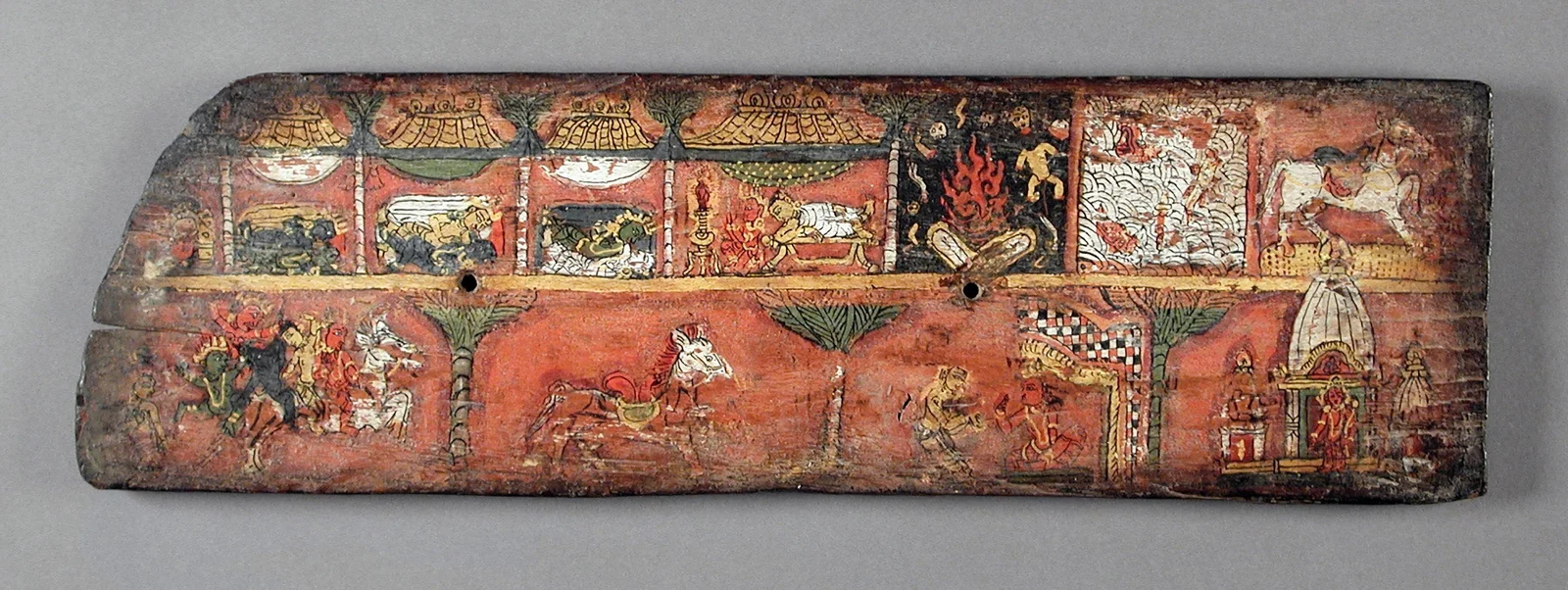
This late sixteenth-century Nepalese manuscript cover sets the merchants’ marriages beside the dangers of the goblin town and their rescue by Valahassa. The upper domestic scenes and demonic figures at the left belong to this illustrated Sirisavatthu episode; their forms are the painter’s interpretation, rather than a fixed anatomy for all female goblins.
Overview
Jātaka 196 locates these female goblins at Sirīsavatthu in Ceylon. They approach shipwrecked traders dressed attractively and offer food and marriage. Their surroundings are deceptive: the narrative gives them the ability to make their settlement resemble a populated, cultivated town, complete with ordinary domestic life. Earlier captives are confined and eaten when new husbands arrive.
A newly arrived trader discovers the danger after his goblin wife returns from eating the previous prisoners with a cold body. He warns his companions, but only half agree to flee. Valāhassa carries the fugitives away; the men who continue to trust their wives are eventually devoured. These are the antagonists of this particular Buddhist rescue narrative, with an illusion and replacement cycle described by the text.
The disguise includes children carried on the women’s hips, attendants bearing rice and gruel, and an apparent countryside with ploughmen, cattle and dogs. The text presents these sights as part of the visitors’ deception, rather than documenting the goblins’ biological families. Their claim that their earlier husbands disappeared at sea is the marriage lure. Existing prisoners are bound with magical chains and put in a place of torment; the chief merchant’s discovery follows his wife’s nocturnal visit there.
The narrative extends the search for shipwrecked men along a named stretch of coast, between the Kalyāṇi river and Nāgadīpa. These literary place references do not identify an actual human population as cannibal spirits. The framing sermon compares sexual temptation with the danger in the tale, and its conclusion turns escape into an analogy for following Buddhist teaching. This profile retains those historical narrative purposes without endorsing the frame’s sweeping judgments about women.
Origins & earliest records
South Asian Buddhist Jātaka narrative tradition
Records & interpretation
Directly read historical English primary-text translation, located by tale number and printed pages.
Selected bibliography
Documented works and useful reading. This is not a list of every appearance.
- 01
The Jātaka, Volume II
Jātaka 196, pp.89–91; complete frame, narrative, concluding identification and three footnotes. Hosted title page independently read.
Family & connections
A source-supported family tree or inspiration record has not yet been compiled for this profile. Related reading below indicates a connection in subject matter, not a proven lineage or creative influence.
Primary records and illustrations
The Jātaka, Volume II
Volume II. Jātaka 196, pp. 89–91
Narrative directly read. Printed English pages distinguished from bracketed Pali-edition pagination; no plate image verified. Complete reread retained jataka2-049.html/.txt; 1895 volume title jataka2-000.html/.txt. Frames, three notes and tentative image attribution distinguished.
References
Sources supporting this profile. Linked pages have their own scope and editorial standards.
- Historical primary-text translationThe Jātaka, Volume II — Jātaka 196, pp. 89–91Research access: 2026-10-05
- Historical primary-text translationRouse1895 II, complete Valāhassa narrative and notesResearch access: 2026-10-05
Image credits
Historical manuscript illustrationGoblin-town marriages and danger in a Nepalese painted cover of the Valahassa Jataka
This late sixteenth-century Nepalese manuscript cover sets the merchants’ marriages beside the dangers of the goblin town and their rescue by Valahassa. The upper domestic scenes and demonic figures at the left belong to this illustrated Sirisavatthu episode; their forms are the painter’s interpretation, rather than a fixed anatomy for all female goblins.