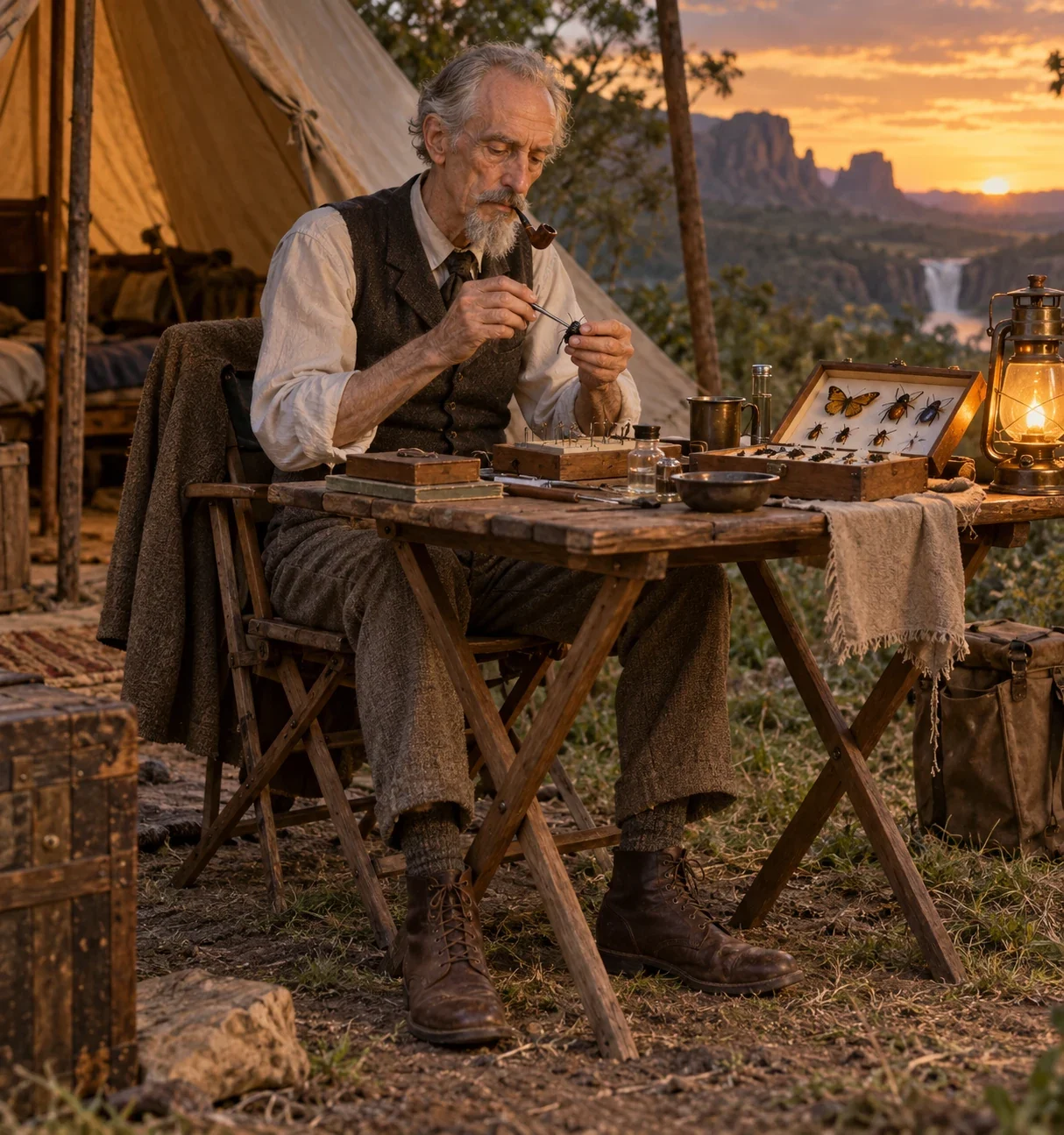
Imagined Summerlee with a grey goat-like beard and short pipe mounts an insect at a camp table.
Unofficial AI interpretation of Summerlee mounting specimens in camp. His gaunt frame, goat-like beard and briar pipe follow Malone’s account; exact portrait, clothes, specimens, tools and camp lighting are imagined, not a scientific plate. Full-frame display derivative; no upscaling.
Overview
Professor Summerlee is the comparative anatomist who challenges Professor Challenger’s claims about surviving prehistoric animals and then joins the expedition intended to test them. At the public meeting he asks why reputable earlier travellers did not find the country Challenger describes, and requests information precise enough to permit verification. Challenger offers to disclose the destination to an investigating committee and invites Summerlee to serve on it. Summerlee thus enters the story as a sceptical investigator with an explicit task, not merely an antagonist who obstructs the hero. His professional title and public reputation belong to the novel’s fictional scientific world. They should not be treated as an identifiable real institution, a modern academic credential or an authority validating the story’s zoology.
Malone describes Summerlee as tall, gaunt and wiry, with thin features and a goat-like beard. He is in his sixty-sixth year, wording that should not be silently converted into a different exact age. His endurance surprises the younger reporter, who initially expects him to impede a difficult journey. Malone also calls him acid, sarcastic, absent-minded and careless about dress, but these are a companion’s assessments rather than a complete diagnosis of character. A short briar pipe is a repeated visual detail; the final reunion adds a thin moustache and grey beard. In South America he devotes himself to insects and birds, collecting during the day and mounting specimens in the evening. This concrete work accompanies his criticism of Challenger and provides an alternative to portraying him only in a quarrel.
The two professors argue over leadership and credibility throughout the journey. Their companions sometimes calm them by introducing a scientific rival whom both dislike, briefly creating common ground. Direct evidence nevertheless affects Summerlee: Malone notices excitement replacing his sneer as the travellers approach the country behind the cliffs. When they cross to the plateau, he carries rifles for both professors and helps Malone complete the precarious transit. The expedition’s discoveries do not protect him from bodily danger. A pterodactyl attack leaves him injured, and later pursuit requires Challenger and Malone to support him while Roxton covers their retreat. The next morning he struggles to stand but remains determined. These episodes limit any image of an untiring or invulnerable elder, even while his practical stamina contrasts with his fragile-looking frame.
On the plateau Summerlee continues studying its insect and bird life and presses for a return with the discoveries already obtained. Back in London he speaks for the investigating committee. The newspaper report embedded in Malone’s narrative says he acknowledges Challenger’s vindication, apologises for his earlier disbelief and describes the expedition while withholding details that would locate the plateau. His reported specimen totals and claims of unprecedented animal life remain assertions within the fiction, not taxonomic records that can be imported into a natural-history profile. At the last gathering Roxton offers equal shares in the proceeds from rough diamonds. Summerlee says that he would retire from teaching to complete his classification of chalk fossils. This is a stated intention at the ending; the selected novel does not establish its execution, a later academic career or the additional events of other Challenger stories.
First appearances & development
Arthur Conan Doyle’s original The Lost World. The retained English narrative and its 1912 copyright statement define this version; later Challenger stories and screen adaptations are excluded. No undocumented biographical model or authorial influence is inferred.
Canon & continuity
Malone’s narrative and quoted reports distinguish viewpoint from observed events.
Selected bibliography
Documented works and useful reading. This is not a list of every appearance.
- 01
The Lost World
Selected original passages.
Family & connections
A source-supported family tree or inspiration record has not yet been compiled for this profile. Related reading below indicates a connection in subject matter, not a proven lineage or creative influence.
References
Sources supporting this profile. Linked pages have their own scope and editorial standards.
- PrimaryThe Lost WorldResearch access: 2026-10-11
- CatalogueGutenberg: The Lost WorldResearch access: 2026-10-11
Image credits
Unofficial modern AI interpretationImagined Summerlee with a grey goat-like beard and short pipe mounts an insect at a camp table.
Unofficial AI interpretation of Summerlee mounting specimens in camp. His gaunt frame, goat-like beard and briar pipe follow Malone’s account; exact portrait, clothes, specimens, tools and camp lighting are imagined, not a scientific plate. Full-frame display derivative; no upscaling.