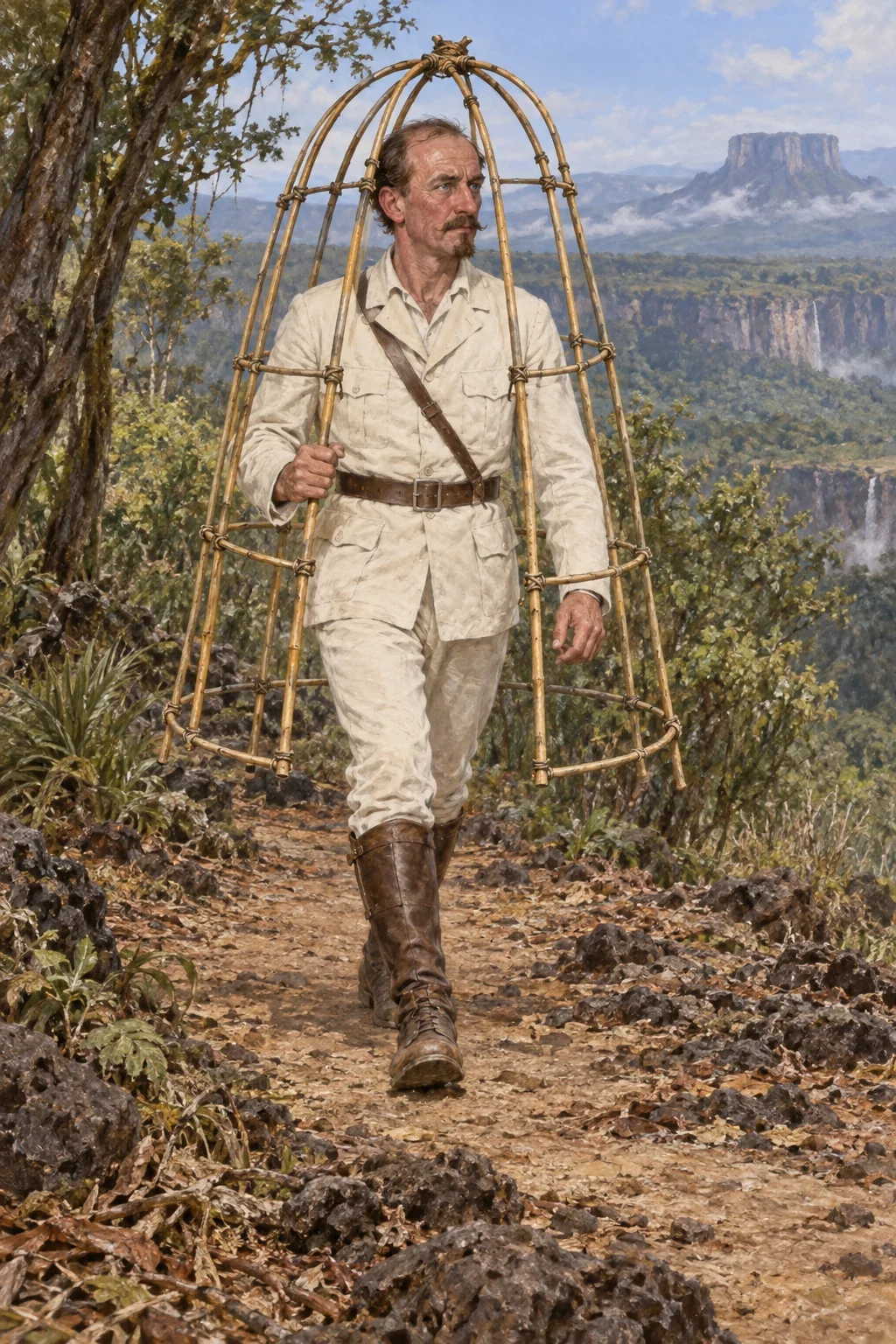
Unofficial AI interpretation of Roxton walking within his bent-cane protective framework. Appearance and clothing follow the novel; exact cage supports, bindings, stride and woodland arrangement are imagined.
Unofficial AI interpretation of Roxton walking within his bent-cane protective framework. Appearance and clothing follow the novel; exact cage supports, bindings, stride and woodland arrangement are imagined. Full-frame display derivative; no upscaling.
Overview
Roxton volunteers alongside Malone when the public meeting appoints investigators to test Challenger’s claims. Malone describes a spare but powerful man a little over six feet tall, apparently shortened by rounded shoulders. His curved nose, hollow cheeks, ruddy hair thinning at the crown, crisp moustaches and small chin tuft are individually specified. Wind and sun have reddened his skin, and the later expedition portrait identifies blue eyes, carefully maintained white drill suits and high brown mosquito-boots. His quiet voice and dry humour contrast with a capacity for determined anger. These details belong to a fictional individual rather than a general portrait of an explorer or a real aristocrat.
Before departure, Roxton’s London rooms and equipment establish wealth, sporting experience and readiness for danger. He also recounts violent opposition to slave-drivers in South America, and Malone subsequently expands the story and describes the reputation it gives him along the river. These are the novel’s accounts of the character’s past, not independent historical confirmation of a particular campaign. His knowledge of the region and willingness to take Challenger seriously help sustain the journey while Summerlee remains sceptical. The narrative’s colonial judgments and labels are viewpoints within the adventure and do not furnish ethnographic facts about actual peoples.
On the plateau, practical precautions distinguish Roxton from his argumentative scientific companions. Malone later encounters him walking inside a bell-shaped framework of bent canes that encloses him on all sides. Roxton explains that he has rigged it to keep the flying reptiles from pressing their attentions too closely. He gives collecting a young specimen for Challenger as one of his tasks, and the closing account connects this expedition with the creature eventually displayed in London. The framework is an improvised protective device, not armour with a specified metal shell or a modern hazard-control design. Its precise fastening and support arrangements are left open by the passage.
Roxton’s interest in the reptiles’ swamp has another purpose. The blue clay in a volcanic vent reminds him of the diamond-bearing site he knows at Kimberley, prompting a private search with a digging tool while protected by his contrivance. Only after returning home and obtaining a valuation does he reveal the rough stones and a cut specimen to his companions. He insists on equal shares of the reported minimum value, offers each man a substantial sum and plans to use his own to equip another expedition to the plateau. Malone chooses to join him instead of immediately marrying. This ending promises renewed exploration; it does not narrate a second completed journey or establish the geology of a real South American diamond deposit.
First appearances & development
The original Lost World adventure pairs Roxton’s practical experience with Challenger’s disputed science and Malone’s developing courage. His earlier exploits are conveyed through speech and narrator report, while the cane framework and final mineral disclosure are encountered within the principal expedition narrative.
Canon & continuity
Primary narrative passages support appearance and selected episodes; Malone’s judgments, dialogue and quoted newspaper reporting remain distinct viewpoints. Catalogue rights metadata is retained separately from its unused automated summary.
Selected bibliography
Documented works and useful reading. This is not a list of every appearance.
- 01
The Lost World
Original narrative carries a 1912 copyright statement. Retained electronic provenance and catalogue rights are separate; the catalogue’s automated plot summary was not used.
Family & connections
A source-supported family tree or inspiration record has not yet been compiled for this profile. Related reading below indicates a connection in subject matter, not a proven lineage or creative influence.
References
Sources supporting this profile. Linked pages have their own scope and editorial standards.
- Primary fictionThe Lost World — original English narrativeResearch access: 2026-10-11
- Bibliographic and rights recordProject Gutenberg catalogue: The Lost WorldResearch access: 2026-10-11
Image credits
Unofficial modern AI interpretationUnofficial AI interpretation of Roxton walking within his bent-cane protective framework. Appearance and clothing follow the novel; exact cage supports, bindings, stride and woodland arrangement are imagined.
Unofficial AI interpretation of Roxton walking within his bent-cane protective framework. Appearance and clothing follow the novel; exact cage supports, bindings, stride and woodland arrangement are imagined. Full-frame display derivative; no upscaling.