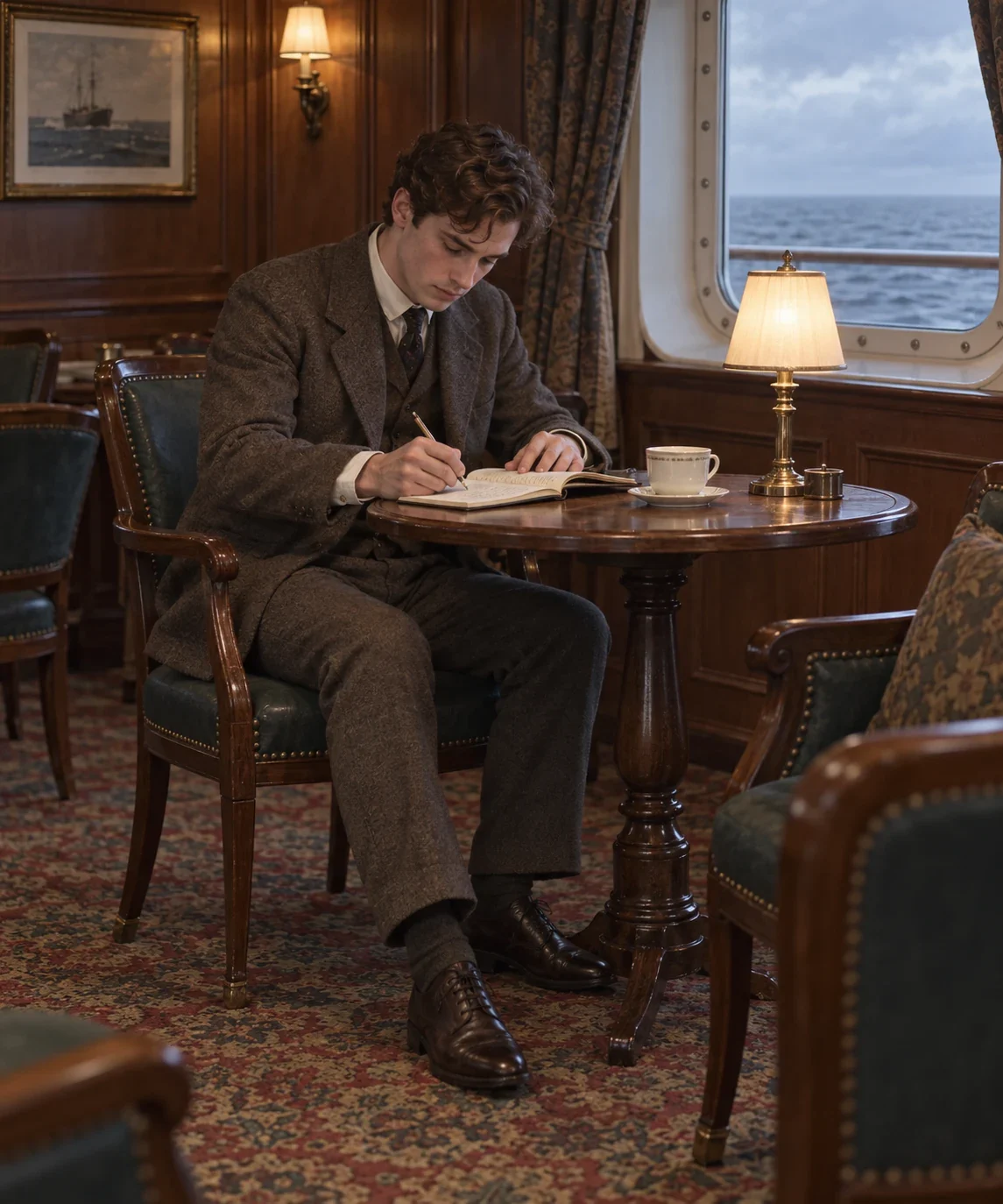
Imagined young reporter Malone writes in a notebook at a table in a ship’s saloon.
Unofficial AI interpretation of E. D. Malone writing aboard the Francisca. The narrative places his account in the ship’s saloon; portrait, clothes, notebook, furnishings, window and lighting are imagined, without an exact vessel or adaptation likeness claim. Full-frame display derivative; no upscaling.
Overview
E. D. Malone is the young Daily Gazette reporter who narrates the expedition to Maple White Land. The novel calls him Malone in ordinary dialogue and gives his initials in the newspaper’s account of the returning travellers; this profile does not expand them from an adaptation or another work. He describes himself as twenty-three when the adventure begins. His wish to impress Gladys Hungerton turns a desire for romantic recognition into a search for danger and distinction. News editor McArdle praises earlier reports on a colliery explosion and a fire, but doubts whether an inexperienced journalist could command a costly special assignment. He instead suggests exposing Challenger as a fraud. The origin of Malone’s journey therefore combines newspaper opportunity, personal ambition and a lover’s idea of heroism.
Malone’s first encounter with Challenger exposes the risks of that approach. His attempted deception is detected, and the scientist attacks him; the confrontation ends in the street before their relationship changes. Challenger subsequently reveals material supporting his story, while Malone declines to turn every confidence into immediate hostile publication. At the public meeting he becomes one of the representatives chosen to accompany Summerlee, alongside Lord John Roxton. Before departure he records a final picture of the travellers on the quay and writes in the saloon of the liner Francisca, entrusting his narrative to McArdle. Later sections pass through the newspaper that he represents. These changes of delivery distinguish personal recollection, correspondence and quoted reporting, rather than making every sentence an impersonal statement by an omniscient narrator.
On the journey Malone’s youth and vigour help him endure demanding travel, but he also learns how dependent the expedition is on cooperation. Challenger’s rope enables him and Summerlee to climb the rock, and Summerlee extends help when Malone completes the dangerous crossing to the plateau. Encounters with unfamiliar animals bring excitement and injury rather than uncomplicated triumph. A pterodactyl attack wounds his neck. In a restless night he slips away from camp hoping to reach the central lake and return with knowledge that will impress both his companions and his editor. The solitary excursion becomes a struggle for survival: he is pursued and falls into a human-made trap, escaping the sharpened central stake. Recognising that trap also forces him to reconsider an earlier assumption that people could not inhabit the plateau.
Malone participates in the party’s subsequent efforts to survive and return, including supporting the weakened Summerlee during flight. In London he helps bring the packing case into the public meeting before Challenger displays the captured pterodactyl. The embedded newspaper report identifies him as an athlete and international rugby player; its genial description of his face is accompanied by Malone’s joking objection to the editor, so it should not become a precise portrait specification. His homecoming also defeats the romantic expectation that helped launch the journey: Gladys has married another man. At Roxton’s final gathering the offer of an equal share of the diamond proceeds gives him a different choice. He says he would rather accompany Roxton back to the plateau than marry immediately. The ending establishes this preference and their renewed comradeship, not a completed second expedition or a later life borrowed from other stories.
First appearances & development
Arthur Conan Doyle’s original The Lost World. The retained English narrative and its 1912 copyright statement define this version; later Challenger stories and screen adaptations are excluded. No undocumented biographical model or authorial influence is inferred.
Canon & continuity
Malone’s narrative and quoted reports distinguish viewpoint from observed events.
Selected bibliography
Documented works and useful reading. This is not a list of every appearance.
- 01
The Lost World
Selected original passages.
Family & connections
A source-supported family tree or inspiration record has not yet been compiled for this profile. Related reading below indicates a connection in subject matter, not a proven lineage or creative influence.
References
Sources supporting this profile. Linked pages have their own scope and editorial standards.
- PrimaryThe Lost WorldResearch access: 2026-10-11
- CatalogueGutenberg: The Lost WorldResearch access: 2026-10-11
Image credits
Unofficial modern AI interpretationImagined young reporter Malone writes in a notebook at a table in a ship’s saloon.
Unofficial AI interpretation of E. D. Malone writing aboard the Francisca. The narrative places his account in the ship’s saloon; portrait, clothes, notebook, furnishings, window and lighting are imagined, without an exact vessel or adaptation likeness claim. Full-frame display derivative; no upscaling.