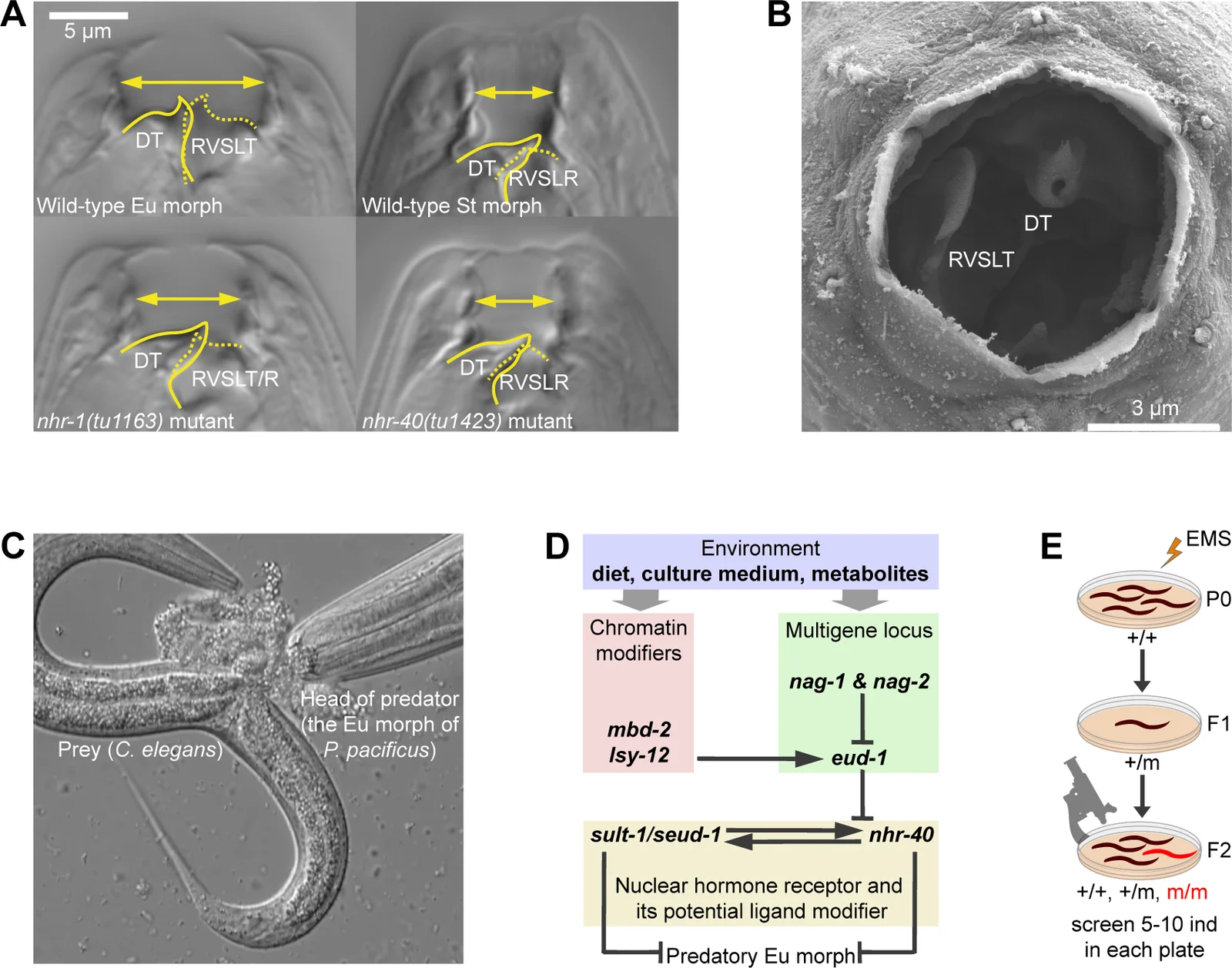
Pristionchus pacificus wild-type and mutant mouth micrographs, electron micrograph, a predation scene with Caenorhabditis elegans prey, and mouth-form regulatory diagrams
Panel A compares broad and narrow wild-type mouths with nhr-1 and nhr-40 mutants; panel B shows the broad mouth by scanning electron microscopy. Panel C shows a Pristionchus predator feeding on Caenorhabditis elegans prey. Panels D and E present a proposed regulatory network and experimental screen, rather than additional animal portraits. Scale bars are 5 μm in A and 3 μm in B.
Overview
Pristionchus pacificus develops one of two alternative adult mouth forms. The narrow stenostomatous form has a small dorsal tooth and feeds on microorganisms; the broader eurystomatous form has an enlarged dorsal tooth and an additional subventral tooth, permitting an omnivorous diet that includes other nematodes. This developmental difference is not an adult switching its mouth back and forth during a meal. Hiramatsu and Lightfoot investigated how predatory ability and strain relatedness influence aggregation, using selected isolates from a high-altitude clade that readily groups under standard laboratory conditions. Such aggregation is not equally characteristic of every isolate.
The four focal strains came from the Nez de Bœuf region of La Réunion. RSB001 and RSB005 formed one closely related pair, while RSA075 and RSB033 formed another. Pairwise assays placed equal numbers of stained young adults on bacterial lawns, allowing each strain to be distinguished. Aggregation between close relatives resembled the single-strain controls. More distantly related combinations showed reduced grouping and altered aggregate composition. Separate larval predation assays likewise found much more killing between the distantly related combinations than within the close pairs. These results connect relatedness with two measured behaviours without demonstrating a single universal recognition rule across the species.
The researchers then disrupted Ppa-nhr-40 in two strains, producing the non-predatory mouth form in the tested mutants. These animals could aggregate with the otherwise rival strain more successfully when neither partner could prey on the other. A predatory wild-type partner still disrupted aggregation by its non-predatory rival. The mouth-form experiment therefore supports a contribution of aggressive interactions, rather than treating aggregate preference as attraction alone. Another experiment altered self-1 genes implicated in kin recognition. The resulting modest kin-killing defect did not abolish aggregation, showing that this genetic manipulation was insufficient to explain the collective behaviour by itself.
Mixed-species assays tested the effect on aggregating Caenorhabditis elegans strains. Predatory Pristionchus disrupted their grouping, whereas a non-predatory mutant did not produce the same effect. Even a relatively small predator fraction affected the laboratory groups. The authors interpreted this as potentially relevant to competition and territorial exclusion, while noting that C. elegans had not been found at the high-altitude sites of the focal clade. The experimental interaction should therefore be distinguished from an observed wild encounter there. Static aggregate counts, larval corpse assays and gene perturbations provide complementary evidence, without establishing every sensory cue or ecological consequence.
Origins & earliest records
The focal strains were isolated from a high-altitude La Réunion locality; this is collection provenance, not a species-origin claim.
Evidence & interpretation
Pairwise aggregation, larval predation and mouth-form/kin-recognition mutations support distinct behavioural conclusions. Ecological benefits and the full recognition mechanism remain interpretations.
Selected bibliography
Documented works and useful reading. This is not a list of every appearance.
- 01
Kin-recognition and predation shape collective behaviors in the cannibalistic nematode Pristionchus pacificus
PLOS Genetics 19(12): e1011056, 14 December. Complete main report, Methods and main captions read. Creative Commons Attribution licence; DOI 10.1371/journal.pgen.1011056.
Family, evolution & connections
Caenorhabditis elegans CB4856 and JU2001
Hiramatsu and Lightfoot found that predation-capable Pristionchus strains disrupted aggregation of these two C. elegans strains in mixed laboratory assays. A non-predatory mouth-form mutant did not produce the same displacement. This supports an experimental interspecies interaction; the authors had not found C. elegans in the focal high-altitude Pristionchus habitat.
References
Sources supporting this profile. Linked pages have their own scope and editorial standards.
- ResearchAggregation and predation experimentsResearch access: 2026-10-06
Image credits
Scientific organism mouth microscopy and experiment figurePristionchus pacificus wild-type and mutant mouth micrographs, electron micrograph, a predation scene with Caenorhabditis elegans prey, and mouth-form regulatory diagrams
Panel A compares broad and narrow wild-type mouths with nhr-1 and nhr-40 mutants; panel B shows the broad mouth by scanning electron microscopy. Panel C shows a Pristionchus predator feeding on Caenorhabditis elegans prey. Panels D and E present a proposed regulatory network and experimental screen, rather than additional animal portraits. Scale bars are 5 μm in A and 3 μm in B.