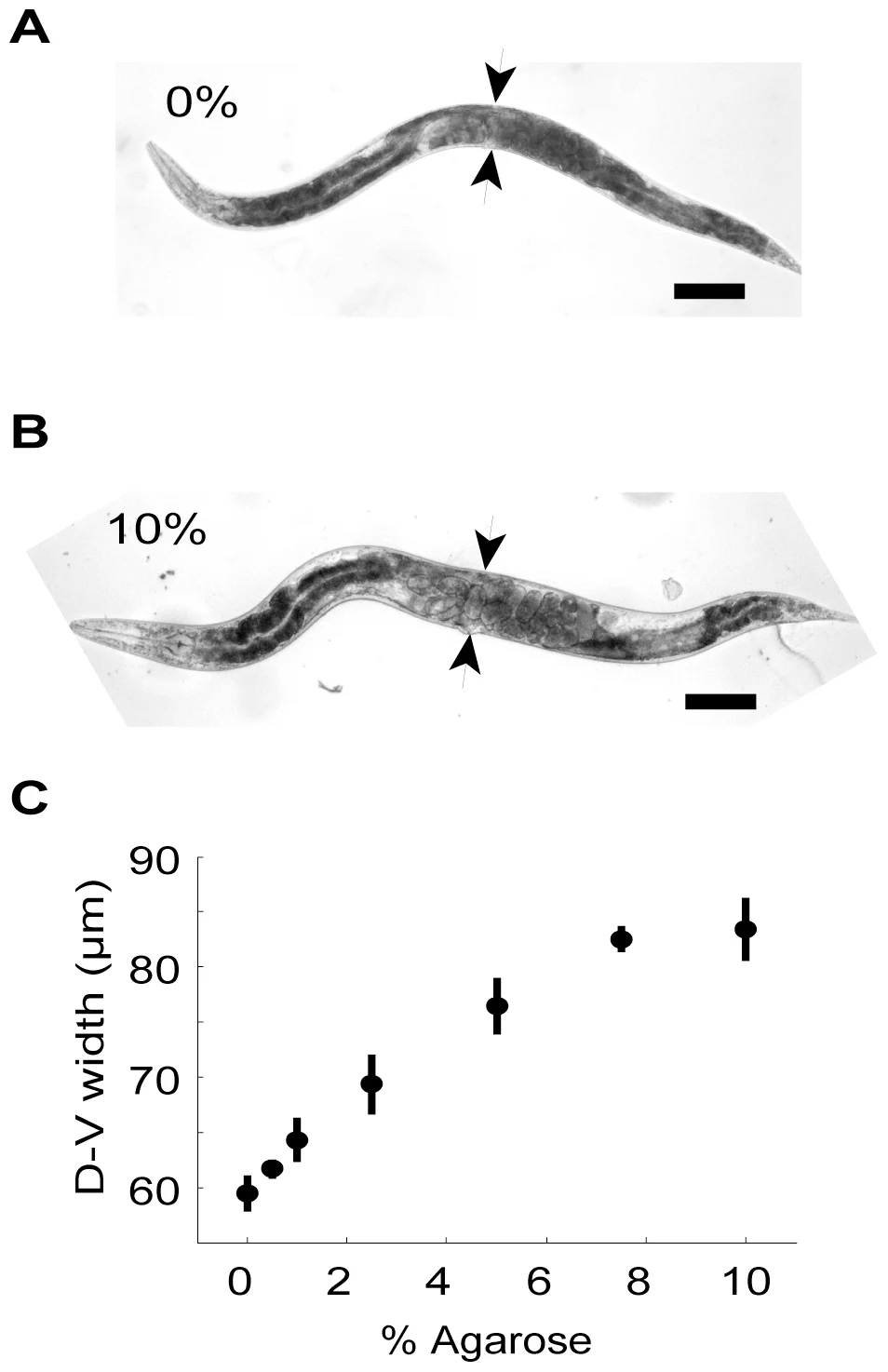
Two bright-field images of the same adult C. elegans hermaphrodite before and during agarose immobilization, with width arrows and 100-micrometre scale bars; a lower graph compares body width.
The same adult hermaphrodite before and during experimental immobilization; the lower plot measures preparation-dependent body width. Whole published Figure3, not a natural-colour portrait.
Overview
Caenorhabditis elegans is a free-living nematode widely used to investigate genetics and behaviour. Sugi and colleagues studied a less familiar group-level behaviour in 2019: large populations of dauer larvae formed networks of densely packed worm bundles. Dauer is a developmentally distinct state associated here with crowded culture conditions. The experiment used the wild-type Bristol N2 strain and genetically modified comparison strains. The networks were larger than individual worms, and their enclosed compartments repeatedly merged and divided rather than remaining fixed structures.
The researchers observed these patterns on glass, plastic and agar surfaces. A comparison with dead worms showed that active movement was necessary for the observed network formation. Worm density and surrounding humidity also mattered. Increasing humidity initially enlarged the compartments, then caused the network to collapse into simpler aggregates. The authors linked attraction between worms to the surface tension of the water around them. These controlled changes concern dense laboratory populations; they do not establish that identical networks occur throughout the animal’s natural habitats.
Observations at the individual scale helped explain the collective pattern. In 43 analysed pairwise collisions, worms tended to leave aligned along the same axis, either moving in the same direction or opposite directions. This is axial alignment rather than a flock in which every member moves forward together. Fluorescently marked neurons allowed researchers to follow individuals within crowded bundles. The study also examined a mechanosensory-channel mutant whose paths curved more strongly and whose networks had smaller compartments. However, other effects of the mutation could not be excluded, so curvature alone was not experimentally isolated as the sole cause.
An agent-based mathematical model combined alignment, smooth turning, attraction and repulsion. It reproduced network formation and several responses to changed parameters, but the real networks depended more strongly on humidity than the model did. Optogenetic activation of touch-sensitive neurons could disrupt bundles, which sometimes recovered or reorganized after stimulation ended. The model and experiment therefore illuminate possible physical rules without providing a complete account of all neural or individual interactions. A role in survival was proposed by comparison with known nematode aggregation strategies, not demonstrated through a survival experiment in this study. The results reveal a collective laboratory behaviour, rather than assigning intention or social organization to the worms.
Origins & earliest records
The cited study concerns laboratory strains and experimentally produced dauer populations. It does not reconstruct the evolutionary emergence of Caenorhabditis elegans or identify direct ancestral species.
Evidence & interpretation
Live-population observations, individual tracking, controlled density and humidity changes, mutant comparisons, optogenetic perturbation and an agent-based model provide distinct evidence. Model agreement is partial; a natural survival benefit remains a hypothesis.
Selected bibliography
Documented works and useful reading. This is not a list of every appearance.
- 01
C. elegans collectively forms dynamical networks
Nature Communications 10:683, 18 February 2019; DOI 10.1038/s41467-019-08537-y. Complete main Introduction, Results, Discussion and Methods with textual captions read; supplementary movies/files, figure pixels, code and experimental reruns not inspected. CC BY 4.0; attributed original summary.
Family, evolution & connections
Taxonomic classification
A hierarchy of classified groups, not a chain of direct ancestors.
- genusCaenorhabditis
- speciesCaenorhabditis elegans
Located primary passages
Specific passages supporting details in this entry, grouped by their published witness.
C. elegans collectively forms dynamical networks
2019 published article
- Crowded laboratory dauer worms formed changing networks of bundled aggregates. Density, humidity and altered movement affected network structure; optical neural stimulation could disrupt bundles. Collision alignment and smooth turning helped a minimal model reproduce broad patterns, but humidity dependence differed from real worms. Mutant effects were not attributable solely to trajectory curvature, and the proposed link to survival strategies remained an expectation rather than an ecological demonstration.
Complete Introduction, Results, Discussion and Methods; textual captions 1–4 and original licence.
No supplementary movies, raw tracking data, figure pixels or model rerun; laboratory networks do not establish a universal social function or natural colony organisation.
References
Sources supporting this profile. Linked pages have their own scope and editorial standards.
- ResearchC. elegans collectively forms dynamical networksResearch access: 2026-10-06
Image credits
Scientific organism microscopy and immobilization comparison figureTwo bright-field images of the same adult C. elegans hermaphrodite before and during agarose immobilization, with width arrows and 100-micrometre scale bars; a lower graph compares body width.
The same adult hermaphrodite before and during experimental immobilization; the lower plot measures preparation-dependent body width. Whole published Figure3, not a natural-colour portrait.