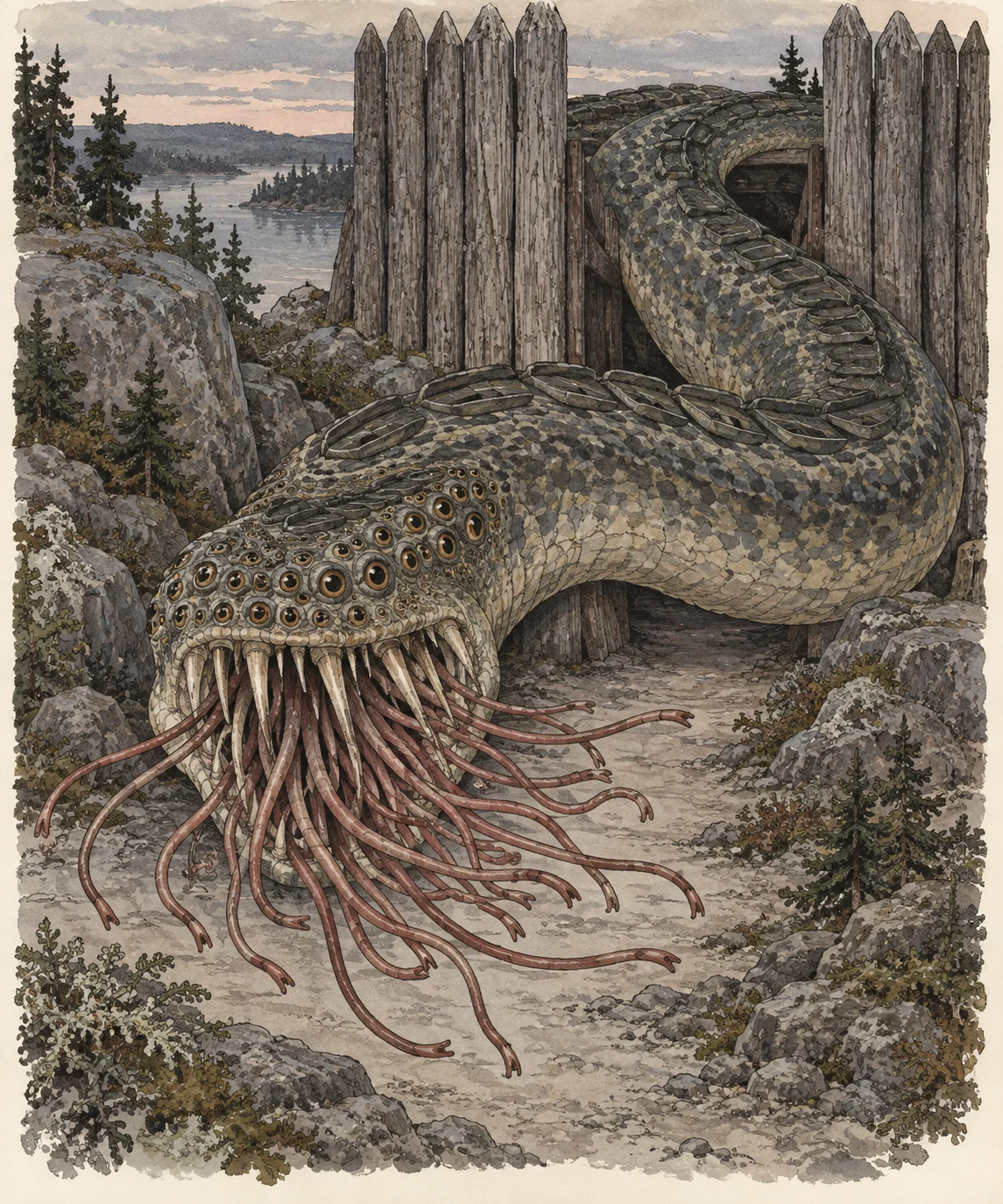
A many-eyed imagined serpent extends numerous long tongues by a gate.
Original AI interpretation of Hundred-Eyed Serpent of Pohjola’s Portal. Undescribed appearance and setting are imagined; not historical artwork or ethnographic reconstruction. Full frame; delivery compression may be applied. Visible eyes and tongues are a selected depiction, not a claim of an exact rendered count.
Overview
After cutting through the serpent-covered palisade, Lemminkäinen confronts the larger serpent stretched across the entrance. Crawford calls it hundred-eyed and gives it a thousand tongues. Its eyes are like sieves, tongues like javelin shafts, teeth like hatchet handles and back like ocean skiffs. These are poetic dimensions; the passage’s surrounding plural snakes are not converted into an invented fixed head count for this individual.
The serpent ignores his first command and lunges. He then recounts its origin: Suoyatar’s spittle is rocked by the sea, and Hisi breathes life into it after the creator refuses. The ensuing genealogy assigns parts to water foam, plants and death-world materials. This recitation finally makes it uncoil and withdraw to another portal, allowing him through. Its successful removal is not a killing scene. Rune XV gives a related serpent-origin explanation in the mother’s instruction, but that earlier attacking serpent is not explicitly identified as this gate guardian.
Origins & earliest records
Kalevala, Rune XXVI, complete final serpent encounter, John Martin Crawford’s English translation (1888), after Elias Lönnrot’s edited epic. This witness does not independently date the original oral narratives.
Records & interpretation
Complete relevant episode read with its preparation and outcome. Translation-specific body terms and comparisons remain attributed.
3D model
An original procedural model made for the Mythscribe World Builder. It is an interpretation based on this entry, not a historical source or a depiction from the records cited here.

Procedural folklore creature kit · 30,568 triangles · 2.3 MB
Opens mythscribe.cloud in a new tab. Sign-in is required.
Selected bibliography
Documented works and useful reading. This is not a list of every appearance.
- 01
Kalevala, Rune XXVI, complete final serpent encounter
Complete selected encounter, not a claim to have collated all Finnish archival variants.
Family & connections
A source-supported family tree or inspiration record has not yet been compiled for this profile. Related reading below indicates a connection in subject matter, not a proven lineage or creative influence.
References
Sources supporting this profile. Linked pages have their own scope and editorial standards.
- Primary epic translationCrawford, Kalevala, Rune XXVI, complete final serpent encounterResearch access: 2026-10-05
Image credits
Modern literary interpretationA many-eyed imagined serpent extends numerous long tongues by a gate.
Original AI interpretation of Hundred-Eyed Serpent of Pohjola’s Portal. Undescribed appearance and setting are imagined; not historical artwork or ethnographic reconstruction. Full frame; delivery compression may be applied. Visible eyes and tongues are a selected depiction, not a claim of an exact rendered count.