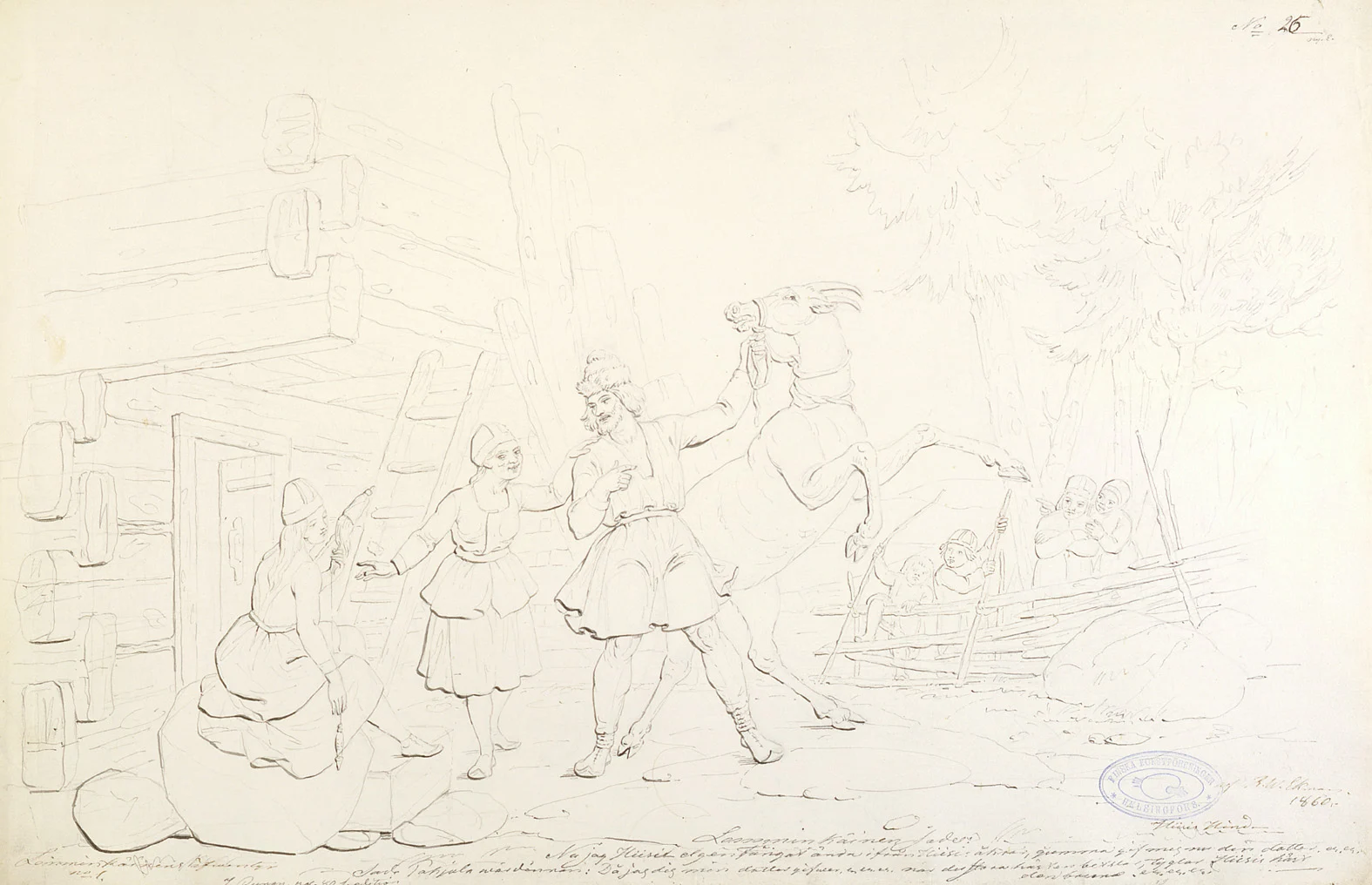
Hiisi’s elk in Robert Wilhelm Ekman’s Lemminkäinen ja Hiiden hirvi (1860)
Actual pencil drawing inspected: Lemminkäinen grips the raised elk’s head in the household-disruption scene. Museum object title identifies the precise Hiisi elk episode. The drawing is an artistic interpretation, not a photograph or proof of real-animal anatomy. Individual multimedia licence CC0. Actual returned signed-original download preserved, with stable source and download API links; signed URL expires.
Overview
Crawford’s Rune XIII presents the elk as a magically constructed animal sent to exhaust Lemminkäinen. Its head is punk-wood, horns willow branches, feet rushes, legs water reeds, veins withered grass, eyes daisies, ears water-flowers, skin fir bark and muscles sappy wood. The English passage alternates moose and reindeer vocabulary, while placing Hisi, Juutas, Lempo and Piru names around the encounter.
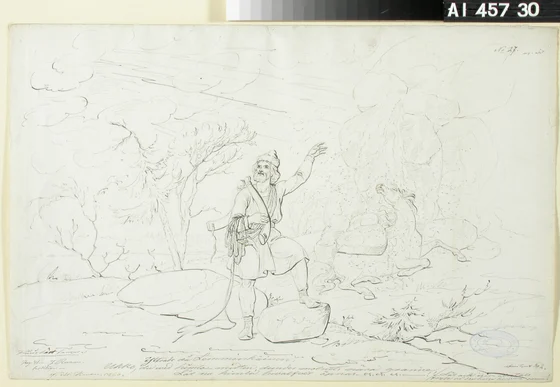
The creature disrupts household work by overturning water tubs, kettles and dishes. Lemminkäinen overtakes and binds it, but his boast about resting with the desired maiden provokes its spoken reply and escape: it breaks the willow bonds and oak hurdle. His renewed pursuit ruins his equipment. Rune XIV changes the approach. After appeals to the forest powers, the animal is driven toward him and he safely lassos its antlers and shoulders. Capture follows a different relationship with the woodland beings, rather than an invented killing of the quarry.
Origins & earliest records
Kalevala, Runes XIII–XIV, John Martin Crawford’s English translation (1888). Lönnrot’s edited epic appeared in versions in 1835 and 1849; those are publication witnesses, not dates of oral beginnings.
Records & interpretation
Complete Runes XIII and XIV read. Crawford’s preface records comparison with German and Hungarian translations. Individual source singers were not identified from these passages.
Selected bibliography
Documented works and useful reading. This is not a list of every appearance.
- 01
Kalevala, Runes XIII–XIV
Specific English rendering; its variable creature and supernatural names retained rather than universalised.
Family & connections
A source-supported family tree or inspiration record has not yet been compiled for this profile. Related reading below indicates a connection in subject matter, not a proven lineage or creative influence.
References
Sources supporting this profile. Linked pages have their own scope and editorial standards.
- Primary epic translationCrawford, Kalevala, Runes XIII–XIVResearch access: 2026-10-05
- Original publisher / custodial historyFinnish Literature Society: Kalevala CollectionResearch access: 2026-10-05
Image credits
Historical illustrationHiisi’s elk in Robert Wilhelm Ekman’s Lemminkäinen ja Hiiden hirvi (1860)
Actual pencil drawing inspected: Lemminkäinen grips the raised elk’s head in the household-disruption scene. Museum object title identifies the precise Hiisi elk episode. The drawing is an artistic interpretation, not a photograph or proof of real-animal anatomy. Individual multimedia licence CC0. Actual returned signed-original download preserved, with stable source and download API links; signed URL expires.