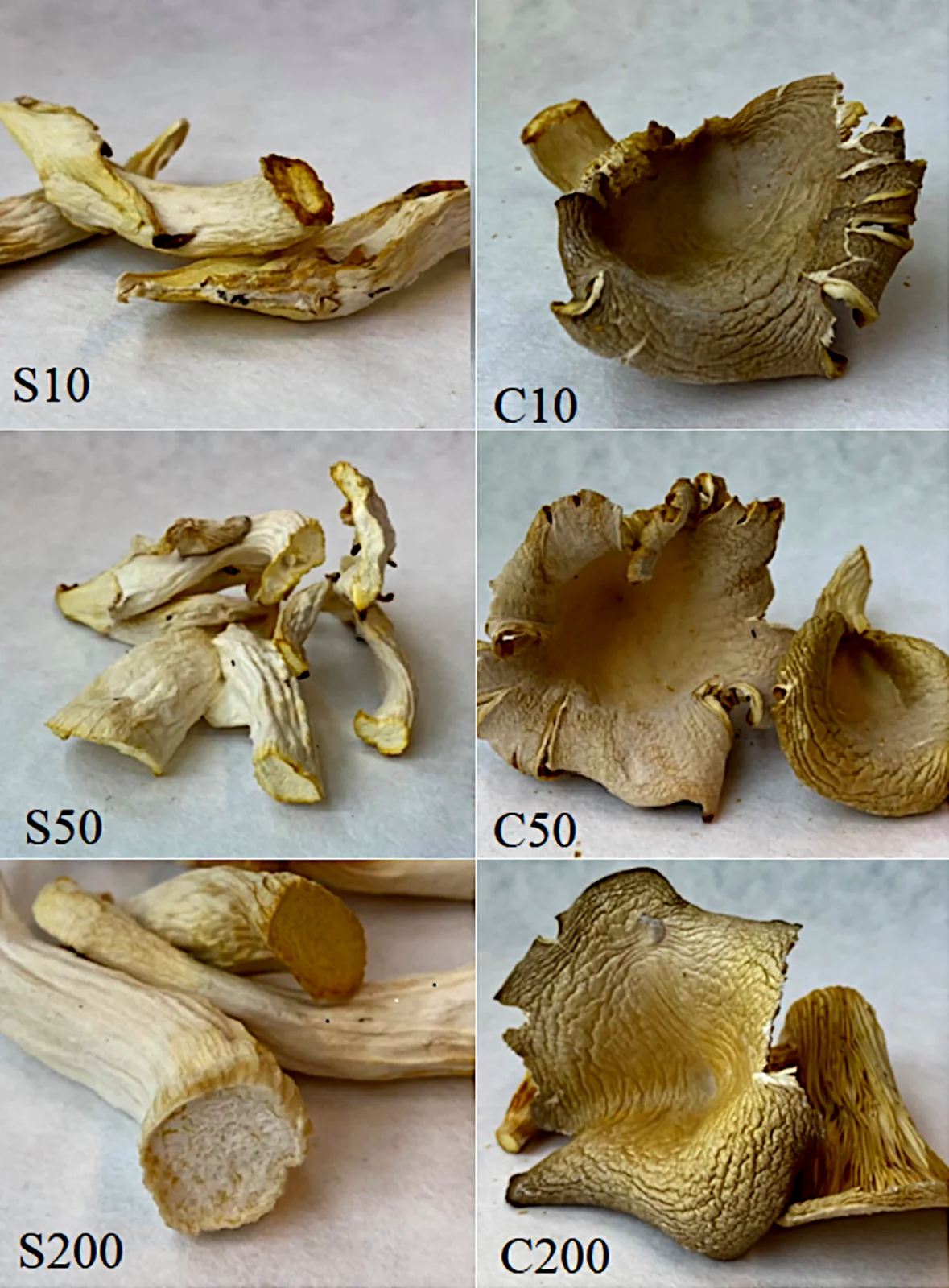
Separated stems and caps of cultivated Pleurotus ostreatus Spoppo strain grown under 10, 50 and 200 lux lighting, Zawadzka and colleagues’ 2022 figure 1
The six photographs compare separated stems (S) and caps (C) of the cultivated Spoppo strain of oyster mushroom. Numbers identify the experimental lighting: 10, 50 or 200 lux. They show prepared anatomical material from a cultivation study, rather than an intact mushroom in its natural habitat. No scale bar is supplied in this figure.
Overview
Pleurotus ostreatus is a basidiomycete mushroom associated with the breakdown of woody plant material. Its lignocellulose-degrading biology has made it useful for investigating fungal metabolism and for developing genetic tools. The selected genome study concentrates on PC9, a laboratory strain, rather than surveying every wild population or establishing the geographical origin of the species. PC9 and the comparison strain PC15 are monokaryotic protoclones derived from the commercial dikaryotic strain N001. Their shared origin does not make their genomes interchangeable: the researchers describe differences in laboratory growth and use the strains as separate genomic references.
Lee and colleagues combined long PacBio reads with shorter Illumina reads to reconstruct PC9 DNA. Their assembly, PC9_AS, contains approximately 35 million bases arranged in 17 scaffolds and predicts 11,875 genes. Its scaffold N50 is about 3.5 million bases, meaning that half the assembled sequence is contained in scaffolds at least that long. The older PC9_JGI reference contained 572 scaffolds. Longer contiguous sequence makes it easier to place genes and repetitive regions in their surrounding genomic context, but a smaller scaffold count alone does not establish that every base or gene prediction is correct.
The researchers searched scaffold ends for repeated TTAGGG sequences associated with fungal telomeres. Five scaffolds carry these repeats at both ends and were interpreted as complete chromosomes; four have a telomere at only one end. Several remaining scaffolds lack apparent telomeric repeats. Thus the 17 scaffolds are not a demonstrated count of 17 chromosomes, and the assembly is not wholly closed from telomere to telomere. A benchmark against conserved basidiomycete genes reported 97.2 percent completeness. That estimate concerns the benchmark gene set rather than proving equivalent completeness for all repetitive DNA or every functional gene.
Repeat annotation identified 253 transposable-element families occupying about 7.12 percent of the assembly. Class I elements accounted for most of the annotated transposable-element sequence, a proportion distinct from their share of the entire genome. The study also predicted 459 carbohydrate-active enzymes and used several databases to assign possible gene functions. Such annotations provide candidates for experimental work; they do not demonstrate the activity of every predicted protein. Differences in gene totals between assemblies can reflect assembly gaps and annotation procedures, so these comparisons should not be read automatically as evolutionary gene loss. The deposited assembly supplies a strain-specific resource for testing fungal biology, with functional and population questions remaining separate from the sequencing results.
Origins & earliest records
PC9 is a monokaryotic derivative of commercial dikaryotic strain N001; this provenance is not a species-origin estimate.
Evidence & interpretation
Long-read assembly, short-read polishing, conserved-gene benchmarking and computational annotations support different aspects of the PC9 reference. Telomere patterns establish only a subset of complete chromosomes.
Selected bibliography
Documented works and useful reading. This is not a list of every appearance.
- 01
Genome sequence of the oyster mushroom Pleurotus ostreatus strain PC9
G3 11(2): jkaa008; online 22 December 2020. Complete main report, Methods, table and caption texts. CC BY 4.0; DOI 10.1093/g3journal/jkaa008.
Family, evolution & connections
PC9 and PC15 laboratory strains
Lee and colleagues report PC9 and PC15 as monokaryotic protoclones of the same dikaryotic strain N001. Their PC9 genome study compares these laboratory references; PC9 grows faster under the cited laboratory conditions. These are strains within Pleurotus ostreatus, not separate species or a species-ancestor sequence.
Caenorhabditis elegans - tested nematode prey
In Lee and colleagues' 2023 laboratory experiments, nematodes contacting oyster-mushroom hyphae became paralysed. Fungal structures called toxocysts mediated this contact response. This is a tested predatory interaction, not shared ancestry or a universal inventory of prey in the wild.
References
Sources supporting this profile. Linked pages have their own scope and editorial standards.
- ResearchPC9 genome assembly and annotationResearch access: 2026-10-06
Image credits
Scientific photograph composite of prepared mushroom partsSeparated stems and caps of cultivated Pleurotus ostreatus Spoppo strain grown under 10, 50 and 200 lux lighting, Zawadzka and colleagues’ 2022 figure 1
The six photographs compare separated stems (S) and caps (C) of the cultivated Spoppo strain of oyster mushroom. Numbers identify the experimental lighting: 10, 50 or 200 lux. They show prepared anatomical material from a cultivation study, rather than an intact mushroom in its natural habitat. No scale bar is supplied in this figure.