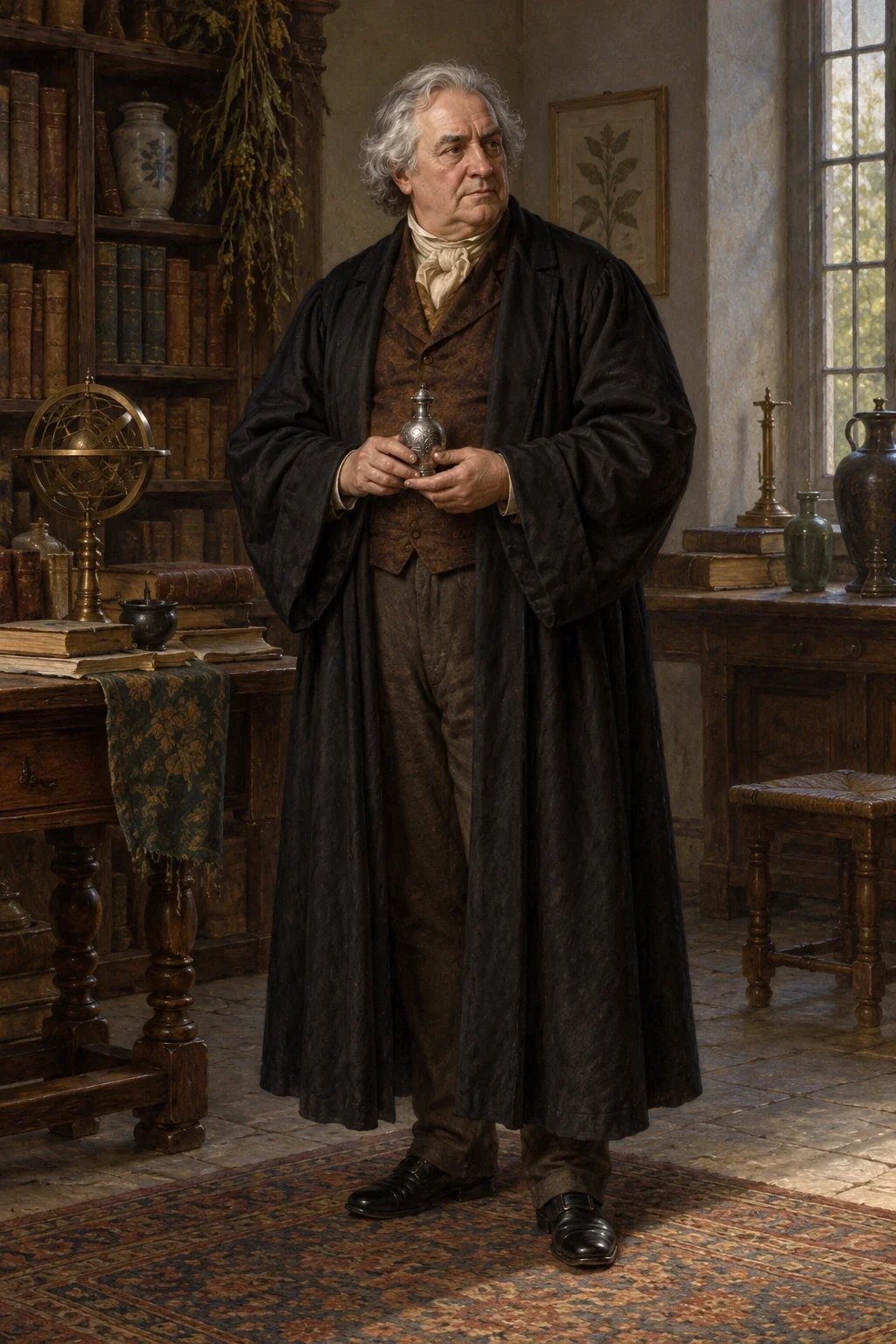
AI interpretation of Professor Baglioni holding a closed silver vial.
Overview
Baglioni receives Giovanni as the son of an old friend, entertains him at dinner and initially appears genial and jovial. He praises Rappaccini’s scientific skill but condemns his willingness to subordinate patients and family to experiment. His account discounts the rival’s successful cures as chance while holding him responsible for failures. The narrator then discloses a long professional struggle in which Rappaccini has generally prevailed. Later, after observing Rappaccini scrutinize Giovanni in the street, Baglioni insists that the student has become an experimental subject. His private resolution joins concern for his friend’s son with indignation that Rappaccini has taken the young man from his influence.
Visiting Giovanni’s chamber, Baglioni tells a story about a poison-nourished woman sent to Alexander and applies the analogy to Beatrice. He notices a strange fragrance in the room and argues that Rappaccini’s science threatens Giovanni as well. He leaves a small worked silver vial, attributed by him to Cellini, claiming that its antidote can overcome the garden’s poisons and perhaps restore Beatrice. As he departs, he chuckles at the prospect of thwarting his rival. Giovanni eventually gives the medicine to Beatrice; she puts it to her lips as her father emerges, and he then confirms the companion experiment. The narrator explains that the antidote becomes death for a body sustained by poison. Baglioni then calls down from a window to Rappaccini in a tone explicitly mixing triumph with horror. His warning is partly vindicated, but neither his rivalry nor the fatal consequences of his intervention are resolved into a simple rescuer’s role.
First appearances & development
Pietro Baglioni, professor of medicine and Rappaccini’s rival in Hawthorne’s Rappaccini’s Daughter.
Canon & continuity
This profile follows the complete English narrative Rappaccini’s Daughter in the retained Mosses from an Old Manse witness, attributed to Nathaniel Hawthorne. Its original collection headings and contents identify the work, but do not establish the particular transcription’s print edition or date. Numbered paragraphs1–136 are local evidence locators, not original printed paragraph numbers.
Selected bibliography
Documented works and useful reading. This is not a list of every appearance.
- 01
Mosses from an Old Manse — Rappaccini’s Daughter
Complete selected English story in retained collection witness. Particular transcription print edition/date unestablished; no whole-collection reading claim.
Family & connections
A source-supported family tree or inspiration record has not yet been compiled for this profile. Related reading below indicates a connection in subject matter, not a proven lineage or creative influence.
References
Sources supporting this profile. Linked pages have their own scope and editorial standards.
- Historical public-domain authored English narrativeHawthorne — complete Rappaccini’s Daughter and retained original collection headingsResearch access: 2026-10-23
Image credits
AI-generated literary interpretationAI interpretation of Professor Baglioni holding a closed silver vial.