
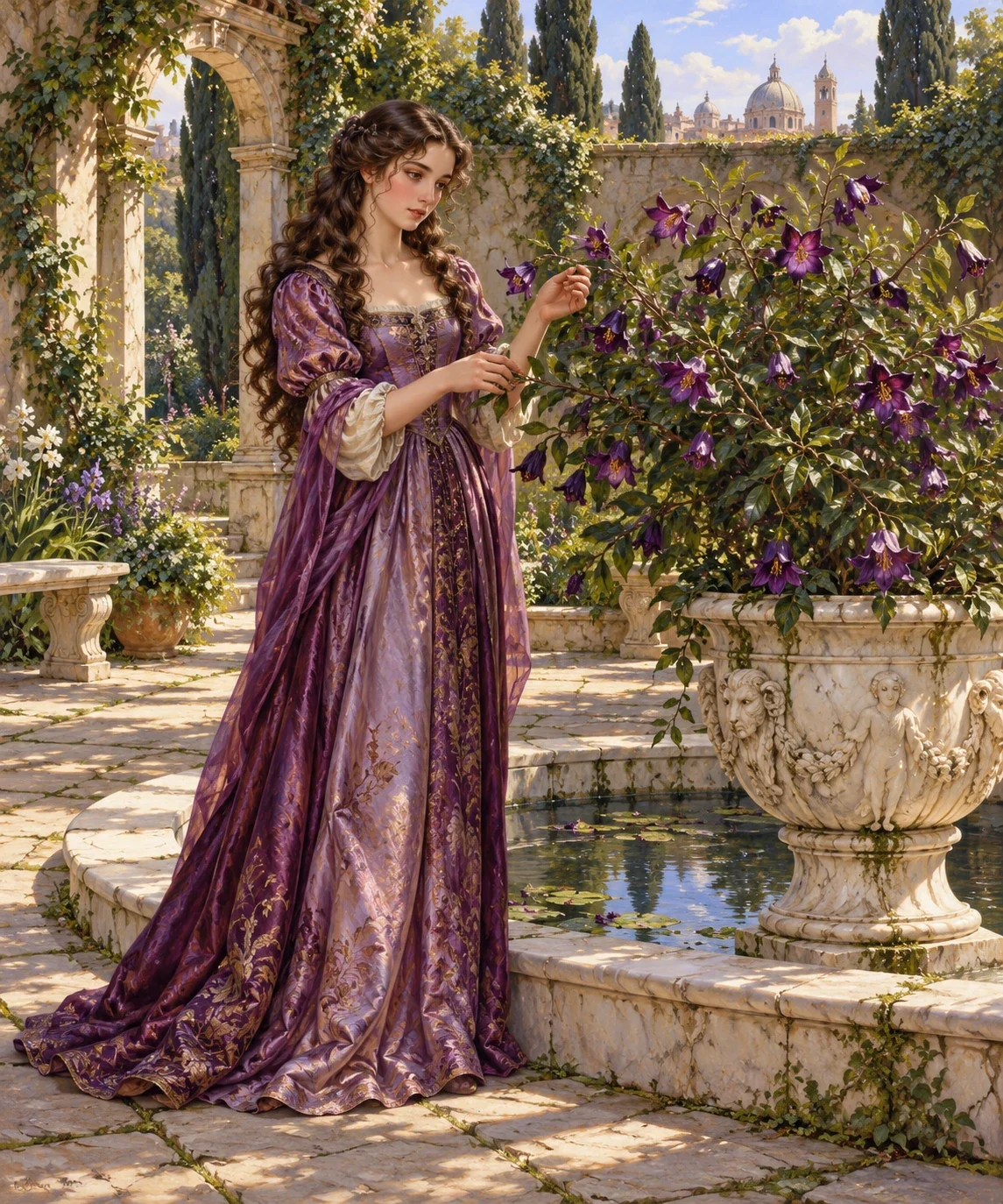
Original AI literary interpretation; unspecified likeness and costume details are artistic choices.
Overview
Beatrice is the daughter of Dr Giacomo Rappaccini, whose carefully tended garden lies beneath the rooms of Giovanni Guasconti, a student newly arrived in Padua. She enters through a sculptured portal to help her father care for a magnificent purple-flowered shrub growing by a ruined marble fountain. Where the doctor uses gloves and a mask, she handles the plants and breathes their fragrance freely, addressing the shrub as a beloved sister. Her vivid beauty, rich voice, glistening ringlets and splendid clothing shape Giovanni’s first impression. He sees or believes he sees a lizard and an insect die near her, and a bouquet wither in her grasp, but the narration repeatedly qualifies the reliability of these distant observations.
Giovanni’s medical acquaintance Baglioni depicts her father as a scientist willing to sacrifice human life. His information is entangled with professional rivalry: even his claim that Beatrice could hold a professor’s chair remains rumour. When Giovanni enters the garden, she says she knows the flowers’ colours and scents rather than her father’s science, and asks him to trust her truthfulness. Their growing affection is constrained by a strict barrier against physical contact. The one time she seizes his hand is to pull it away from the deadly shrub, after which he finds painful purple finger-marks. Beatrice’s isolation and delight in ordinary conversation complicate the monstrous identity Giovanni alternately fears and imagines.
When Giovanni discovers a bouquet withering in his hand and finds that his breath kills insects, he accuses her of deliberately drawing him into her condition. Beatrice denies it: she had expected only a little companionship and says her body’s poison does not determine her spirit. Giovanni then offers Baglioni’s supposed antidote. Beatrice tells him to await the result and drinks first. As she drinks, her father arrives and confirms that his science has made Giovanni a companion who can endure the flowers and share her separation from others. He presents this as protection and power; she describes it as a miserable doom and says she wished to be loved rather than feared. The narrator explains that, because poison has become necessary to her altered life, the antidote kills her. Baglioni’s final cry mixes triumph with horror, leaving his successful rivalry inseparable from her death.
First appearances & development
Individual in Nathaniel Hawthorne’s English literary tale Rappaccini’s Daughter. Her poisonous condition is an experiment imposed within the story, not evidence for a historical woman or a real human biological type.
Canon & continuity
Complete selected tale and retained original title/author/contents framing read. Early sightings are explicitly filtered through Giovanni’s distance, wine and imagination; final dialogue and outcome supply firmer narrative confirmation.
Selected bibliography
Documented works and useful reading. This is not a list of every appearance.
- 01
Mosses from an Old Manse - Rappaccini’s Daughter
Retained complete English tale; date and precise edition not asserted from this transcription.
Family & connections
A source-supported family tree or inspiration record has not yet been compiled for this profile. Related reading below indicates a connection in subject matter, not a proven lineage or creative influence.
References
Sources supporting this profile. Linked pages have their own scope and editorial standards.
- Primary authored literary narrativeNathaniel Hawthorne - Rappaccini’s Daughter, complete original English narrativeResearch access: 2026-10-23
Image credits
AI-generated literary illustrationOriginal AI literary interpretation; unspecified likeness and costume details are artistic choices.