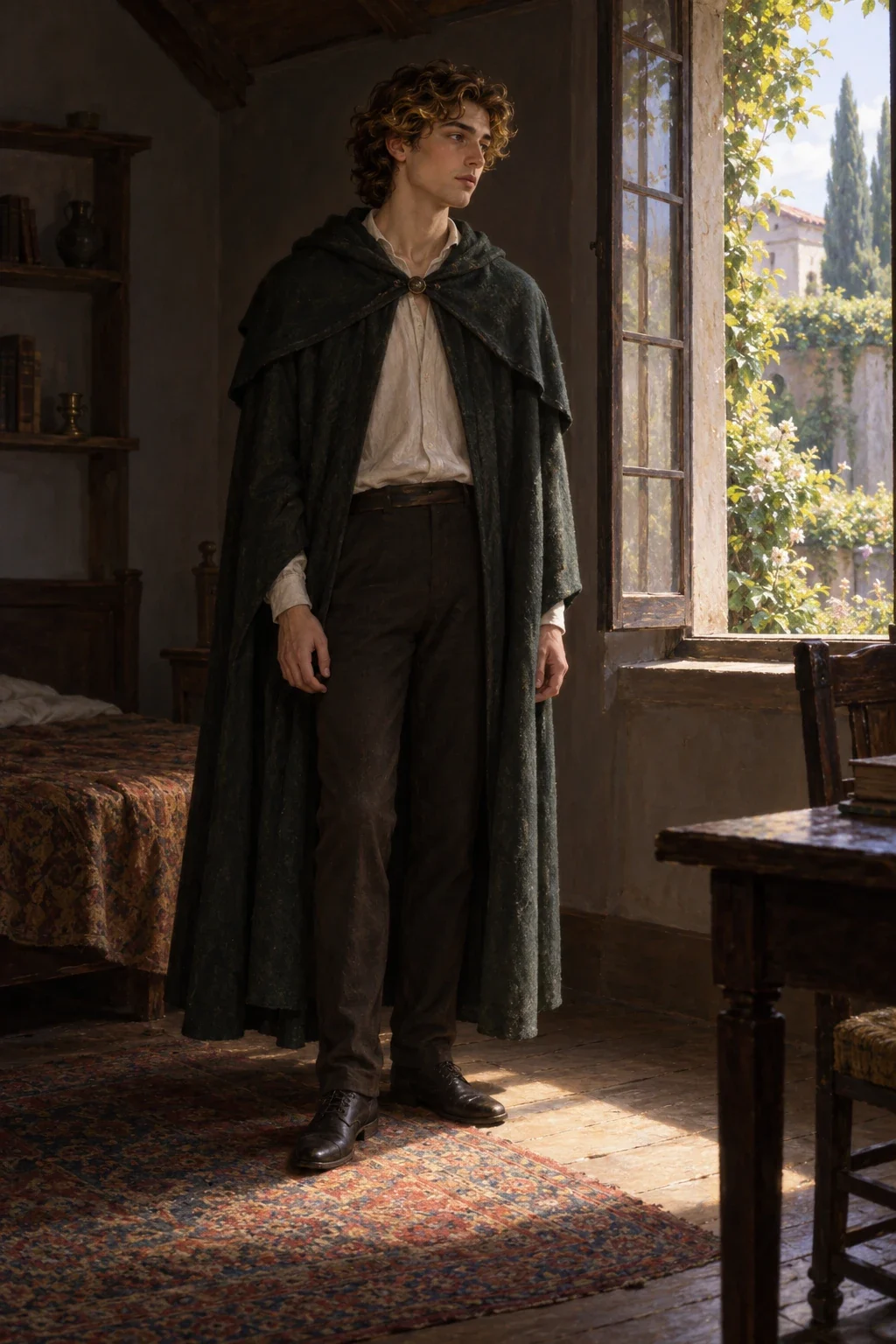
AI interpretation of Giovanni Guasconti standing beside his chamber window.
Overview
Giovanni arrives in Padua to study, with limited money and a letter introducing him to his father’s old friend, Professor Baglioni. From his gloomy rented chamber he watches Rappaccini’s garden and becomes fascinated by Beatrice. Apparent signs of danger—a dying lizard, an insect and a fading bouquet—are filtered through the narrator’s cautions about his senses and imagination. Baglioni warns him about Rappaccini’s experiments, but Giovanni pays Lisabetta for access to the garden and begins meeting Beatrice. She stops him touching the dangerous central shrub; a painful mark later appears where she grasped his hand. Their growing intimacy remains physically restrained, while his confidence alternates with suspicion.
After Baglioni supplies a purported antidote, Giovanni buys fresh flowers to test Beatrice. Before he reaches her, the bouquet withers in his own hand. He separately tests his breath on a spider, which dies. In the garden he then demonstrates the same power on flying insects and bitterly accuses Beatrice of having deliberately made him poisonous. She denies doing so and attributes their condition to her father’s science. Giovanni’s anger subsides enough for him to offer Baglioni’s medicine and propose that they drink together. Beatrice takes it first and tells him to await the result. At the same moment that she puts the antidote to her lips, Rappaccini emerges; he then announces that his experiment has made Giovanni a companion capable of sharing her dangerous condition. Beatrice dies from the antidote, condemning the hatred in Giovanni’s words. The narrator’s criticism of his shallow faith remains central; the ending supplies no later history or completed moral recovery for him.
First appearances & development
Giovanni Guasconti, the young student whose perceptions guide much of Hawthorne’s Rappaccini’s Daughter.
Canon & continuity
This profile follows the complete English narrative Rappaccini’s Daughter in the retained Mosses from an Old Manse witness, attributed to Nathaniel Hawthorne. Its original collection headings and contents identify the work, but do not establish the particular transcription’s print edition or date. Numbered paragraphs1–136 are local evidence locators, not original printed paragraph numbers.
Selected bibliography
Documented works and useful reading. This is not a list of every appearance.
- 01
Mosses from an Old Manse — Rappaccini’s Daughter
Complete selected English story in retained collection witness. Particular transcription print edition/date unestablished; no whole-collection reading claim.
Family & connections
A source-supported family tree or inspiration record has not yet been compiled for this profile. Related reading below indicates a connection in subject matter, not a proven lineage or creative influence.
References
Sources supporting this profile. Linked pages have their own scope and editorial standards.
- Historical public-domain authored English narrativeHawthorne — complete Rappaccini’s Daughter and retained original collection headingsResearch access: 2026-10-23
Image credits
AI-generated literary interpretationAI interpretation of Giovanni Guasconti standing beside his chamber window.