Piasa
Image associated with the exact linked encyclopedia article; consult credited file description for its interpretation.
Overview
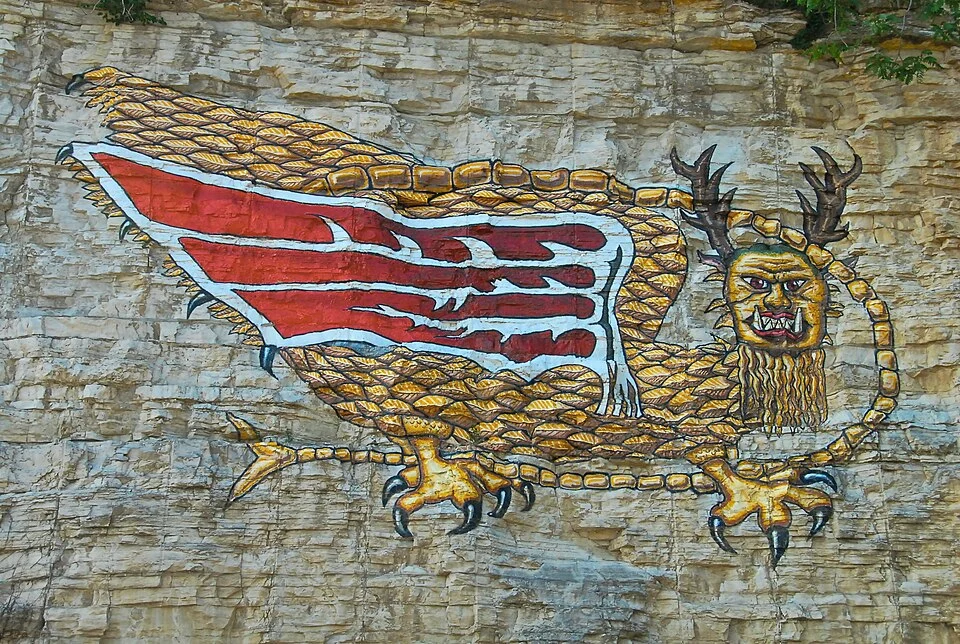
The University of Illinois project distinguishes Marquette’s 1673 description from a 1678 French drawing and a 1682 map. These document a Mississippi bluff image whose composite features do not fit a simple winged bird. The original was destroyed by quarrying in the 1850s; today’s roadside painting is a later reconstruction and reinterpretation.
Contributor Mark J. Wagner interprets the serpentlike tail, pantherlike body and antlered head through different regions of an Indigenous cosmos. He proposes a Mississippian-period origin rather than conclusively dating the painting. Early nineteenth-century reports of wings and subsequently written legends form additional layers. Keeping these witnesses separate prevents a later dramatic story from becoming a verbatim Indigenous account, or the present heritage display from becoming an exact copy of the destroyed original.
Origins & earliest records
The 1673 voyage account supplies a dated European description, with early drawings as additional witnesses. Proposed earlier Mississippian dating is a scholarly interpretation, not a surviving artist’s written date. A surviving record dates its documentation, not the beginning of an oral tradition; earlier transmission cannot be timed precisely from this witness alone.
Records & interpretation
Historic descriptions and drawings attest a lost image; archaeological comparison informs its interpretation. Later legends document reception, and cannot alone verify their plots or prove the identity intended by the original makers. This is evidence for cultural expression and recorded interpretation, rather than a zoological specimen or independently verified supernatural event.
Selected bibliography
Documented works and useful reading. This is not a list of every appearance.
- 01
Journal of Jacques Marquette’s Mississippi voyage
Selected relevant primary or ethnographic work; the online source below is separate.
Family & connections
A source-supported family tree or inspiration record has not yet been compiled for this profile. Related reading below indicates a connection in subject matter, not a proven lineage or creative influence.
Encyclopedia background
An additional attributed reference, separate from the editorial profile above.
Read the open encyclopedia overview
The Piasa ( PY-ə-saw) or Piasa Bird (aka Paillissa, Piesa) is a later name applied to the creature[s] from Native American mythology depicted in a mural painted by Native Americans high on cliffsides above the Mississippi River. Its original location was at the end of a chain of limestone bluffs in Madison County, Illinois, at present-day Alton, Illinois. Contemporary sketch of one of the beasts, which is wingless (and matching the description of a scaly quadruped with a man-like face and a long tail terminating in fishlike fins) is identifiable as the underwater panther type. A second mural site depicting tritons (mermen) was also rumored.
Later string of reports claimed the mural was still well preserved and visible upto the first half of the 19th century, and claimed to be called "piesa" in 1812. A painting published 1857 and a sketch published 1887 (claimed drawn 1825) purported to depict the creature with wings added, but many folklorists adjudge the eyewitnesses not to be earnest, deeming the attached legend of the chieftain Ouatoga (who fended his tribe from the bird, protected by a divine invisible shield) to be fakelore, i.e., a piece of fiction by John Russell (1836, 1848), with varying versions of this folktale explainable as works of other fabricators, or modified retellings collected orally from residents where Russell's tale had circulated. A separate legend, contending that a monster bird took sides in a historic tribal conflict between the local natives was published by Perry A. Armstrong (1887).
The wall where the original paintings existed at Alton was probably destroyed ca. 1850s. The mural has been restored with replicas a number of times in the 20th century (image right).
Text from Wikipedia contributors, “Piasa”. CC BY-SA 4.0. Extracted introduction; formatting changed. Retrieved 5 October 2026. The source article may have changed since retrieval.
References
Sources supporting this profile. Linked pages have their own scope and editorial standards.
- ReferenceUniversity of Illinois Mythic Mississippi Project: Piasa BirdResearch access: 2026-10-05
Image credits
Reference illustrationPiasa
Image associated with the exact linked encyclopedia article; consult credited file description for its interpretation.