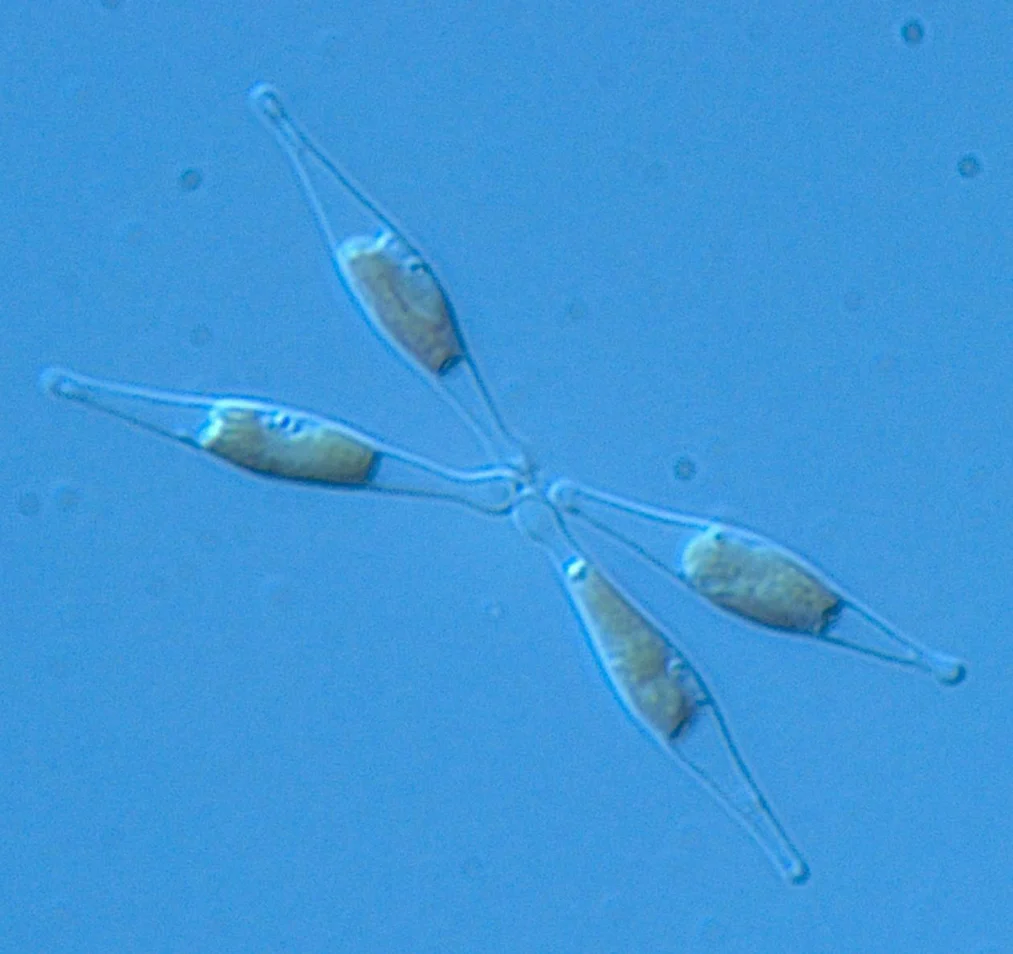
Light micrograph of four elongated Phaeodactylum tricornutum diatom cells with visible internal bodies against a blue background
The source identifies these elongated cells as Phaeodactylum tricornutum and credits Alessandra de Martino and Chris Bowler. The blue background belongs to the microscopy image, rather than a depiction of seawater habitat. No scale bar is supplied in this figure.
Overview
Phaeodactylum tricornutum is a marine diatom used to investigate cell biology and develop methods for manipulating algal genomes. Giguere and colleagues studied culture CCAP 1055/1, grown in silica-free medium under a controlled light cycle. Their 2022 work addressed gaps in its earlier nuclear reference sequence. A scaffold that ends prematurely is not necessarily an entire chromosome: repeated sequences and differing chromosome copies can interrupt assembly. The researchers combined ultra-long Oxford Nanopore reads with shorter Illumina reads and developed a way to recognize chromosome ends from telomeric repeats and neighbouring sequences.
The resulting reference comprises 25 nuclear chromosome assemblies extending from telomere to telomere, alongside circularized mitochondrial and chloroplast assemblies. Previously separate fragments could be placed within these continuous nuclear sequences. The team checked continuity using several independent paths of overlapping long reads. This is evidence for connecting sequence across difficult regions, rather than directly counting chromosomes in every cell of a wild population. Their separate estimate from groups of overlapping telomere-bearing reads closely agreed with 25 chromosomes, but depended on assumptions about chromosome copies, sequence divergence and read coverage.
The assembly is explicitly collapsed: it does not preserve every distinct chromosome copy or every variant present in the cultured population as a separately resolved sequence. Although about 98 percent of the long reads could be recruited to the reference, stringent alignment filtering reduced that fraction. A sequence-word benchmark estimated approximately 80 percent completeness, while a conserved-gene benchmark reported 95 percent. These measures ask different questions and are not interchangeable proofs that the whole genome is complete. The authors attributed much of the unrepresented sequence-word diversity to variation among chromosome copies and discussed mitotic recombination as a possible contributor.
Chromosome 19 differed from the others in its more uniform filtered read coverage and higher estimated base accuracy. The authors interpreted this pattern as reduced divergence among its chromosome copies and proposed a recent homogenization history. That explanation remains an inference from sequence patterns; the study did not directly observe the historical event. Nanopore signals also supported an association between predicted DNA methylation and long-terminal-repeat retrotransposons. Repetitive regions had complicated the older assembly and overlapped some areas of variable coverage. These results identify genomic regions for further testing, without demonstrating that each repeat caused a particular rearrangement or that methylation alone explains its function.
Origins & earliest records
The selected reference derives from the laboratory culture CCAP 1055/1; it is not an inferred ancestral genome or a species-wide population survey.
Evidence & interpretation
Long-read continuity checks, telomere grouping, short-read polishing and separate completeness metrics support a collapsed chromosome reference. Historical homogenization and causes of coverage variation remain interpretations.
Selected bibliography
Documented works and useful reading. This is not a list of every appearance.
- 01
Telomere-to-telomere genome assembly of Phaeodactylum tricornutum
PeerJ 10: e13607, 5 July. Complete main report, Methods and main caption texts read. Creative Commons Attribution licence; DOI 10.7717/peerj.13607.
Family & connections
A source-supported family tree or inspiration record has not yet been compiled for this profile. Related reading below indicates a connection in subject matter, not a proven lineage or creative influence.
Look for a taxonomic record and classified relativesReferences
Sources supporting this profile. Linked pages have their own scope and editorial standards.
- ResearchCCAP 1055/1 chromosome assemblyResearch access: 2026-10-06
Image credits
Scientific organism light micrographLight micrograph of four elongated Phaeodactylum tricornutum diatom cells with visible internal bodies against a blue background
The source identifies these elongated cells as Phaeodactylum tricornutum and credits Alessandra de Martino and Chris Bowler. The blue background belongs to the microscopy image, rather than a depiction of seawater habitat. No scale bar is supplied in this figure.