
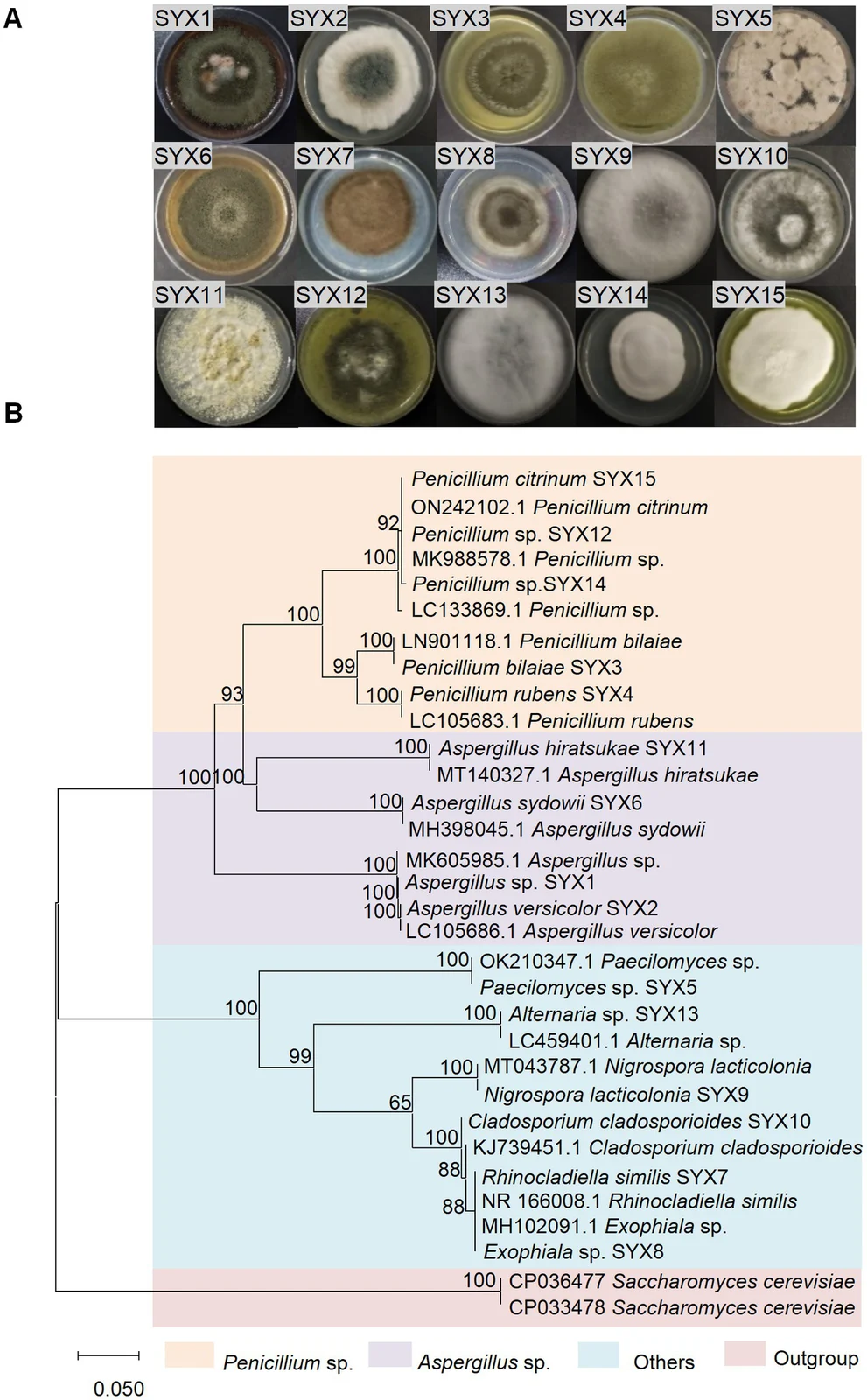
Penicillium rubens strain SYX4, fourth culture in the top row, among fifteen sediment-derived fungal cultures and an ITS phylogeny, Deng and colleagues 2023 figure 1
Penicillium rubens is the culture labelled SYX4, fourth from the left in the top row. The other dishes contain different fungal isolates. Deng and colleagues grew these sediment-derived cultures on potato dextrose agar for ten days and used morphology and ITS sequences for identification; the lower panel shows their inferred relationships. This is a laboratory isolate, not a photograph of the penicillin-production strain.
Overview
Penicillium rubens includes the preserved fungal isolate associated with Alexander Fleming’s discovery of penicillin and strains developed for industrial production. Historical names attached to this material include Penicillium notatum and Penicillium chrysogenum; the 2020 comparative study identifies the examined strains as P. rubens. This naming history does not make every organism ever called P. chrysogenum the same species. The study compares a particular set of identified cultures, rather than replacing all older classifications indiscriminately.
Researchers revived Fleming’s strain from the CABI living culture collection, where it is recorded as IMI 15378, also cross-referenced as ATCC 8537, NRRL 824 and CBS 205.57. These are identifiers of the preserved research isolate, not a type designation made by the genomic paper. Its draft genome was compared with the industrial strains Wisconsin 54-1255 and P2niaD18, which derive from a different wild American isolate, and with the related species Penicillium nalgiovense. The industrial history includes mutagenesis and selection, so present differences cannot automatically be interpreted as unaltered geographical variation.
The Fleming-strain assembly spans about 30.46 million bases in 101 scaffolds. It was built from pooled short-read libraries and retains the limitations of a draft assembly rather than providing fully resolved chromosomes. The examined penicillin G synthesis pathway includes the clustered genes pcbAB, pcbC and penDE. Their sequences differ between the Fleming isolate and the two industrial strains, while the industrial strains match each other at the focal production and regulatory genes. Regulatory conservation therefore contrasts with variation in several enzyme-encoding genes; it does not establish that every regulatory mechanism is identical.
Structural changes tell a partly different story. P2niaD18 contains a tandem duplication of the principal synthesis-gene cluster, and partial duplicate fragments occur in other pathway regions. Some are absent from Fleming’s genome. The authors suggest possible regulatory functions, but also acknowledge that fragments might be neutral or harmful consequences of mutagenesis. The comparison does not demonstrate that every duplication increases antibiotic output, nor does it resolve whether all shared industrial differences arose before collection or during their early laboratory history.
The study proposes that some amino-acid differences accumulated during divergence of wild progenitors, whereas industrial improvement prominently involved structural changes. Its sequence models did not detect statistically significant positive selection. Whether the variants alter enzyme efficiency, substrate preference or the chemical products still requires functional investigation. The preserved fungus is consequently both a historical biological record and a comparative research organism: genomic differences can generate testable explanations without proving a new medicine or a superior production strain.
Origins & earliest records
Account centered on Pathak and colleagues’ 2020 comparison of preserved IMI 15378 with industrial isolates and P. nalgiovense; historical isolation and later taxonomic reassignment are reported through that study.
Evidence & interpretation
Short-read draft assembly, genome alignments, pathway-gene searches and sequence models support identified strain differences. Proposed functional consequences and wild-versus-industrial origins remain qualified.
Selected bibliography
Documented works and useful reading. This is not a list of every appearance.
- 01
Comparative genomics of Alexander Fleming’s original Penicillium isolate (IMI 15378) reveals sequence divergence of penicillin synthesis genes
Scientific Reports 10, 15705. Complete main introduction, culturing/assembly/gene-analysis Methods, Results and Discussion. CC BY 4.0 adaptation credited. Assembly GCA_902636305.1, Study PRJEB35151.
- 02
Fleming’s penicillin producing strain is not Penicillium chrysogenum but P. rubens
IMA Fungus2(1):87–95,7June2011.
Family, evolution & connections
Penicillium, 2011
Figure 1; isolates collapsed.
Scroll sideways to see all branches. With a keyboard, focus the tree and use the arrow keys.
- Selected clade
- Penicillium flavigenum
- Paired lineages
- Penicillium chrysogenum
Three-gene partitioned RAxML GTR. Sampled lineages; no ancestors, dates or recomputed supports.
Taxonomic classification
A hierarchy of classified groups, not a chain of direct ancestors.
- GenusPenicillium
- SpeciesPenicillium rubens
P2niaD18 and Wisconsin 54-1255 industrial strains
Pathak and colleagues compared Fleming’s preserved isolate with two industrial strains derived from a separate American isolate. The industrial strains differed structurally but shared the focal penicillin-pathway protein sequences; Fleming’s isolate differed at several pathway genes. These are comparisons among strains, not a chain of separate species. The study did not detect significant positive selection or establish whether every difference arose before or during industrial improvement.
Located primary passages
Specific passages supporting details in this entry, grouped by their published witness.
Fleming’s penicillin producing strain is not Penicillium chrysogenum but P. rubens
IMA Fungus2(1):87–95,7June2011.
- Combined partial β-tubulin, calmodulin and RPB2 sequences distinguish two strongly supported species groups. Fleming’s preserved isolate and important Wisconsin production strains fall within P.rubens. Similar appearance alone did not clearly separate the groups; metabolite profiles supplied additional evidence. The discussion distinguishes modern reidentification from historical naming under earlier classifications and leaves the exact contamination route hypothetical.
Complete main Introduction/Methods/Results/Taxonomy/Discussion; original87 licence checked.
Historical originals and raw alignments uninspected; no experimental protocols or universal penicillin-producer claim.
References
Sources supporting this profile. Linked pages have their own scope and editorial standards.
- ResearchPathak et al. 2020, primary strain-genomics study (CC BY 4.0)Research access: 2026-10-05
Image credits
Scientific fungal culture photographs and phylogeny figurePenicillium rubens strain SYX4, fourth culture in the top row, among fifteen sediment-derived fungal cultures and an ITS phylogeny, Deng and colleagues 2023 figure 1
Penicillium rubens is the culture labelled SYX4, fourth from the left in the top row. The other dishes contain different fungal isolates. Deng and colleagues grew these sediment-derived cultures on potato dextrose agar for ten days and used morphology and ITS sequences for identification; the lower panel shows their inferred relationships. This is a laboratory isolate, not a photograph of the penicillin-production strain.