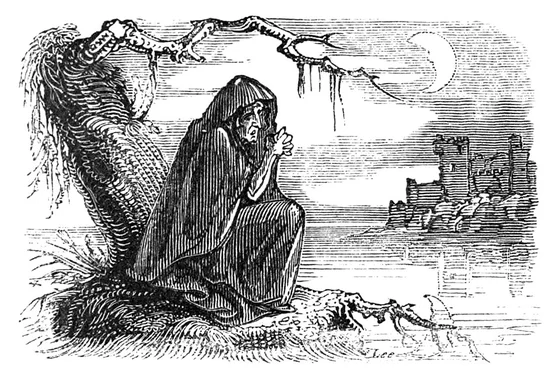
A sourced illustration has not yet been added. This gap is included in the coverage record.
Overview
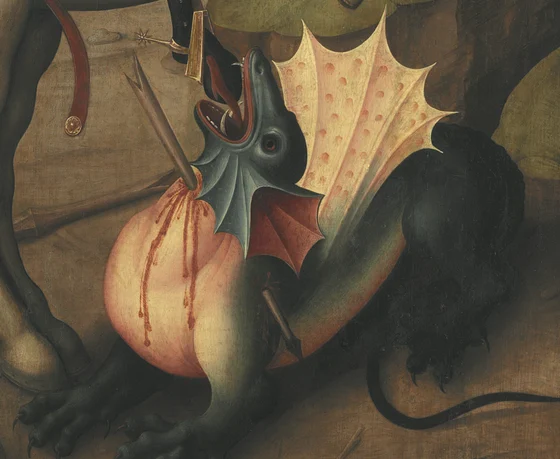
The narrator’s unnamed cowherd guide locates the creature’s pool near the ruined O’Rourke hall at Dromahair and reports a story his father heard from Manus O’Rourke. Repeated dreams promise Manus wealth if he dives there at midnight on the eve of All Saints. Beneath the river he meets the Payshtha-more: about seven yards long, shaped like a huge conger eel, thick through the body like a bull, and maned at the neck like a horse. It speaks English, recognizes him and threatens punishment, then spares him because he has some O’Rourke blood.
The guardian opens an iron door in the riverbed into a dry cave which admits no water. Once inside, he shrinks to a brownish man about four feet tall. Asked whether he belongs to the good people, he declines to give a firm answer; when Manus suggests a banshee, he explicitly rejects that identification. He says his obligation is to protect the lords of Breffni through generations and guard their holdings until the old family returns to rule. The contents include precious vessels, family money, weapons for three hundred men, regalia and legal papers: a whole dynastic inheritance rather than an indiscriminate heap of gold.
Manus is forbidden to return and must leave by another opening, Poul-maw-Gullyawn. The guardian propels him upward. The storyteller’s ending complicates his account: his wife actually finds him asleep beside an empty bottle on the island, away from the place where he believes he emerged. The cowherd says his father heard Manus swear to the story. This layered recollection and drinking-related ending remain part of the witness; they do not establish an independently examined underwater guardian or require identifying the creature with every Irish serpent legend.
Origins & earliest records
T. Crofton Croker, Fairy Legends and Traditions of the South of Ireland, condensed new edition, Philadelphia: Lea and Blanchard, 1844; XXXVI, Linn-na-Payshtha, pp. 220–225. The narrative reports an unnamed cowherd’s version, attributed through his father to Manus O’Rourke.
Records & interpretation
The complete edited story supplies the maned eellike form, reduced human form, stated family obligation and competing details of Manus’s eventual discovery. Its named pools and dynastic setting are narrative locations rather than independently verified supernatural sites.
Selected bibliography
Documented works and useful reading. This is not a list of every appearance.
- 01
Fairy Legends XXXVI: Linn-na-Payshtha, pp. 220–225
Complete story and concluding discovery read. The separate treasure-section note is comparative editorial commentary, not an additional biography.
Family & connections
A source-supported family tree or inspiration record has not yet been compiled for this profile. Related reading below indicates a connection in subject matter, not a proven lineage or creative influence.
References
Sources supporting this profile. Linked pages have their own scope and editorial standards.
- Primary edited folklore collectionCroker’s Fairy Legends, 1844 edition transcriptionResearch access: 2026-10-05
Image credits
A sourced illustration has not yet been added. This gap is included in the coverage record.