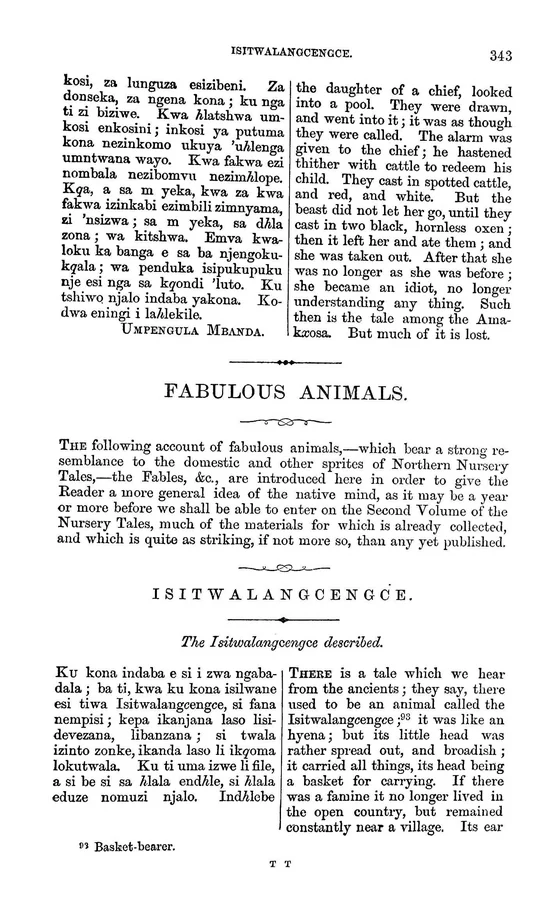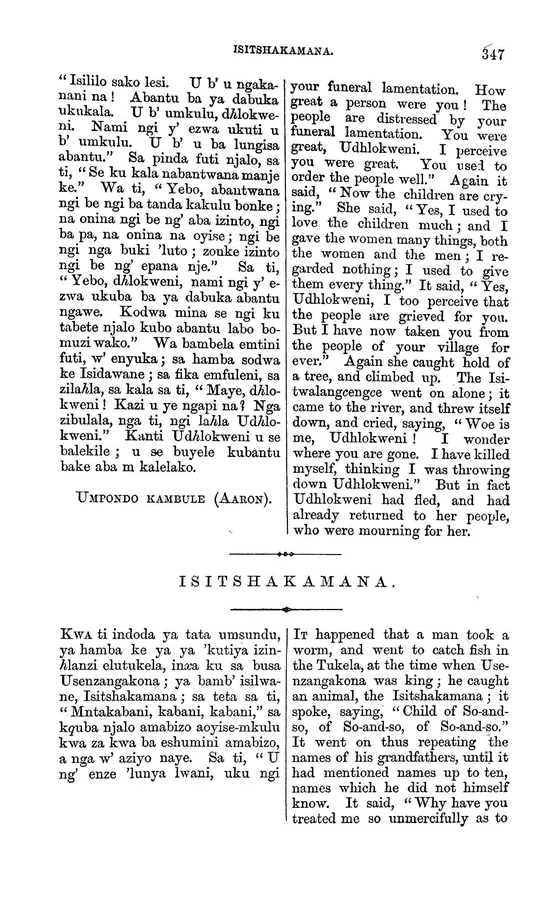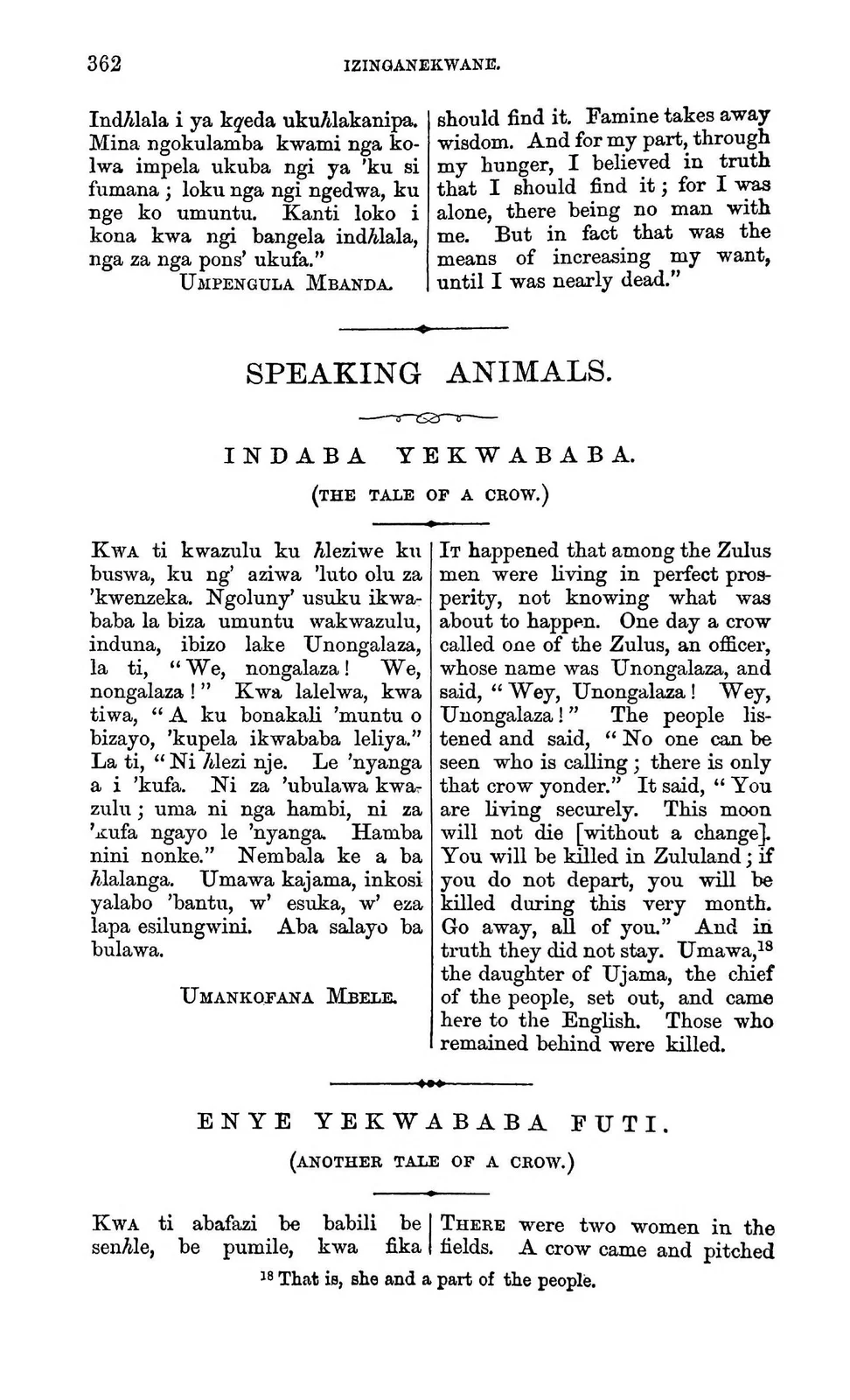
Speaking Omen Crows in Callaway’s Accounts: documentary text witness, Callaway 1868, printed page 362; documentary source-page facsimile
Named warning crow Unongalaza and printed first narrator credit; second crow-account heading begins below. Individually inspected original bilingual Zulu/English scanned page; documentary text, no creature illustration claimed. Physical edition 1868; translator/editor distinguished from traditional narrators. Public-domain publication and expired Callaway lifetime.
Overview
In Umankofana Mbele’s account, people in Zululand live without anticipating danger when a crow calls the officer Unongalaza by name. The listeners see no human speaker, only the bird. It warns that people will be killed before the month ends and tells them all to depart. Umawa, daughter of Ujama, leaves with part of the community toward the English; the narration says those who remain are killed. The crow’s warning and claimed fulfilment belong to this attributed account, without an independently established event date.
A second account, credited to Uluhoho Madonda, concerns two women in the fields. A crow perches on a tree and laments over a woman who has no children, asking what she will do. The women flee home and report the speech, which others call an omen. The named woman’s husband becomes very ill afterward. This second report is an ominous lament with a subsequent illness, not the same political warning or evidence that the bird caused the illness. The two witnesses are grouped by their speaking-crow motif while their settings, messages and contributors remain separate.
Origins & earliest records
The selected account credits Umankofana Mbele; Uluhoho Madonda. Callaway supplies the English translation and commentary; personal recollection, hearsay and editorial explanation are separated below.
Records & interpretation
Complete selected account read: Speaking Animals: The Tale of a Crow, p. 362; Another Tale of a Crow, pp. 362–363.
Selected bibliography
Documented works and useful reading. This is not a list of every appearance.
- 01
Nursery Tales, Traditions, and Histories of the Zulus, in Their Own Words, volume I
Speaking Animals: The Tale of a Crow, p. 362; Another Tale of a Crow, pp. 362–363
- 02
Nursery Tales, Traditions, and Histories of the Zulus, Volume I
Henry Callaway, Nursery Tales, Traditions, and Histories of the Zulus, Volume I, Springvale, Natal: John A. Blair, 1868; bilingual Zulu/English edition, selected Princeton scan. Complete individual accounts read; narrator credits retained at section boundaries.
Family & connections
A source-supported family tree or inspiration record has not yet been compiled for this profile. Related reading below indicates a connection in subject matter, not a proven lineage or creative influence.
Located primary passages
Specific passages supporting details in this entry, grouped by their published witness.
Nursery Tales, Traditions, and Histories of the Zulus, in Their Own Words, volume I
Henry Callaway, Nursery Tales, Traditions, and Histories of the Zulus, Volume I, Springvale, Natal: John A. Blair, 1868; bilingual Zulu/English edition, selected Princeton scan. Complete individual accounts read; narrator credits retained at section boundaries.
- A crow calls the officer Unongalaza and warns that people remaining in Zululand will be killed before the month ends. Umawa, daughter of Ujama, departs toward the English settlement with part of the community; those staying are said to be killed.
Indaba yekwababa / The Tale of a Crow, printed p.362; footnote14
- Two women hear a crow lamenting a childless woman’s prospects. They report the event as an omen; the account identifies the woman as Usipongo’s daughter of Idhlanimi among the Amakuza and ends with her husband becoming very ill.
Enye yekwababa futi / Another Tale of a Crow, printed pp.362–363
Attributed omen account, not independently corroborated chronology. The footnote specifies only part of the people departed. The account supplies illness, not his death. The crow’s kinship address is not proof of literal crow-human parentage.
References
Sources supporting this profile. Linked pages have their own scope and editorial standards.
- Attributed primary account with translation; digitized bilingual editionCallaway bilingual edition — Speaking Animals: The Tale of a Crow, p. 362; Another Tale of a Crow, pp. 362–363Research access: 2026-10-05
Image credits
Historical text facsimileSpeaking Omen Crows in Callaway’s Accounts: documentary text witness, Callaway 1868, printed page 362; documentary source-page facsimile
Named warning crow Unongalaza and printed first narrator credit; second crow-account heading begins below. Individually inspected original bilingual Zulu/English scanned page; documentary text, no creature illustration claimed. Physical edition 1868; translator/editor distinguished from traditional narrators. Public-domain publication and expired Callaway lifetime.