A sourced illustration has not yet been added. This gap is included in the coverage record.
Overview
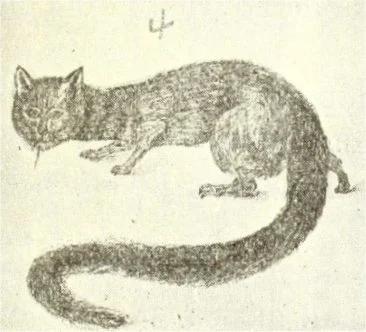
Lecturas Araucanas describes the guardian as a ñullñull, a sea-cat whose movement changes the direction of the ocean's sound. People fear killing or imprisoning it: the sea follows the captor up the rocks and threatens to swallow them unless the animal is released. Villagrán and colleagues repeat this animal-shaped account in their 1999 study of Mapuche ethnozoology, citing Plath for the narrative.
Yuri Jeria Muñoz's ethnographic account of Tirúa Sur records another context. A coastal delegation makes offerings to Ngenlafken, also called lafkenwentro, following a land-based nguillatun. Juan Segundo Huenupil explains the connection between these observances. The coastal ceremony asks for abundance of marine resources, including cochayuyo. This living religious relationship does not depend on imposing the earlier sea-cat appearance on every participant's understanding.
The original 1910 appendix places this sea-cat account inside Augusta’s disagreement with earlier missionary terminology. He argues that nguen should not automatically be translated as a god, but describes control over a particular sphere. His examples distinguish a well-guarding toad called arəmko from Nguenlafquen and from people credited with influence over rain. These adjacent figures are not alternate animal bodies assigned to one universal water deity. His statement that people probably invoke the sea guardian for successful fishing is explicitly tentative; the more definite report concerns the consequences of capturing it. Thus the appendix supplies a particular interpretation of relationships among beings and people, filtered through missionary comparison. The later Tirúa testimony offers a separately attributed account of observance, rather than retroactively proving every inference Augusta made.
Origins & earliest records
The 1910 Lecturas Araucanas collection supplies an early published witness inspected here, but its missionary interpretation requires attribution. Jeria's 2019 book reports research from 1996–2002 rather than the beginning of the coastal practice. Ngenlafken's name and role belong to ongoing cultural traditions, not an extinct monster classification.
Records & interpretation
The historical appendix was read in transcription, and Villagrán et al.'s printed p. 604 was inspected directly. Jeria's publication details were verified in the PDF colophon; the indexed coastal-ceremony passage names its speaker. These witnesses establish differing contexts rather than a universal appearance, and their descriptions are not independent proof of supernatural events. Original p.236 and the full surrounding Observaciones were checked; its probable fishing invocation remains qualified.
Selected bibliography
Documented works and useful reading. This is not a list of every appearance.
- 01
Lecturas Araucanas: Apéndice
Appendix, complete Observaciones on Valdivia, pp.235–239; Nguenlafquen and neighbouring nguen examples p.236. Original page checked; missionary interpretation distinguished from reports.
- 02
En los caminos del Lafkenmapu. Relatos etnográficos desde las costas de la provincia de Arauco (1996–2002)
Servicio Nacional del Patrimonio Cultural; Tirúa Sur coastal observance and named speaker.
Family & connections
A source-supported family tree or inspiration record has not yet been compiled for this profile. Related reading below indicates a connection in subject matter, not a proven lineage or creative influence.
References
Sources supporting this profile. Linked pages have their own scope and editorial standards.
- Primary textLecturas Araucanas (1910), appendix: NguenlafquenResearch access: 2026-10-05
- ResearchVillagrán et al.: Etnozoología Mapuche: un estudio preliminar (1999), p. 604Research access: 2026-10-05
- ResearchJeria Muñoz: En los caminos del Lafkenmapu (2019)Research access: 2026-10-05
Image credits
A sourced illustration has not yet been added. This gap is included in the coverage record.