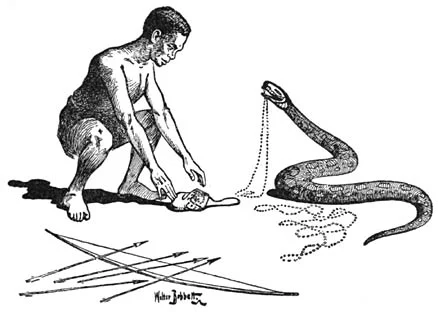
A coiled snake holds a chain beside a crouching youth and an open bag; a bow and arrows lie in the foreground.
Bobbett’s historical illustration of Neeoka giving chains to the youth who released him from a trap, in Bateman’s The Ape, the Snake, and the Lion. An imagined narrative scene, distinct from the seven-headed palace serpent.
Overview
Neeoka is caught in a young hunter’s trap after an ape has already been released from it. The hunter initially goes to summon villagers to kill the snake, but Neeoka calls him back, asks for freedom and promises reciprocal help. He cautions the youth that a man may repay kindness with injury. The hunter subsequently frees an old lion and a man as well. When scarcity returns, he loses his way while hunting; the ape and lion separately supply food, forming earlier instances of the animals’ promised gratitude.
Neeoka reappears as a large snake inside a well near the road to a principal town. The youth does not recognize him at first. Neeoka recalls the rescue, fills his small bag with gold and silver chains and tells him to use them for his benefit. The freed man later offers the youth lodging, but secretly tells the sultan that the visitor is a snake capable of appearing human. He also persuades the assembled people to fear harm to the rulers’ children from the bag. The youth is bound after this accusation; the narrative does not establish that he really transforms into a serpent.
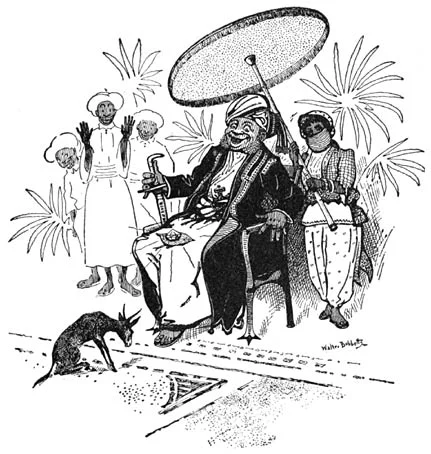
The actual snake arrives and lies at the accuser’s feet. His refusal to move turns suspicion back upon that man and leads to the hunter’s release. The youth then explains the successive rescues and the animals’ warnings. The sultan answers that some people are ungrateful, rather than accepting a rule condemning all humanity, and declares the accuser deserving of death. The final pronouncement is not followed by a narrated execution. Neeoka’s intervention completes a reciprocal rescue, distinct from the snake king and royal marriage in another tale of the same collection.
Origins & earliest records
George W. Bateman, translator, Zanzibar Tales (1901), VI, The Ape, the Snake, and the Lion, complete pp. 81–96; collection introduction pp. 5–9.
Records & interpretation
Entire chapter VI read through the sultan’s final distinction and sentence. Neeoka’s trap rescue, well treasure and physical appearance at the accuser’s feet are explicit. The youth’s alleged snake transformation is a false accusation, not an attested power. The death sentence is not inflated into an execution.
Selected bibliography
Documented works and useful reading. This is not a list of every appearance.
- 01
Zanzibar Tales
VI, whole pp. 81–96; translator’s introduction pp. 5–9 for collection context.
- 02
Zanzibar Tales: Told by Natives of the East Coast of Africa
Chicago: A. C. McClurg & Co., 1901; translated from Swahili by George W. Bateman. Title, copyright leaf and complete To My Readers pp. 5–9, dated 1 August 1901, independently read.
Family & connections
A source-supported family tree or inspiration record has not yet been compiled for this profile. Related reading below indicates a connection in subject matter, not a proven lineage or creative influence.
Located primary passages
Specific passages supporting details in this entry, grouped by their published witness.
Zanzibar Tales: Told by Natives of the East Coast of Africa
Chicago: A. C. McClurg & Co., 1901; translated from Swahili by George W. Bateman. Title, copyright leaf and complete To My Readers pp. 5–9, dated 1 August 1901, independently read.
- The rescued snake defeats a false accusation.
Narrators individually unnamed. Bateman’s provenance statement is a published claim, not independently verified transmission or independence from Steere; no original Swahili collation, medicinal claim or universal zoological assertion.
References
Sources supporting this profile. Linked pages have their own scope and editorial standards.
- Historical collected tale in English translationBateman 1901: The Ape, the Snake, and the LionResearch access: 2026-10-05
Image credits
Exact narrative illustration in historical American collected-tale editionA coiled snake holds a chain beside a crouching youth and an open bag; a bow and arrows lie in the foreground.
Bobbett’s historical illustration of Neeoka giving chains to the youth who released him from a trap, in Bateman’s The Ape, the Snake, and the Lion. An imagined narrative scene, distinct from the seven-headed palace serpent.