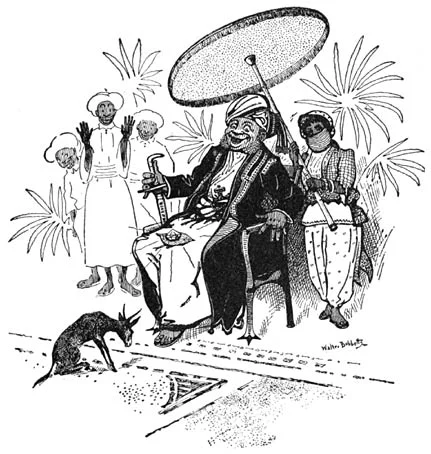
A gazelle bends before a seated sultan with a small parcel, while attendants surround the chair and hold a large parasol.
Bobbett’s imagined scene of Keejeepaa presenting the diamond in Bateman’s Haamdaanee. The illustration’s stylized figures belong to this 1901 American publication; they are not portraits of named Swahili community members.
Overview
Haamdaanee buys the small gazelle Keejeepaa with the coin he found while searching a refuse heap for food. For a week they share the poor man’s meagre millet. Keejeepaa then speaks, startling his owner, and negotiates permission to feed outside each day while promising to return every evening. He keeps that promise. Finding a large diamond, he decides that merely giving it to the poor man might expose him to suspicion; instead he presents it to a sultan as a gift from an invented wealthy master, Sultan Daaraaee, and negotiates a royal marriage.
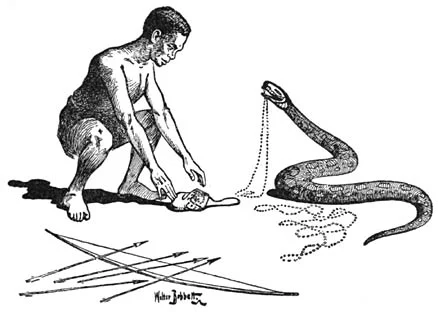
To sustain the invented identity, Keejeepaa beats Haamdaanee near a stream and reports that robbers stripped and injured him. The sultan supplies clothing, weapons and a horse. The gazelle leads the horse by a bridle tied around his neck, has Haamdaanee clean and dress himself, and instructs him to let the gazelle speak. After the marriage, Keejeepaa searches for a suitable home and finds a seemingly deserted town. Its magnificent palace belongs to Neeoka Mkoo, a seven-headed snake whose captive cook warns him of previous deaths. Using the snake’s own sword and the doorway as an advantage, Keejeepaa cuts off each arriving head. After the seventh, he faints and the old woman revives him.
The palace contains goods, food, people held prisoner, horses and enslaved people. Keejeepaa brings his master and the bride there; Haamdaanee orders the prisoners released. During their journey the gazelle attends to everyone’s food and comfort, gaining affection that his master does not share. Settled in the palace, Keejeepaa worries that Haamdaanee has neither asked how these possessions were obtained nor returned his kindness. When he becomes ill, the master offers inferior millet food and repeatedly refuses further care, despite the old woman’s reports and his wife’s protests.
The wife finally sends suitable food, bedding and an offer of physicians, but Keejeepaa dies before these arrive. Haamdaanee orders his body thrown into a well. The bride summons her father, whose party retrieves and buries the gazelle. That night husband and wife dream of their former homes and awaken there: she among her own people, he again at the refuse heap. The conclusion leaves the gazelle dead, the wife happy and Haamdaanee poor until death. No resurrection or explicitly named agent of the final return is supplied.
Origins & earliest records
George W. Bateman, translator, Zanzibar Tales (1901), VII, Haamdaanee, complete pp. 99–151; introduction pp. 5–9 for the translator’s collection claim. Individual oral contributor not named.
Records & interpretation
Entire long tale read through gazelle burial, separate dream returns and both human outcomes on pp. 150–151. Serpent scene pp. 127–135 lies within that complete witness. Invented identity, attributed hearing warning and unspecified final agency are kept distinct from demonstrated events.
Selected bibliography
Documented works and useful reading. This is not a list of every appearance.
- 01
Zanzibar Tales
VII, whole pp. 99–151; seven-headed serpent episode pp. 127–135, illness/burial/return ending pp. 139–151.
- 02
Zanzibar Tales: Told by Natives of the East Coast of Africa
Chicago: A. C. McClurg & Co., 1901; translated from Swahili by George W. Bateman. Title, copyright leaf and complete To My Readers pp. 5–9, dated 1 August 1901, independently read.
Family & connections
A source-supported family tree or inspiration record has not yet been compiled for this profile. Related reading below indicates a connection in subject matter, not a proven lineage or creative influence.
Located primary passages
Specific passages supporting details in this entry, grouped by their published witness.
Zanzibar Tales: Told by Natives of the East Coast of Africa
Chicago: A. C. McClurg & Co., 1901; translated from Swahili by George W. Bateman. Title, copyright leaf and complete To My Readers pp. 5–9, dated 1 August 1901, independently read.
- The benefactor dies and prosperity is reversed.
Narrators individually unnamed. Bateman’s provenance statement is a published claim, not independently verified transmission or independence from Steere; no original Swahili collation, medicinal claim or universal zoological assertion.
References
Sources supporting this profile. Linked pages have their own scope and editorial standards.
- Historical collected tale in English translationBateman 1901: complete Haamdaanee taleResearch access: 2026-10-05
Image credits
Exact narrative illustration in historical American collected-tale editionA gazelle bends before a seated sultan with a small parcel, while attendants surround the chair and hold a large parasol.
Bobbett’s imagined scene of Keejeepaa presenting the diamond in Bateman’s Haamdaanee. The illustration’s stylized figures belong to this 1901 American publication; they are not portraits of named Swahili community members.