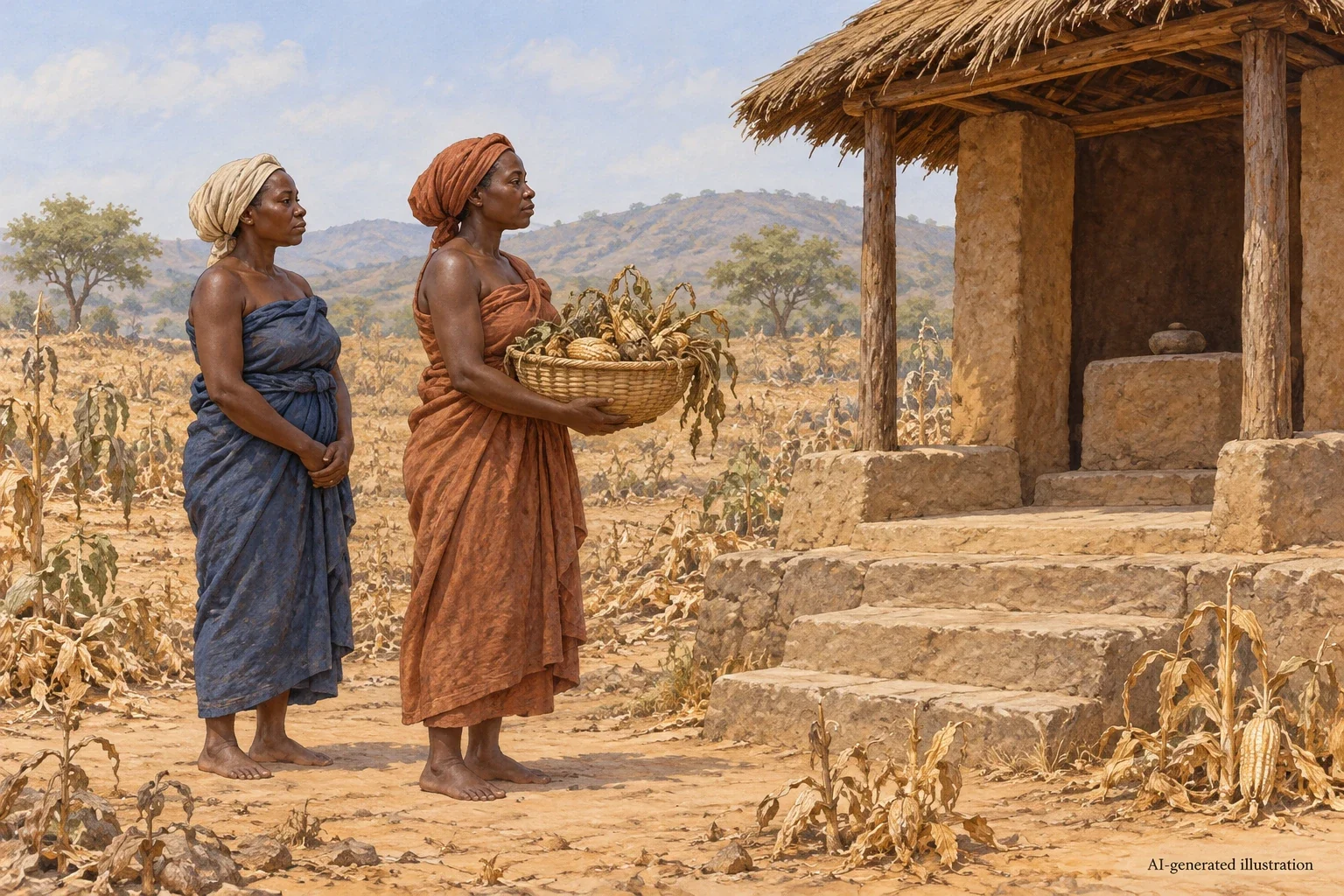
Two imagined female messengers carry a basket of withered produce to a shrine.
Women bring withered produce during the drought appeal to Nagawonyi. Human appearance, garment and scenery are illustrative choices, not authenticated divine anatomy or historical costume.
Overview
Roscoe calls Nagawonyi the goddess of hunger and places her temple on Mubande hill in Bulemezi. Her priests belong to the Bird Clan. During drought and crop failure, people send offerings together with samples of withered produce, showing the need behind their request. Women serve as messengers and ask her to pity her dying children. The account describes intercession: Nagawonyi is expected to influence Musoke and Gulu, the gods associated here with command of the elements.
The medium, while possessed, gives an oracle about when rain may be expected. The subsection then changes from insufficient rain to dangerous weather. When rain is very heavy and lightning severe, people make smoky fires to keep the clouds from falling and beat drums so Gulu will know where they are and refrain from harming them. These connected appeals preserve distinctions between hunger, mediation and elemental power. They do not make Nagawonyi the sole source of all weather. Roscoe supplies no appearance for the goddess, individual teller for the passage or evidence verifying the stated weather effects; the profile retains the historical attribution and its limits.
Origins & earliest records
John Roscoe, The Baganda (London: Macmillan,1911), Chapter IX, p.315.
Records & interpretation
Complete Nagawonyi subsection through the smoky-fire and drum response to severe rain/lightning, before the separate Walumbe account. Complete selected continuous subsection and preface ix–xii read from retained original English OCR. No whole-book or contemporary-community consensus claim.
Selected bibliography
Documented works and useful reading. This is not a list of every appearance.
- 01
The Baganda: An Account of Their Native Customs and Beliefs
Chapter IX, p.315, complete selected subsection; preface ix–xii for method and mediation.
Family & connections
A source-supported family tree or inspiration record has not yet been compiled for this profile. Related reading below indicates a connection in subject matter, not a proven lineage or creative influence.
References
Sources supporting this profile. Linked pages have their own scope and editorial standards.
- Historical missionary-mediated ethnographic collectionRoscoe1911 — Nagawonyi in Roscoe’s Rain-Appeal AccountResearch access: 2026-10-17
Image credits
Original imagined narrative scene; physical appearance, costume and setting are illustrative choices. No authenticated divine anatomy, historical costume or current ritual documentation.Two imagined female messengers carry a basket of withered produce to a shrine.
Women bring withered produce during the drought appeal to Nagawonyi. Human appearance, garment and scenery are illustrative choices, not authenticated divine anatomy or historical costume.