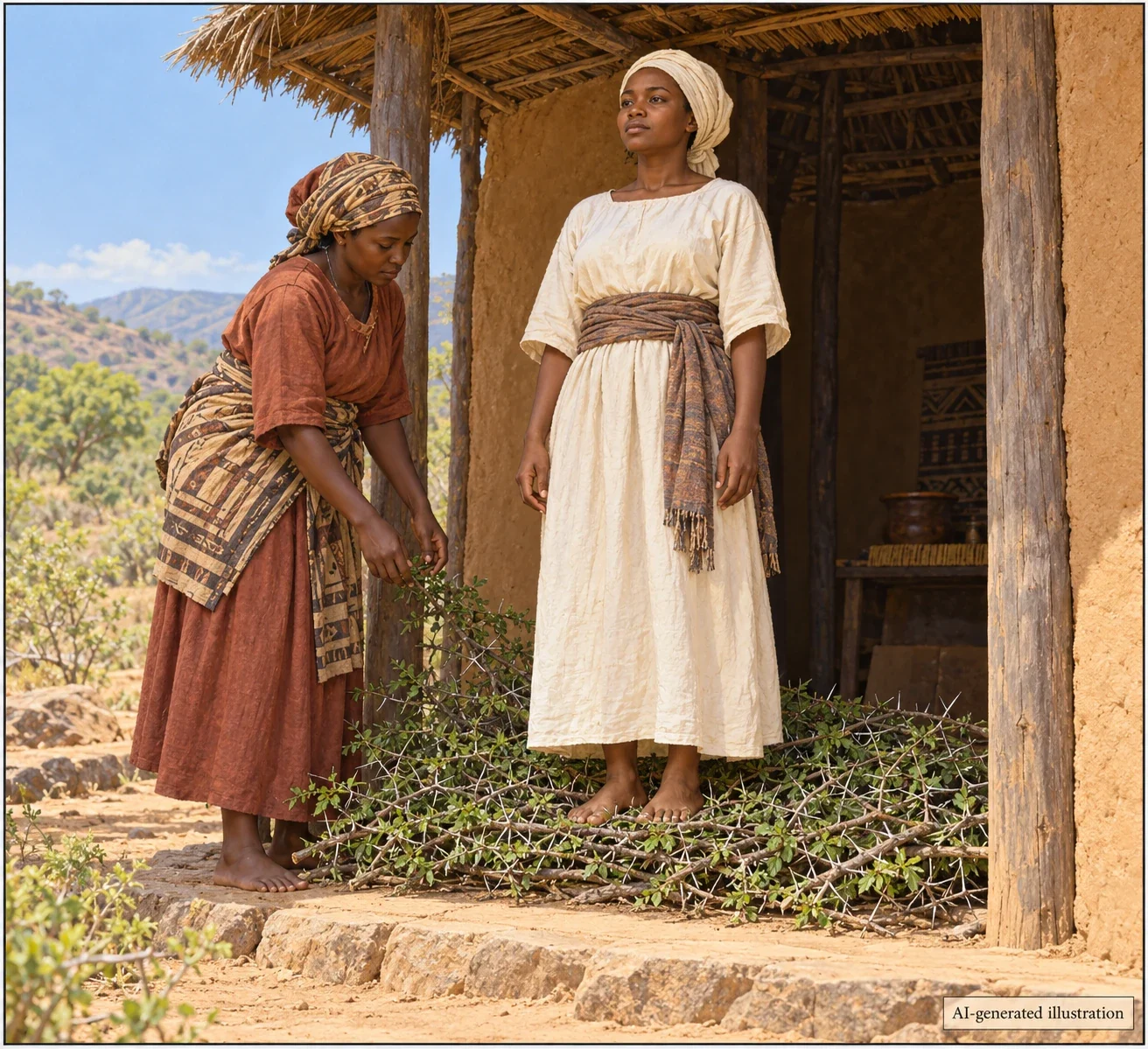
An imagined medium stands on a low layer of shrubs beside a priestess.
The female medium gives Mirimu’s oracle while standing on shrubs in Roscoe’s reported account. Human appearance, garment and scenery are illustrative choices, not authenticated divine anatomy or historical costume.
Overview
Roscoe identifies Mirimu as a son of Mukasa and locates his temple on Ndeje hill in Bulemezi. Its medium is a woman, served by priestesses. Before an oracle, the priestesses gather shrubs called Nkangwe and place them in the doorway. The medium stands barefoot on the shrubs, becomes possessed and delivers the message. The text expressly says the thorns neither injure nor pierce her feet. This is the account’s reported extraordinary protection, not a demonstrated property of the plant or an instruction for safe conduct.
The deity is also credited with enabling people to capture their enemies’ weapons in battle. Roscoe says the medium and priestesses officiate in the usual temple dress but gives no precise garment description in this subsection. Neither that costume nor the woman’s body is a description of Mirimu’s divine anatomy. The named plant is retained as a historical label without a botanical species identification. The short account supplies no individual narrator, dated performance or present-day survey; its scope is a remembered institution transmitted through the collection’s intermediaries.
Origins & earliest records
John Roscoe, The Baganda (London: Macmillan,1911), Chapter IX, p.313.
Records & interpretation
Complete Mirimu subsection: attributed parentage, temple location, female medium/priestesses, Nkangwe doorway preparation, uninjured feet and enemy-weapon capture association. Complete selected continuous subsection and preface ix–xii read from retained original English OCR. No whole-book or contemporary-community consensus claim.
Selected bibliography
Documented works and useful reading. This is not a list of every appearance.
- 01
The Baganda: An Account of Their Native Customs and Beliefs
Chapter IX, p.313, complete selected subsection; preface ix–xii for method and mediation.
Family & connections
A source-supported family tree or inspiration record has not yet been compiled for this profile. Related reading below indicates a connection in subject matter, not a proven lineage or creative influence.
References
Sources supporting this profile. Linked pages have their own scope and editorial standards.
- Historical missionary-mediated ethnographic collectionRoscoe1911 — Mirimu in Roscoe’s Thorn-Oracle AccountResearch access: 2026-10-17
Image credits
Original imagined narrative scene; physical appearance, costume and setting are illustrative choices. No authenticated divine anatomy, historical costume or current ritual documentation.An imagined medium stands on a low layer of shrubs beside a priestess.
The female medium gives Mirimu’s oracle while standing on shrubs in Roscoe’s reported account. Human appearance, garment and scenery are illustrative choices, not authenticated divine anatomy or historical costume.