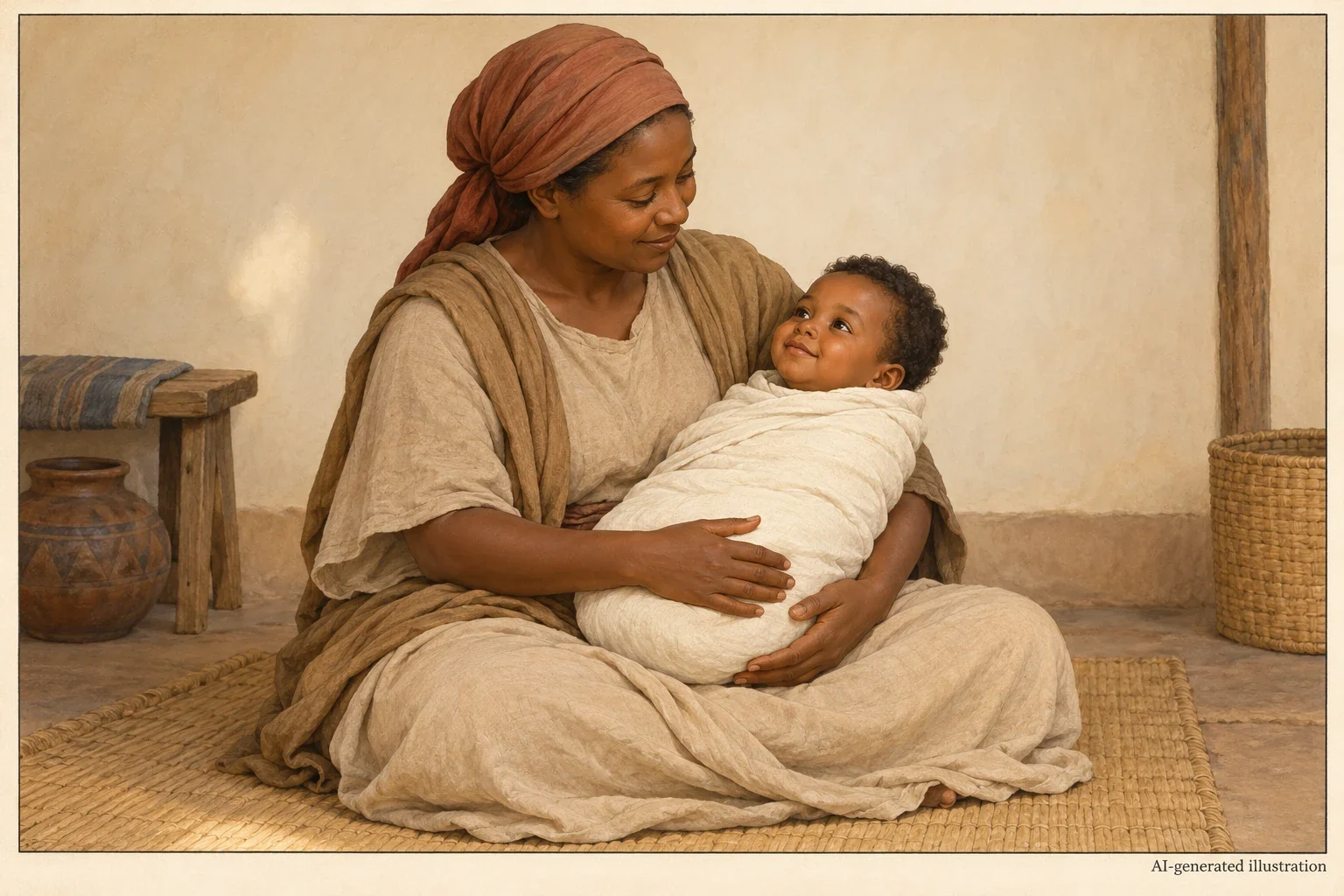
An imagined nurse supports a fully wrapped child in a quiet caregiving scene.
Nabuzana cares for the child Kaumpuli in Roscoe’s birth narrative. Human appearance, garment and scenery are illustrative choices, not authenticated divine anatomy or historical costume.
Overview
Roscoe begins with Prince Kayemba, a brother of King Juko, marrying Naku of the Civet-cat Clan despite a warning attributed to the gods. Their child is born without arms or legs. Fearing the child, Kayemba sends mother and child away by canoe to Busoga. They are refused refuge there and elsewhere before settling at Bugoya. A nurse, Nabuzana, cares affectionately for the child until his death. The gods then declare him the deity of plague, and his remains are placed in a temple called Nabibubalo. The narrative’s rejection of the child is part of the reported story, not a judgment about people born with limb differences.
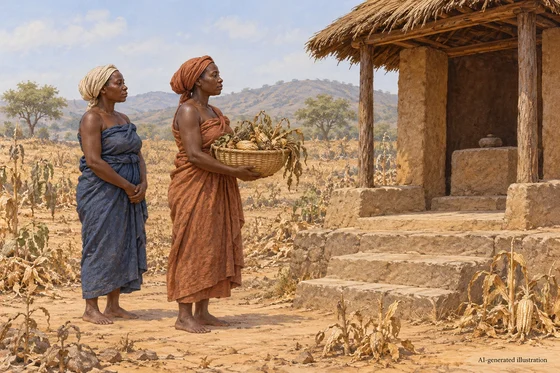
The temple is maintained through royal labour and contains a deep hole where the deity is believed to reside. Plantain stems, wild-cat skins and stones seal the opening; escape in a puff of smoke is said to threaten the country. The account also links Juko’s death to violating a prohibition against looking towards the temple. Its institutions are represented by the priest Kanalira and medium Nageza. The priest distributes miniature metal shields as protective amulets, and subordinate priests are requested when households or gardens are affected by plague.
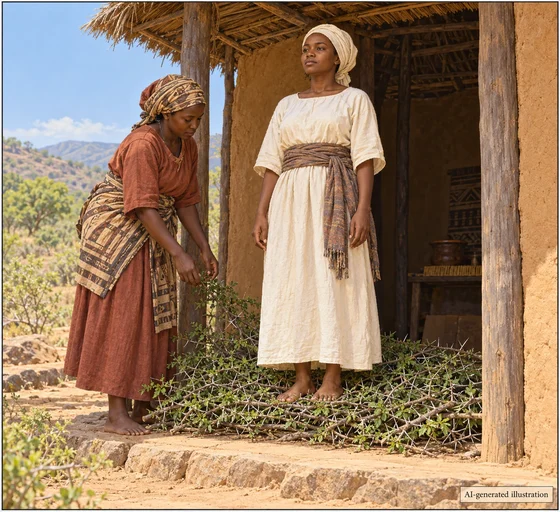
Roscoe describes nursing and treatment alongside ritual cleansing and coercive claims over property and people. In the purification sequence a young plantain stem is pierced with reed spears, fitted with small fibre shields and carried to waste land as Kyonzire, the scapegoat. A barkcloth-covered arch is erected at the path entrance. Property of people who die, including women and children treated as dependants, is claimed for the deity; relatives may redeem the people. The subsection closes with thanksgiving offerings and an account of punishment for unauthorized purifiers. These are historical reported institutions and explanations, not evidence that amulets or the ceremony prevent infectious disease.
Origins & earliest records
John Roscoe, The Baganda (London: Macmillan,1911), Chapter IX, pp.309–311.
Records & interpretation
Complete birth, rejection, Nabuzana’s care, posthumous status, covered-pit temple, Juko prohibition and priestly plague-response subsection through its final thanksgiving paragraph. Complete selected continuous subsection and preface ix–xii read from retained original English OCR. No whole-book or contemporary-community consensus claim.
Selected bibliography
Documented works and useful reading. This is not a list of every appearance.
- 01
The Baganda: An Account of Their Native Customs and Beliefs
Chapter IX, pp.309–311, complete selected subsection; preface ix–xii for method and mediation.
Family & connections
A source-supported family tree or inspiration record has not yet been compiled for this profile. Related reading below indicates a connection in subject matter, not a proven lineage or creative influence.
References
Sources supporting this profile. Linked pages have their own scope and editorial standards.
- Historical missionary-mediated ethnographic collectionRoscoe1911 — Kaumpuli in Roscoe’s Containment AccountResearch access: 2026-10-17
Image credits
Original imagined narrative scene; physical appearance, costume and setting are illustrative choices. No authenticated divine anatomy, historical costume or current ritual documentation.An imagined nurse supports a fully wrapped child in a quiet caregiving scene.
Nabuzana cares for the child Kaumpuli in Roscoe’s birth narrative. Human appearance, garment and scenery are illustrative choices, not authenticated divine anatomy or historical costume.